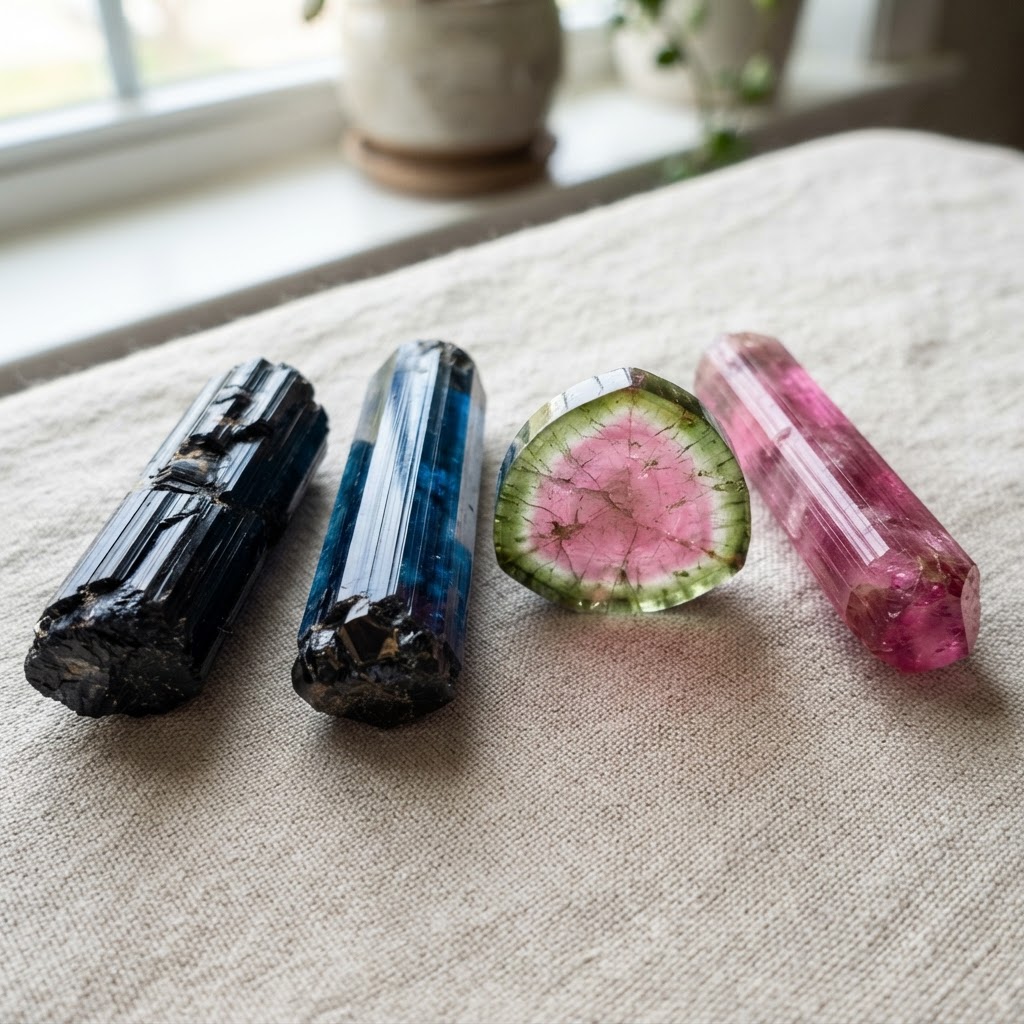
What Tourmaline Is
Tourmaline is not one mineral but a group of them. They are boron-bearing cyclosilicates with a complicated chemistry, and different members of the group produce black, brown, blue, green, pink, red, yellow and colourless stones.
Schorl is the black iron-rich tourmaline and by far the most common. Dravite is the brown magnesium one. Elbaite is the lithium one, and it covers most of the gem colours: indicolite for blue, verdelite for green, rubellite for pink and red.
The essential properties are consistent across the group. Hardness is 7 to 7.5, specific gravity is 3.0 to 3.25, there is no cleavage, the lustre is vitreous, and the crystals grow as long prisms with rounded triangular cross-sections.
Colour Zoning Is the Signature
This is the thing that makes tourmaline identifiable at a glance, and it is worth understanding properly. A single tourmaline crystal often changes colour as it grows, because the chemistry of the fluid around it changes over time.
The result is a crystal that is pink at the core and green at the rim, or green at one end and pink at the other. Cut a slice across such a crystal and you get the famous watermelon tourmaline: a pink centre surrounded by a green rind.
A crystal that is pink at the base and green at the tip is sometimes called a "bi-colour" or by the older name "Mohrenkopf". A crystal that is dark at the base and pale at the tip is common in elbaite from Brazil.
Very few gem minerals do this. Beryl can be zoned, but it is rare. Quartz amethyst is often zoned but in tone rather than hue. If you are looking at a transparent gem crystal with two clearly different colours in different zones, tourmaline should be your first guess.
Pleochroism and the Striations
Tourmaline is strongly pleochroic, which means it absorbs different wavelengths of light depending on the direction the light travels through the crystal. Turn a tourmaline and the colour deepens, lightens or shifts hue.
In blue indicolite the shift can be dramatic, running from a deep blue to almost colourless. In green tourmaline the difference between looking down the length and looking across it can be striking, which is why tourmaline cutters orient the rough very carefully.
The second clue is the surface of the crystal. Tourmaline prisms carry fine lengthwise striations running down the length of the crystal, parallel to the long axis. Those striations are present on almost every tourmaline, rough or cut, and they are visible on a polished crystal face with the naked eye.
There is also a fun property: tourmaline is both piezoelectric and pyroelectric. Squeeze it or heat it and it develops an electrical charge, which is strong enough that a warmed tourmaline crystal will attract dust and small paper scraps. It was used in pressure sensors for exactly this reason.
Tourmaline vs Its Lookalikes
The lookalikes depend on which colour you have, and the pleochroism is the common thread.
| Stone | Hardness | How to tell it from tourmaline |
|---|---|---|
| Ruby | 9 | Harder, so it scratches tourmaline. Specific gravity 4.0 against tourmaline at 3.0 to 3.2, and ruby is doubly refractive with strong pleochroism of its own but no colour zoning. |
| Emerald | 7.5–8 | Beryl, so much lighter at 2.7 and harder. A more blue-green colour, and almost always visibly included with a characteristic internal garden. |
| Peridot | 6.5–7 | Softer, and much more strongly doubly refractive so facet edges look doubled. Olive-yellow-green rather than blue-green, and no striations. |
| Tsavorite garnet | 7–7.5 | Singly refractive, so no facet doubling and no pleochroism at all. Usually a brighter, purer green than green tourmaline. |
| Pink sapphire | 9 | Harder and much heavier at 4.0. Pleochroic, but without the colour zoning and without striations. |
| Glass | 5–5.5 | Soft enough for a knife to mark, isotropic, and usually full of round bubbles. No pleochroism and no striations. |
Where Tourmaline Comes From
Brazil is the classic source, and Minas Gerais has produced tourmaline in every colour for centuries, including spectacular watermelon and bi-colour crystals. Sri Lanka, Madagascar, Nigeria, Mozambique, Namibia, Zambia and Tanzania all produce significant quantities.
Pakistan and Afghanistan produce some of the finest recent material, particularly vivid green and blue crystals from pegmatites in the Hindu Kush and Karakoram ranges. The United States has notable deposits in California and in Maine, where tourmaline is the state mineral.
Australia has tourmaline in pegmatites, particularly in Western Australia and the Northern Territory, and schorl is a common accessory mineral in granites and pegmatites across the eastern states. It is not a significant commercial source of gem tourmaline.
Because tourmaline forms in pegmatites, it is often found alongside quartz, feldspar, mica and beryl. Tourmalinated quartz — clear quartz shot through with black schorl needles — is a familiar and attractive combination from the same deposits.
The Bottom Line
Tourmaline is a group of boron-bearing silicates at hardness 7 to 7.5 and specific gravity 3.0 to 3.25, with no cleavage, a vitreous lustre, long striated prisms, strong pleochroism and often dramatic colour zoning.
Ruby and sapphire are much harder and heavier. Emerald is lighter and a different green. Peridot shows much stronger facet doubling. Tsavorite garnet is singly refractive. Glass is softer with bubbles.
For the stones it competes with, see aquamarine identifier and citrine identifier. Pink crystal identifier covers the pink end, green stones identification covers the green, and crystal identifier app explains the photo-first approach.
Frequently Asked Questions
Look for long prisms with fine lengthwise striations, hardness 7 to 7.5, and strong pleochroism so the colour shifts as you turn it. Colour zoning — two different colours in one crystal — is the strongest single clue.