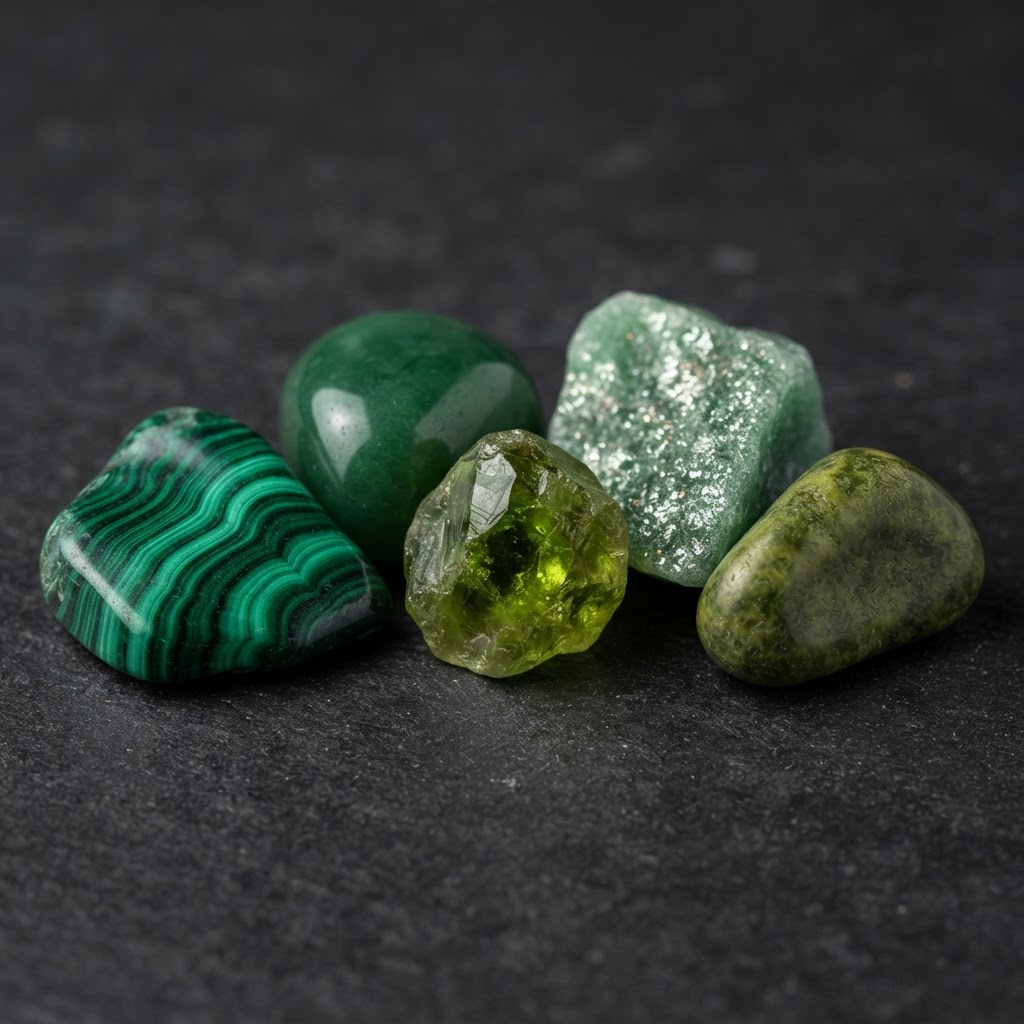
Green Is the Hardest Colour to Identify
No other colour hides as many different minerals. Jade, serpentine, aventurine, malachite, peridot, emerald, amazonite, turquoise, prehnite and green fluorite can all land in your hand looking broadly the same shade of green, and they range in hardness from 2.5 to 8.
The good news is that hardness splits them into groups very cleanly. Once you know whether a fingernail scratches it, a knife scratches it, or nothing you own scratches it, you are usually down to two or three candidates.
Start by Deciding What Kind of Green You Have
Before testing, look at the surface. Is the green translucent and glassy, like a gemstone? Opaque and banded, like malachite? Waxy and slightly greasy, like jade or serpentine? Sparkly, with glints of light inside, like aventurine?
Texture narrows the field as fast as hardness. Banded green with swirling light and dark rings is almost certainly malachite. Uniform waxy green with a soapy feel is serpentine or jade. Translucent olive-green with a glassy surface is peridot.
The Green Stones You Are Most Likely Holding
These are the greens that turn up most often in collections, souvenir shops and river gravel.
| Stone | Hardness | How to tell it |
|---|---|---|
| Malachite | 3.5–4 | Banded light and dark green, often with a silky sheen. Fizzes in acid. |
| Jade (nephrite) | 6–6.5 | Waxy, extremely tough, feels soapy. Does not fizz. |
| Jade (jadeite) | 6.5–7 | Harder and more translucent than nephrite, with a finer texture. |
| Serpentine | 2.5–5.5 | Greasy waxy green, often veined with white. Softer than jade. |
| Aventurine | 7 | Translucent green quartz with sparkly mica flakes inside. |
| Peridot | 6.5–7 | Translucent olive-green with a glassy lustre, often with inclusions. |
| Amazonite | 6–6.5 | Opaque blue-green feldspar, often with white grid-like veining. |
| Green fluorite | 4 | Cubes or octahedra, often colour-zoned, with perfect cleavage. |
Jade and Its Many Impostors
Jade is the most counterfeited green stone in the world. True jade is one of two minerals — nephrite, an amphibole, or jadeite, a pyroxene — and both are tough out of all proportion to their hardness because of their interlocking fibrous structure.
The usual substitutes are serpentine, soapstone, dyed quartz and glass. Serpentine is the classic fake because it looks right and feels soapy, but it is significantly softer: a steel blade scratches serpentine and will not scratch jade. Soapstone is softer still and feels like chalk. If a green stone scratches easily with a knife, it is not jade.
Malachite, Azurite and the Copper Greens
Malachite and azurite are copper carbonate minerals, and they usually occur together — azurite is the deep blue, malachite the banded green, and specimens often show both. Both are soft, both fizz in dilute acid, and both leave a pale green or blue streak.
They also carry a health consideration that matters if you work with them. Copper carbonate dust is toxic, so cutting, grinding or polishing malachite or azurite should be done wet, with a respirator, and never dry on a bench where the dust can be inhaled. This is one of the few genuine safety rules in amateur lapidary.
Testing a Green Stone Safely
Work on an unimportant surface. Scratch tests leave permanent marks, and on a polished or valuable piece that is a real cost. If the stone is finished and you care about it, do not scratch it — use a jeweller or a lapidary club instead.
For rough material, test hardness on the underside first. Then check acid reaction on a small, hidden area. Then check streak, which for most green stones is white or pale green and rarely decisive, but which rules out the metallic minerals.
The Bottom Line
Green stones are identified by texture first and hardness second. Banded and soft means malachite. Waxy and tough means jade. Sparkly and hard means aventurine. Translucent and glassy means peridot. Greasy and easily scratched means serpentine.
If your green stone turns out to be a crystal rather than a rock, crystal identification app covers the extra tests. If it is a cut gem, see gemstone identification app for why a photo alone will not settle it.
Frequently Asked Questions
Jade is very tough and has a waxy, soapy feel. A steel blade will not scratch true jade but will scratch serpentine, soapstone and most lookalikes. For a finished piece, have a jeweller check it rather than scratching it.