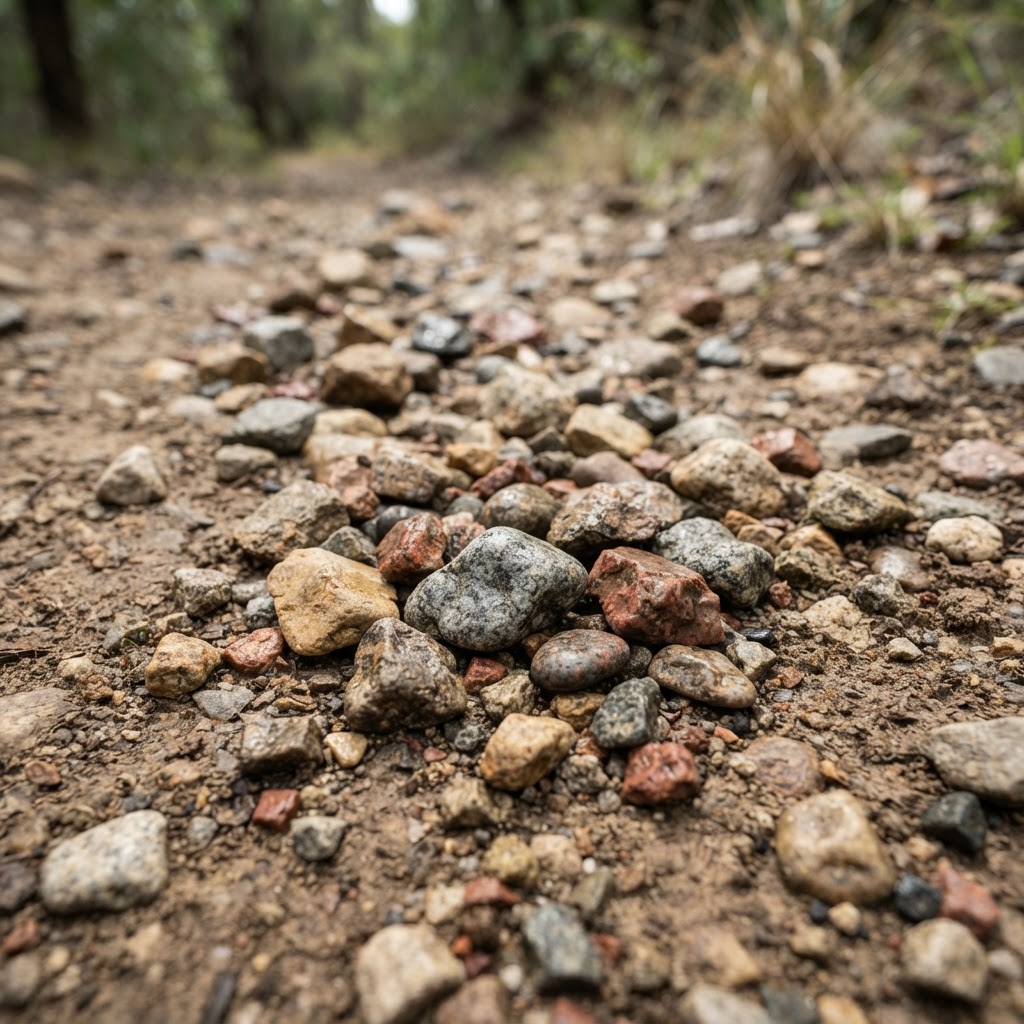
Free Is Not the Same as Useless
There is a reasonable suspicion that anything free must be a demo. In rock identification that is not really true, because the hard part was never the software — it was the method. A free app that gives you colour, texture and a shortlist, plus a scratch test you can run with a coin, will identify more rocks than a paid app used badly.
The scanner on this site runs in your browser with no download and no account. You get a ranked identification with rock type, hardness, lustre and streak for each candidate. That is the same information a beginner needs regardless of what it cost.
What a Free Rock Identifier Actually Does
Photo-based identification reads the visible properties of the stone: overall colour and colour variation, grain size, whether the surface is crystalline or smooth, any banding or layering, and the shape of the piece itself. From that it proposes likely rock types.
That works well for the common rocks people actually pick up — granite, basalt, sandstone, limestone, quartzite. It struggles more with rocks that have weathered heavily, because weathering strips away the texture that carries the identification.
Why 'Free' Usually Means a Paywall Later — and When It Doesn't
Most free rock apps are free for a handful of scans and then ask for a subscription. That is a business model, not a scam, but it is worth knowing before you get attached. The pattern to look for is whether identification itself is limited, or whether the limit sits on extras like saving a collection or exporting notes.
Tools that run in a browser rather than an app store tend to have fewer artificial limits, because there is no store listing to convert. If you only want to know what a rock is, that is usually enough.
The Four Things You Can Measure at Home for Nothing
These four tests, run in order, will classify the large majority of rocks you find lying around:
- Hardness. Does a fingernail scratch it (hardness 2.5)? A copper coin (3.5)? A steel blade (5.5)? A quartz point (7)?
- Acid reaction. A drop of vinegar is weak, but it will still bubble faintly on limestone and marble. Stronger dilute acid fizzes hard on any carbonate.
- Grain. Can you see individual crystals with the naked eye, or does it look like a uniform grey mass, or like cemented sand?
- Layering. Does it split into flat sheets, show sedimentary bands, or look completely uniform in all directions?
Identify by Elimination: A Practical Method
Start broad and narrow. First decide whether the rock is crystalline (igneous or metamorphic) or made of grains or layers (sedimentary). Then use grain size: coarse visible crystals mean it cooled slowly underground, fine or glassy texture means it cooled fast at the surface.
Once you have a family, hardness separates the rest. A rock that scratches glass and contains visible pink and white crystals is almost certainly granite. A dark, fine-grained rock that does not scratch glass and looks uniform is basalt. A rock that fizzes in acid and scratches easily is limestone. For a fuller walkthrough, see rock identification by photo.
The Rocks Beginners Bring Home Most Often
If you are new to this, you are almost certainly holding one of these.
| Rock | What gives it away | Hardness |
|---|---|---|
| Granite | Coarse, speckled, visible pink or white feldspar plus grey quartz and dark mica | 6–7 |
| Basalt | Dark, fine-grained, often with tiny holes from trapped gas | 6 |
| Sandstone | Gritty, feels like cemented sand, often banded or layered | 6–7 |
| Limestone | Pale, soft, fizzes in acid, may contain shell fragments | 3 |
| Slate | Dull, splits into flat sheets along parallel planes | 3–4 |
| Quartzite | Very hard, glassy, often white or pinkish, fractures through the grains | 7 |
| Obsidian | Glossy black volcanic glass, breaks into sharp curved shards | 5–5.5 |
When Free Tools Are Not Enough
A free app and a scratch test will not identify a rare mineral, a meteorite, or a heavily weathered stone with no remaining texture. They also cannot tell you whether a rock contains gold or any other metal worth money — and anything that claims otherwise should be treated with suspicion.
If a stone matters to you, a local lapidary club or geology department will usually look at it. Many run open days where members identify specimens for the public at no cost.
The Bottom Line
A free rock identification app is a solid starting point, not a compromise. Photograph the stone in good daylight, get a shortlist, then confirm it with a hardness test and an acid drop. That combination costs nothing and works on the vast majority of rocks an amateur will ever pick up.
For crystals specifically, crystal identification app covers the tests that separate the lookalikes.
Frequently Asked Questions
Yes. Browser-based scanners have no app store listing to convert, so they tend to have fewer artificial limits than free mobile apps. You get a ranked identification without paying or signing up.