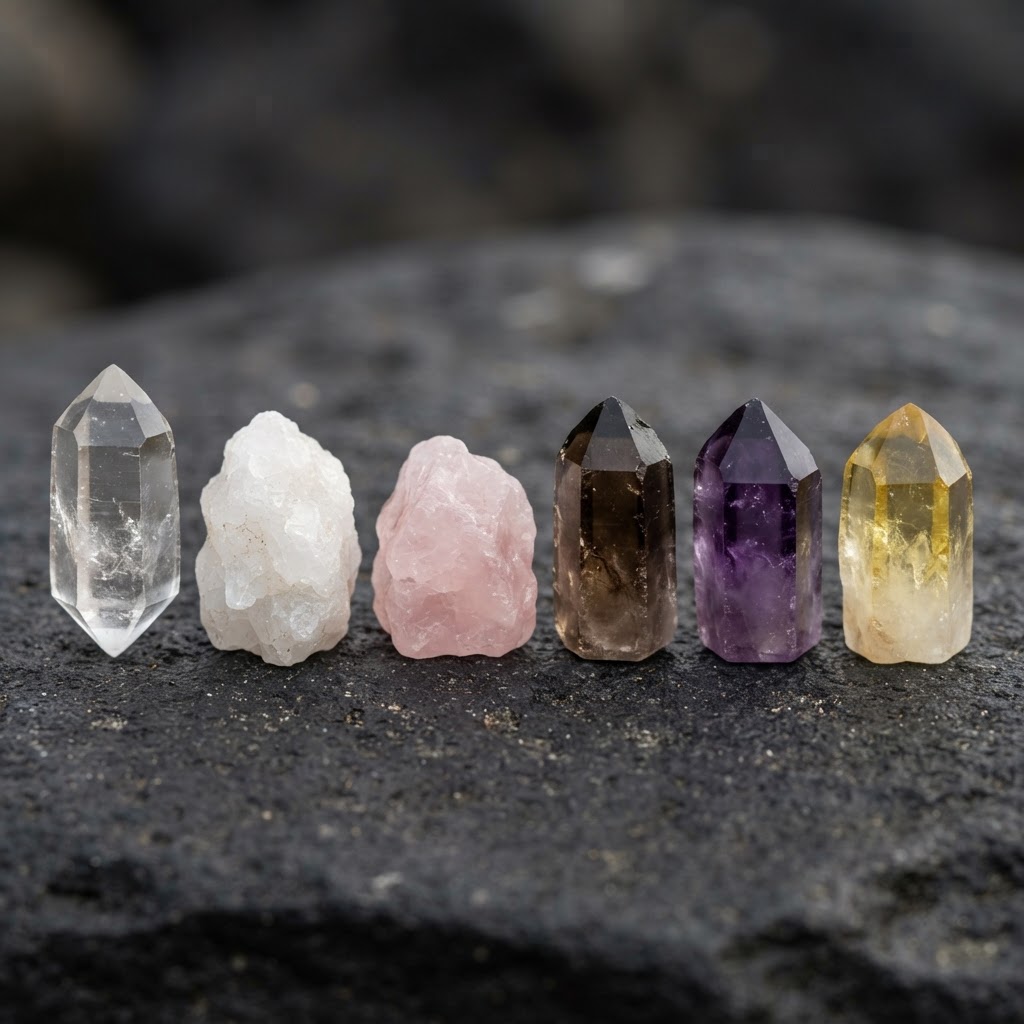
Quartz Is the Most Common Answer
If you have a hard, glassy, translucent crystal with no obvious cleavage and you have no idea what it is, quartz is the most statistically likely answer by a wide margin. Quartz makes up about 12 per cent of the Earth’s crust by volume, it survives weathering better than almost anything else, and it is the main component of most beach sand.
That prevalence makes it worth learning properly. Once you can confirm quartz confidently, you have eliminated the majority of the confusion in amateur mineral identification.
The Two Rules That Cover Most Quartz
First, hardness. Quartz is a 7 on the Mohs scale. A steel blade will not scratch it, and it will scratch glass. Second, fracture. Quartz has no cleavage at all, so it breaks with a curved, shell-like surface rather than splitting along flat planes.
Those two rules together are enough to identify quartz in most cases. If it is harder than a knife and it fractures instead of cleaving, you are almost certainly looking at quartz or something close to it.
The Quartz Family at a Glance
The varieties are all the same mineral, SiO2, differing only in colour, transparency and crystal size.
| Variety | Colour | Notes |
|---|---|---|
| Rock crystal | Colourless | Clear, glassy hexagonal prisms. The purest form. |
| Milky quartz | White | Cloudy white, caused by tiny fluid inclusions. |
| Rose quartz | Pink | Usually massive rather than crystallised. Colour from trace titanium or iron. |
| Smoky quartz | Brown to black | Colour produced by natural radiation acting on aluminium impurities. |
| Amethyst | Purple | Coloured by iron impurities plus irradiation. Hardness 7. |
| Citrine | Yellow | Natural citrine is rare; most commercial citrine is heat-treated amethyst. |
| Aventurine | Green | Quartz containing reflective fuchsite mica flakes. |
| Tiger’s eye | Golden brown | Quartz that replaced crocidolite fibres, producing a moving sheen. |
Macrocrystalline vs Microcrystalline
The quartz family splits into two groups that behave very differently. Macrocrystalline quartz — rock crystal, amethyst, smoky quartz, citrine — forms crystals you can see, and it is usually translucent and glassy.
Microcrystalline quartz, called chalcedony, has crystals too small to see. That gives it a smooth, waxy look and a completely different surface feel. Agate, jasper, onyx, chert and flint all belong to this group. They are still quartz, but they never look like it. Our rough agate identification guide covers that half of the family.
Amethyst, Citrine and the Heat-Treatment Question
Almost all commercial citrine is amethyst that has been heated to around 500 degrees Celsius, which turns the purple to yellow-brown. Natural citrine is much rarer and usually a paler, smokier yellow. Both are genuine quartz, and both are hardness 7 — the difference is origin, not identity.
The same logic applies in reverse. Heat-treating smoky quartz also produces a yellow colour that gets sold as citrine. Unless a dealer tells you a stone is natural citrine, the safe assumption is that it was treated.
How to Confirm Quartz in One Test
Try to scratch a piece of window glass with a sharp edge of your specimen. Quartz at hardness 7 will cut glass easily. Then try to scratch the specimen with a steel blade at 5.5 — it will not leave a mark on quartz.
If you have no glass to hand, a scratch comparison against a known quartz point works just as well. Two pieces of quartz will scratch each other; quartz will not scratch topaz at 8 or corundum at 9.
Quartz Lookalikes
Calcite is the most common confusion, and it is soft — hardness 3, scratched easily by a copper coin, and it fizzes in dilute acid. Fluorite is hardness 4 and cleaves into flat planes. Topaz is harder than quartz at 8 and has perfect cleavage. Glass has bubbles inside and is softer than quartz.
For a complete breakdown of these distinctions, see mineral identifier. If your quartz turns out to be purple, purple stone identification goes through the specific candidates.
The Bottom Line
Quartz is hardness 7, has no cleavage, and fractures with a curved glassy surface. Those three facts identify the majority of specimens. Colour then tells you which variety you have.
The microcrystalline varieties — agate, jasper, chert, onyx — are chemically identical but look entirely different. If your find is waxy rather than glassy, start there instead.
Frequently Asked Questions
Test hardness and fracture. Quartz is 7 on the Mohs scale, so it scratches glass and a steel blade will not mark it. It also has no cleavage, so it breaks with a curved, shell-like surface.