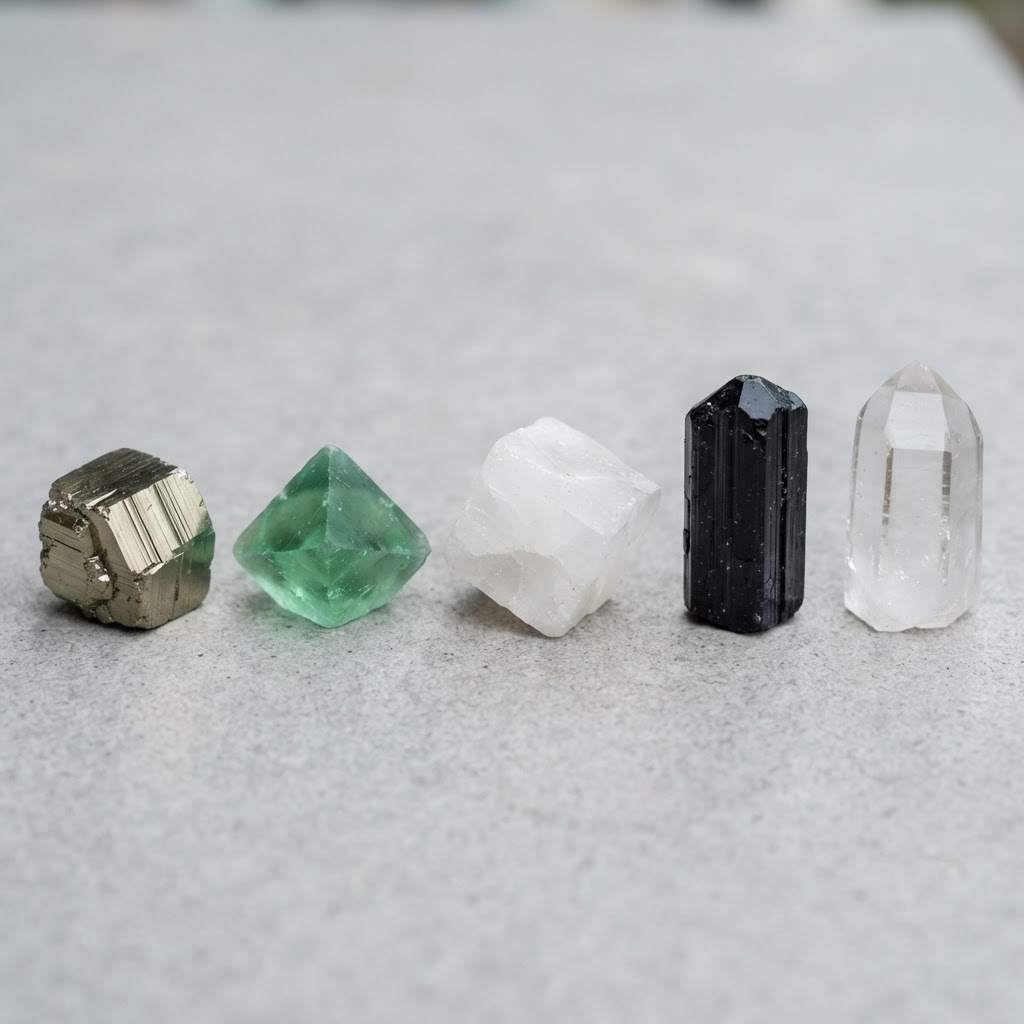
A Mineral Is Not a Rock
The distinction matters more than it sounds. A rock is an aggregate — a mixture of one or more minerals stuck together. Granite is a rock. The quartz, feldspar and mica inside it are minerals. When people say they want to identify a mineral, they usually mean a specimen with a consistent composition and a repeating internal structure.
That consistency is what makes minerals identifiable. A mineral has the same chemical composition and the same crystal structure wherever it formed, so a set of physical tests gives the same answer every time. A rock does not, which is why rocks are identified by texture and minerals by properties.
The Five Properties That Actually Identify a Mineral
There are dozens of properties you could measure. Five do almost all the work.
- Hardness. Resistance to scratching, measured on the Mohs scale from 1 to 10. The single most useful test.
- Lustre. How the surface reflects light — metallic, vitreous (glassy), pearly, silky, greasy or earthy.
- Streak. The colour of the powder left when you rub the specimen on unglazed porcelain. Often completely different from the surface colour.
- Cleavage and fracture. Whether it breaks along flat repeating planes, or into curved shell-like surfaces, or unevenly.
- Specific gravity. How heavy it feels for its size. Simple to estimate, and decisive for a handful of heavy minerals.
The Mohs Scale, Without the Memorisation
You do not need to know all ten reference minerals. You need four checkpoints you already own: a fingernail (2.5), a copper coin (3.5), a steel knife blade (5.5) and a quartz point (7). Glass is about 5.5, which makes a scrap of window glass a useful fifth.
Test from softest upward. If a fingernail scratches it, the mineral is under 2.5 — that alone eliminates most of the common minerals. If nothing scratches it except quartz, you are looking at a hardness of 7 or above, which narrows the field sharply.
Specific Gravity: The Test Everyone Forgets
Pick up a piece of galena and you will understand immediately why specific gravity matters. Lead ore feels absurdly heavy for its size, and that heft is diagnostic. Most common rock-forming minerals sit between 2.5 and 3. Anything noticeably heavier is worth investigating.
You can estimate it without instruments. Hold the specimen in one hand and a similar-sized piece of quartz in the other and compare. If the unknown feels clearly heavier, you are probably looking at a sulphide or an oxide ore rather than a common silicate.
Common Minerals and Their Signatures
These are the minerals an amateur is most likely to encounter.
| Mineral | Hardness | Lustre | Streak | Tell-tale sign |
|---|---|---|---|---|
| Quartz | 7 | Vitreous | White | Six-sided prisms, conchoidal fracture, no cleavage |
| Calcite | 3 | Pearly | White | Rhombohedral cleavage, fizzes in dilute acid |
| Fluorite | 4 | Vitreous | White | Cubes or octahedra, perfect cleavage in four directions |
| Pyrite | 6–6.5 | Metallic | Greenish-black | Brassy gold cubes with striated faces |
| Hematite | 5–6 | Metallic to dull | Red-brown | Red streak even when the specimen is grey |
| Galena | 2.5 | Metallic | Grey-black | Cubic cleavage and unusually heavy |
| Muscovite | 2–2.5 | Pearly | White | Splits into thin flexible transparent sheets |
| Gypsum | 2 | Pearly | White | Scratched by a fingernail; selenite is the clear form |
Mineral Lookalikes That Fool Everyone
A few pairings cause most of the confusion, and each has a quick resolution.
| Looks like | Actually is | The test |
|---|---|---|
| Gold | Pyrite | Gold is soft and marks paper; pyrite is hard and brittle |
| Silver | Galena | Galena has cubic cleavage and a grey-black streak |
| Quartz | Calcite | Calcite is hardness 3 and fizzes; quartz is 7 and does not |
| Topaz | Quartz | Topaz has perfect cleavage and is noticeably heavier |
| Mica | Talc | Talc is soft enough to scratch with a fingernail and feels greasy |
Building a Basic Mineral Test Kit
You can put together a working kit for almost nothing. A copper coin, a steel nail or pocket knife, a scrap of unglazed tile from a hardware shop, a small piece of quartz, a magnifying loupe, and a bottle of dilute hydrochloric acid if you want to test carbonates properly.
Vinegar will do at a pinch for a rough carbonate check, but it is weak — a genuine fizz on limestone takes a stronger acid. If you do keep acid, store it in a proper labelled bottle and keep it away from anything you care about.
The Bottom Line
Identify a mineral by working from the broadest property to the narrowest. Lustre first, because metallic versus non-metallic halves the field instantly. Then hardness. Then streak and cleavage. In most cases that sequence reaches a confident answer in under five minutes.
Photograph the specimen first if you want a shortlist to work from — see rock identification by photo — then confirm it with the scratch test. If your mineral turns out to be quartz, which it often does, quartz identifier goes through the whole family.
Frequently Asked Questions
A mineral is a naturally occurring solid with a consistent chemical composition and a repeating crystal structure. A rock is an aggregate of one or more minerals. Granite is a rock; the quartz and feldspar in it are minerals.