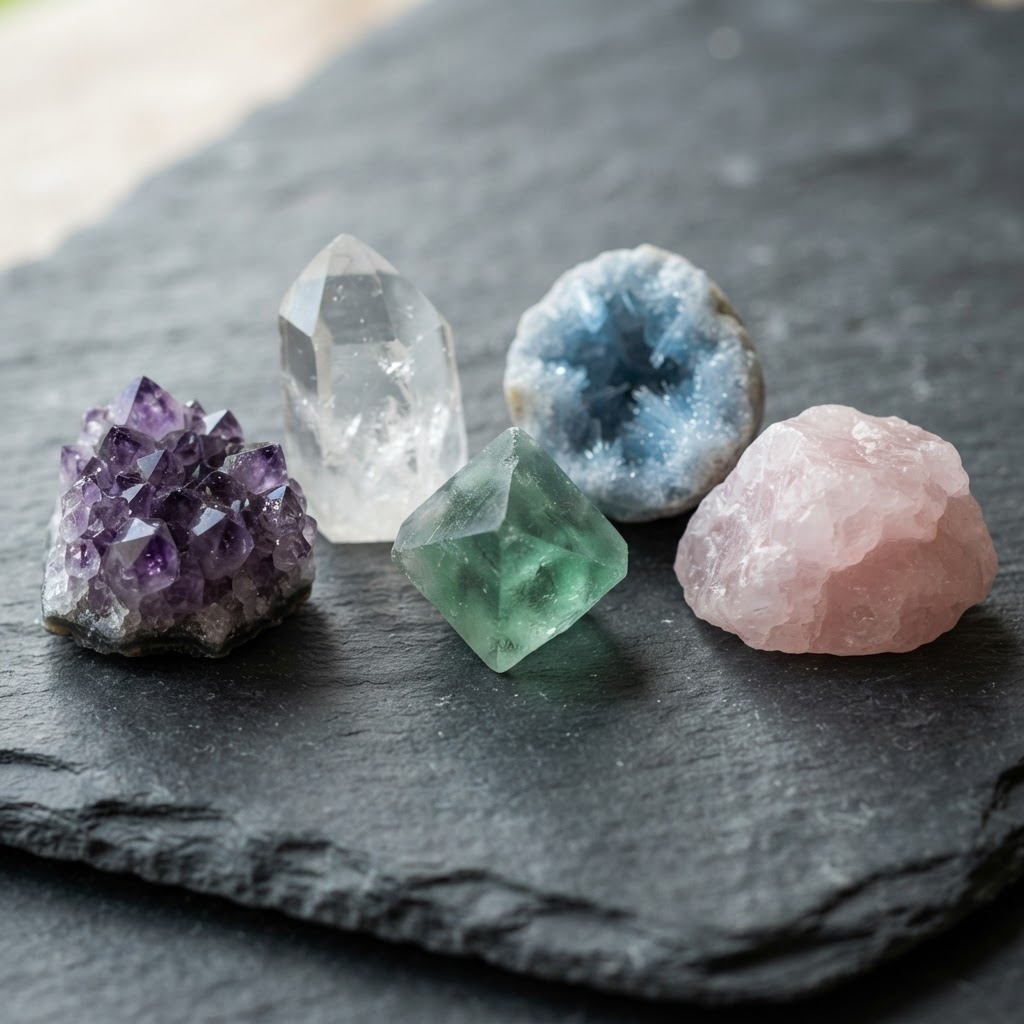
You Know It's a Crystal. You Just Don't Know Which One.
Almost every crystal collection starts the same way. Something catches your eye — flat faces, a glassy surface, clearly not an ordinary pebble — and you have no idea what to call it. Crystal identification is not really a mystery, though. It runs on a short list of properties you can observe, and a phone camera reads several of them well.
The catch is that the properties which actually settle an identification are usually the ones you cannot photograph. Hardness, streak colour and the way a crystal breaks are what separate lookalikes, and none of them show up in an image. Understanding that split is the most useful thing you can learn before you point an app at anything.
What a Crystal Identification App Can Actually Do
A photo-based app reads colour, crystal habit (the overall shape), transparency, surface lustre, and structural features like banding, cleavage faces or visible inclusions. That is genuinely a lot of information, and most of the time it gets you to a shortlist of two or three plausible minerals.
What it cannot do is scratch the specimen with a steel blade, drag it across unglazed porcelain to see the streak, or drop dilute acid on it to watch for fizzing. Those are the tests that finish the job. Treat an app result as a ranked shortlist rather than a verdict and you will get far more out of it.
The Three Tests That Narrow It Down Fastest
If you only ever do three things with an unidentified crystal, make them these. They cost nothing and they eliminate more candidates than any amount of staring.
- Hardness. Try scratching the crystal with a copper coin (about 3.5 on the Mohs scale), then a steel knife blade (about 5.5), then a quartz point (7). What scratches what rules out whole families at once.
- Streak. Rub the crystal on the unglazed back of a bathroom tile. Many minerals look nothing like their streak — hematite is grey-black in the hand and blood red on the tile.
- Cleavage versus fracture. Does it split along flat, repeating planes, or break into curved shell-like surfaces? Fluorite cleaves cleanly in four directions. Quartz has no cleavage at all and fractures with a curved, glassy shell.
Colour Is a Clue, Not an Answer
The same mineral turns up in a startling range of colours, and completely unrelated minerals share the same colour. Quartz alone gives you clear, white, pink, purple, yellow, brown and black. That is why purple stone identification and green stone identification both need more than a colour match.
Colour still works as a first filter. If a crystal is purple and glassy, amethyst is a strong opening guess. If it is purple, opaque and flaky, lepidolite is far more likely. Use colour to open the shortlist, then let hardness and streak close it.
Photographing a Crystal So an App Can Read It
Most bad identifications are bad photographs. A few simple habits make a real difference:
- Use daylight, not flash. Direct flash blows out the surface and hides the internal colour that often carries the clue.
- Shoot the whole crystal first, then a close-up of a single crystal face.
- Include something for scale — a coin or a fingertip.
- If it still has matrix attached, photograph that too. The host rock is frequently a better clue than the crystal itself.
- Keep the background plain. A sheet of white paper beats a patterned table every time.
The Crystals Beginners Most Often Confuse
These five mix-ups come up again and again, and each one has a test that resolves it in seconds.
| Confusion | How to tell them apart |
|---|---|
| Amethyst vs fluorite | Amethyst is quartz at hardness 7 and fractures. Fluorite is hardness 4 and splits along flat cleavage planes. |
| Clear quartz vs glass | Quartz is harder than glass, feels cold, and has no bubbles inside. Glass usually contains tiny round bubbles. |
| Citrine vs heat-treated amethyst | Most citrine sold today is amethyst that has been heated. Natural citrine is a paler, smokier yellow. |
| Rose quartz vs pink calcite | Rose quartz is hardness 7 and inert. Pink calcite is hardness 3 and fizzes in dilute acid. |
| Selenite vs quartz | A fingernail scratches selenite (hardness 2). Nothing you have at home scratches quartz (hardness 7). |
Where an App Fits in a Real Workflow
The most effective approach is a loop. Photograph the crystal and note what the app suggests. Run the hardness test and see whether the suggestion survives it. If two candidates both survive, use streak or cleavage to separate them.
That loop usually takes under five minutes and gets you to a confident answer far more often than either method on its own. Our rock identification by photo guide walks through the same loop for whole rocks rather than single crystals.
When to Stop Guessing and Test Properly
If the crystal is valuable, sentimental, or you are about to spend money on it, stop guessing. Two or three tests will usually settle it, and a lapidary club or jeweller will run them for free or close to it.
Be careful with destructive tests. A scratch test leaves a mark, and acid testing only belongs on a specimen you do not mind damaging. For anything fragile — selenite, halite, mica — rely on visual features and leave the tools in the drawer.
The Bottom Line
A crystal identification app is a genuinely useful first pass. It reads colour, form and lustre faster and more consistently than most beginners can, and it usually gets you to a shortlist.
Pair it with a hardness test and a streak test and you have a method that works on almost anything you pick up. Start with the photo, confirm with the scratch, and keep a note of what each test ruled out — that note is what turns a guess into an identification.
Frequently Asked Questions
Usually not on its own. A photo gives you colour, shape and lustre, which narrows the field to a shortlist. Hardness, streak and cleavage are what confirm it, and none of those are visible in a photograph.