Purple Is Rarer Than You Think
Compared with green, purple is a short list. Only a handful of minerals form in violet or lilac tones, which is good news for identification — you can often work through the whole set in a couple of minutes.
The bad news is that two of them, amethyst and fluorite, look almost identical in a photo and are separated only by hardness. That single pair accounts for most of the confusion around purple stones.
Three Questions That Split the Purple Stones
Ask these in order and you will usually have your answer before you pick up a tool.
- Is it translucent and glassy, or opaque? Translucent points to amethyst or fluorite. Opaque points to lepidolite, charoite, sugilite or purpurite.
- Does it flake? Lepidolite is a mica and splits into thin glittery sheets. Nothing else in the purple group does that.
- Can you scratch it with a knife? Fluorite is hardness 4 and scratches easily. Amethyst is hardness 7 and a knife will not mark it.
The Purple Stones You Are Most Likely Holding
These are the purples that actually turn up in collections and crystal shops.
| Stone | Hardness | How to tell it |
|---|---|---|
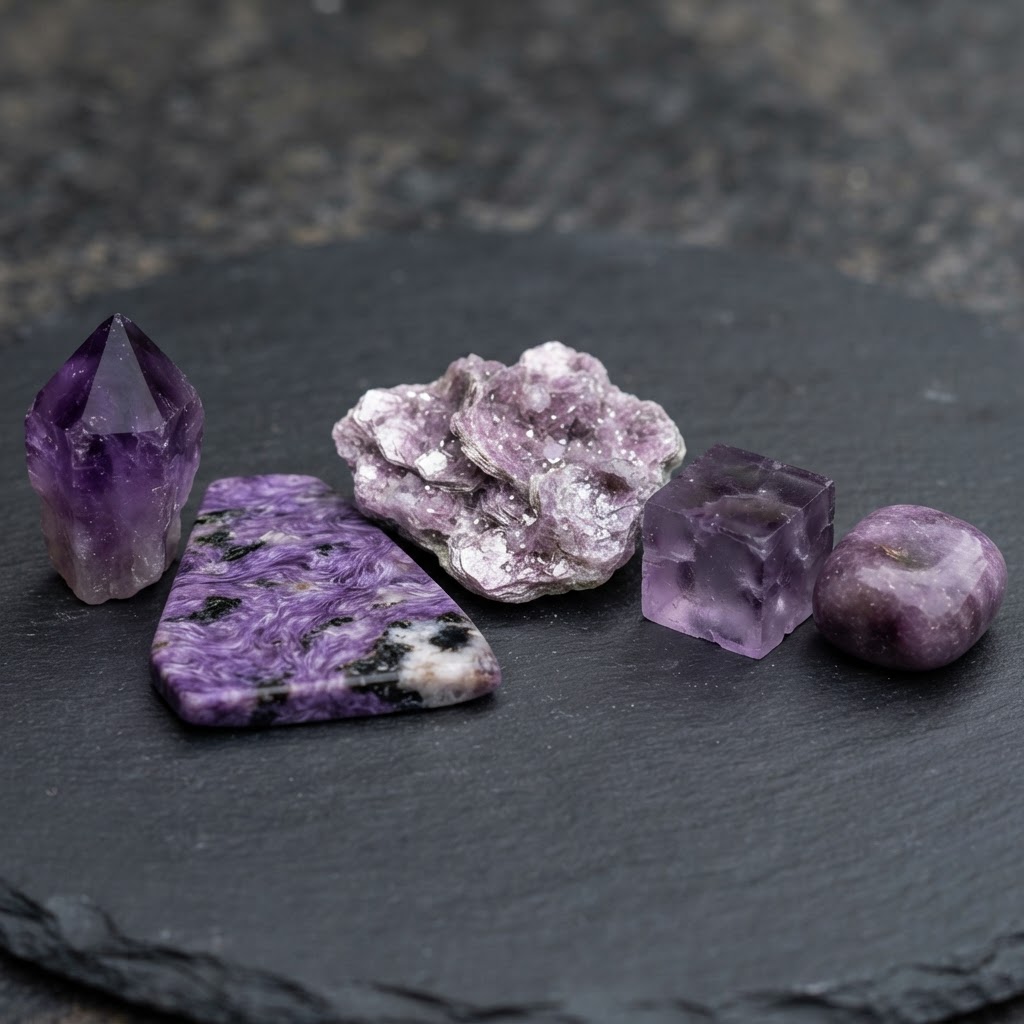
| Amethyst | 7 | Translucent purple quartz, often in pointed hexagonal crystals or colour-zoned bands. |
| Fluorite | 4 | Cubic or octahedral crystals, often with purple and green zoning. Splits along flat cleavage planes. |
| Lepidolite | 2.5–3 | A lithium mica. Opaque, glittery, and splits into thin flexible flakes. |
| Charoite | 5–6 | Fibrous, swirling violet stone with white and black veining. Found only in Siberia. |
| Sugilite | 6–6.5 | Opaque to waxy purple, usually massive. Rare and expensive in good colour. |
| Purpurite | 4–4.5 | Dull earthy purple-brown, often powdery. A manganese iron phosphate. |
| Iolite | 7–7.5 | Translucent violet-blue, strongly pleochroic — it changes colour as you turn it. |
| Tanzanite | 6–7 | Blue-violet and strongly pleochroic. Found in one small area of Tanzania. |
Amethyst vs Fluorite: The Classic Mix-Up
Amethyst is quartz coloured by iron impurities and natural irradiation. Fluorite is calcium fluoride, coloured by trace elements and structural defects. Chemically they have nothing in common, but a purple crystal of either can look remarkably similar.
The scratch test settles it in seconds. Fluorite is a 4 on the Mohs scale and a steel blade marks it easily. Amethyst is a 7, and a steel blade will not touch it. If you do not want to scratch the specimen, look at the shape: fluorite forms cubes and octahedra, amethyst forms six-sided prisms with pointed tips.
Lepidolite, Charoite and Sugilite: The Opaque Purples
These three are usually polished into cabochons or carved, and they are easy to tell apart once you know what to look for. Lepidolite is glittery and flaky — the sparkle comes from its mica structure. Charoite has a distinctive fibrous, swirling pattern with white and black threads running through it. Sugilite is usually a solid, waxy purple with no visible pattern at all.
All three are considerably softer than amethyst, and lepidolite is soft enough that a fingernail will scratch it. None of them fizz in acid.
Purple Gemstones and Why You Probably Do Not Have One
Tanzanite and fine iolite are genuine gemstones, and both are strongly pleochroic — meaning they show different colours depending on the angle you view them from. A tanzanite can look blue from one side and violet from another, which is one of the few things you can check at home without instruments.
If you have a faceted purple stone of unknown origin, treat it as a sorting problem rather than an identification one. Colour and cut narrow it, but confirming a natural gemstone needs a laboratory. Our gemstone identification app guide explains why.
How to Test a Purple Stone
Start with hardness on an inconspicuous surface. Then check cleavage: fluorite breaks into flat shiny planes, amethyst breaks with a curved glassy shell. If the stone is opaque, look at the texture instead — flaky, fibrous or solid.
If it turns out to be amethyst, you are in good company; it is one of the most common collector minerals in the world. Our crystal identification app guide covers the full method, and quartz identifier covers the rest of the quartz family.
The Bottom Line
Purple stones are a short list, and hardness does most of the work. Translucent and knife-proof means amethyst. Translucent and easily scratched means fluorite. Flaky and glittery means lepidolite. Fibrous and swirled means charoite. Solid and waxy means sugilite.
Run one scratch test and you will usually have it. For the green stones that cause the opposite problem — too many candidates — see green stones identification.
Frequently Asked Questions
Hardness. Fluorite is 4 on the Mohs scale and a steel blade marks it easily. Amethyst is 7 and a blade will not scratch it. Fluorite also forms cubes and splits along flat cleavage planes; amethyst forms pointed hexagonal prisms.