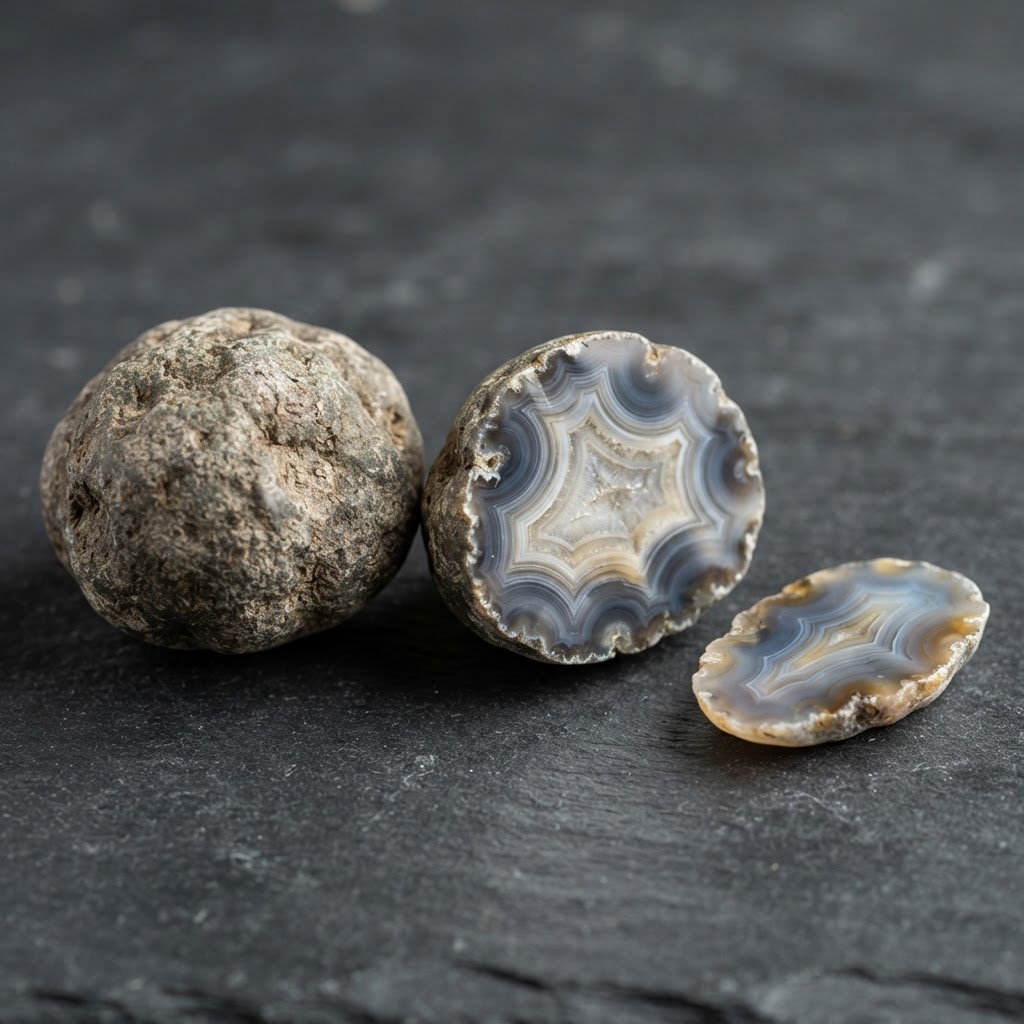
Rough Agate Looks Like Nothing Special
An uncut agate nodule usually looks like a grey or brown lump with a rough, pitted exterior. There is no sparkle, no visible crystal, and nothing to suggest the banded pattern inside. This is why so many agates end up in garden beds and driveways.
What you are looking for is a combination of small signals rather than one obvious clue. Once you know the four, you will start finding agates in gravel you have walked past for years.
What Actually Separates Agate From Other Rocks
Agate is a variety of chalcedony, which is itself microcrystalline quartz. The crystals are too small to see, which is what gives chalcedony its smooth, waxy look. Agate is specifically the banded form — concentric layers of chalcedony in different colours, laid down inside a cavity.
That microcrystalline structure is the key to everything. It means an agate has no visible grains, breaks with a smooth curved fracture rather than a rough one, and feels noticeably waxy rather than gritty.
The Four Signs You Have an Agate Nodule
Check these in order. Most agates will show three of the four.
- A waxy or greasy surface. Wet the stone — agate goes noticeably glossier than the surrounding rock and holds a sheen.
- Translucency at the edges. Hold it up to a bright light and look at the thinnest part. Agate glows faintly; jasper and chert do not.
- A knobbly or rounded crust. Agate nodules are often lumpy with a pitted outer skin, sometimes with a thin white rim where the crust meets the interior.
- Conchoidal fracture. If you have a broken piece, the broken surface is smooth and curved, like the inside of a shell, with no grain.
Agate, Jasper, Chert and Flint: Sorting Them Out
These four are all forms of microcrystalline quartz and they are genuinely easy to confuse.
| Material | How to tell it apart |
|---|---|
| Agate | Translucent and banded. Light passes through thin edges. |
| Jasper | Opaque, usually red, yellow, brown or green, often with a duller surface. |
| Chert | Opaque, dull grey to brown, with a slightly chalky or waxy look. |
| Flint | A dark variety of chert, grey to black, often with a white cortex. |
| Chalcedony | Translucent but unbanded — the plain, single-colour form. |
Where to Find Agate and What It Looks Like in the Field
Agate forms in cavities in volcanic rock, where silica-rich water deposits layer after layer of chalcedony. That means the best places to look are areas with ancient volcanic geology, and the gravel and riverbeds downstream of them.
In the field, look for rounded, waxy-looking pebbles that stand out slightly from the duller stones around them, especially after rain when everything is wet. Gravel roads, farm tracks, ploughed fields and creek beds are all productive. Small agates are also commonly used as decorative gravel, so check garden beds and driveways.
How to Test a Suspected Agate Without Cutting It
You can confirm most of it without any cutting at all. Wet the stone and check the waxy sheen. Hold it to a strong light and look for translucency at the edges. Try to scratch it with a steel blade — agate is hardness 6.5 to 7, so a knife will not touch it, which rules out calcite, limestone and most lookalikes.
If you want certainty, a lapidary club will cut and polish a slice for a small fee, and the banding will be obvious immediately. A tile saw with a diamond blade will also do it, though the surface will need polishing afterwards to show the pattern.
What to Do Once You Have One
Agate takes an exceptional polish because it is hard, dense and has no grain. Tumbling is the easiest route for small pieces: coarse grit to shape them, then progressively finer grits, then a polish. Nodules are better sliced, because the banding is the whole point and it is only visible on a cut face.
If you would rather not invest in equipment, many lapidary clubs run open workshop sessions where members can use the club machines. It is by far the cheapest way to find out what is inside a rock.
The Bottom Line
Rough agate identification comes down to three things: a waxy surface, translucency at the edges, and no visible grain. If it is also banded when cut, it is agate; if it is opaque and solid-coloured, it is jasper.
For the crystal forms of quartz rather than the microcrystalline ones, see quartz identifier. And if you are unsure whether your find is agate or something else entirely, rock identification by photo covers the photo method.
Frequently Asked Questions
Wet it and look for a waxy sheen, hold it to a light to check for translucency at the edges, and try scratching it with a steel blade. Agate is hardness 6.5 to 7, so a knife will not mark it.