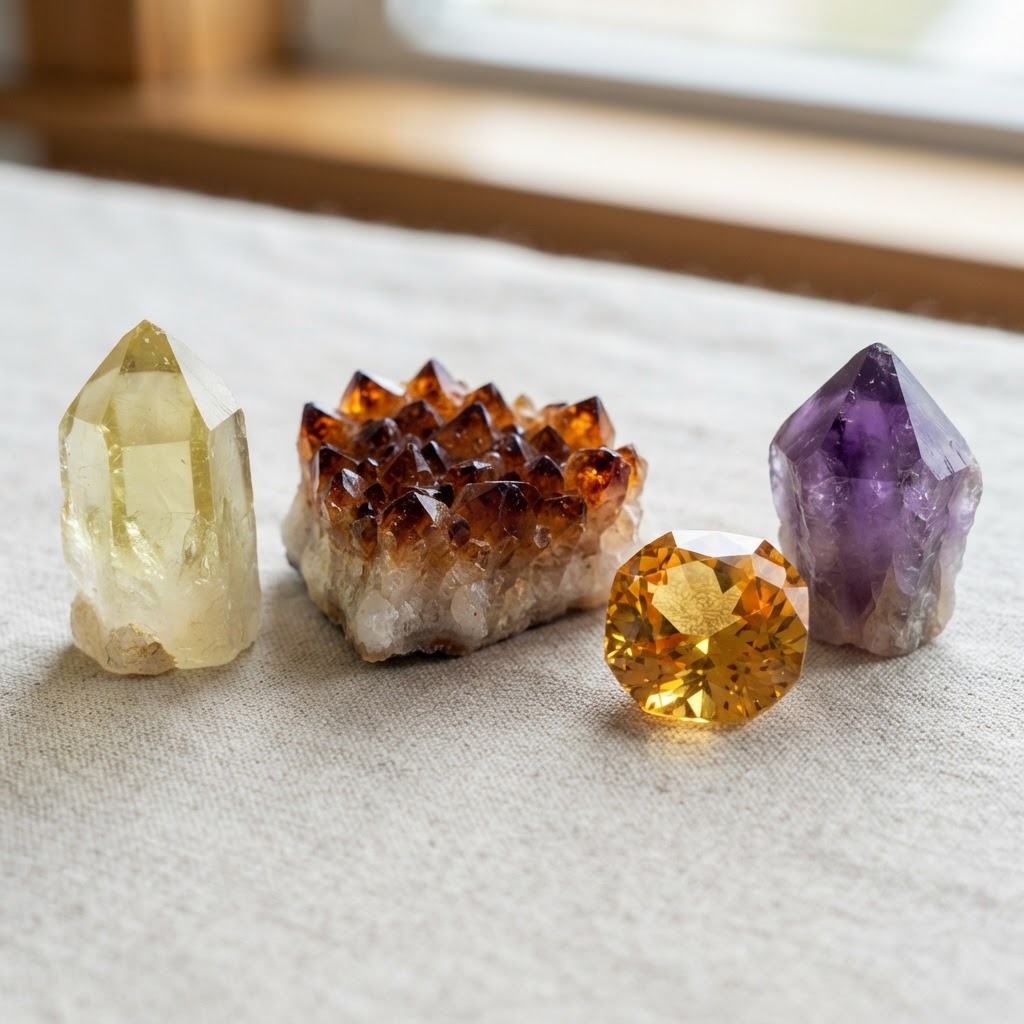
What Citrine Is
Citrine is the yellow to orange-yellow variety of quartz. It has the same hardness as any quartz — 7 on the Mohs scale — the same specific gravity of 2.65, the same white streak and the same glassy lustre with a conchoidal fracture and no cleavage.
The colour comes from trace iron in the crystal structure. In amethyst, that iron is in one oxidation state and produces purple. Heat it and the oxidation state changes, and the colour becomes yellow to orange. That single chemical fact is the reason the citrine market is what it is.
Here is the honest headline: the overwhelming majority of citrine sold today is heat-treated amethyst, or heat-treated smoky quartz. Natural citrine is genuinely uncommon, and most of what is marketed as natural is not.
Natural vs Heat-Treated
There is no simple field test that separates them, because they are chemically the same mineral and often come from the same deposits. What you can do is look for the patterns that heat treatment leaves behind.
Natural citrine tends to be a pale lemon-yellow to pale golden colour, often with a slight smoky or brownish tinge. It is usually weakly coloured and slightly cloudy, and it is often found as small crystals rather than large clusters.
Heat-treated amethyst tends to be a stronger orange, amber or reddish-brown — the colour the trade calls Madeira citrine, after the wine. It is often sold as large crystal clusters and points, because amethyst geodes and clusters are the raw material.
The single most useful clue is the base of the crystal. Heat an amethyst point and the tips, which were deepest purple, turn the strongest orange, while the base often stays pale, white or colourless. So a point with a strong orange tip and a white, colourless base is almost certainly heat-treated amethyst. Natural citrine is usually more evenly coloured along the crystal.
Citrine vs Its Lookalikes
Yellow is a crowded colour in the gem world, and five stones compete with citrine.
| Stone | Hardness | How to tell it from citrine |
|---|---|---|
| Yellow topaz | 8 | Harder than quartz, so it scratches citrine. Much heavier at specific gravity 3.5, and it has perfect basal cleavage so it splits on one flat plane. |
| Heliodor (yellow beryl) | 7.5–8 | Harder, and much lighter at specific gravity 2.7. Usually a cleaner, paler yellow-green rather than orange. |
| Yellow sapphire | 9 | Much harder and much heavier at 4.0. Pleochroic, and usually far more brilliant. |
| Yellow tourmaline | 7–7.5 | Harder, heavier at 3.0 to 3.25, strongly pleochroic so the colour shifts as you turn it, and it shows striations down the prism. |
| Amber | 2–2.5 | Organic, not a mineral. Very soft, warm to the touch, and light enough to float in saturated salt water. |
| Yellow glass | 5–5.5 | Soft enough for a knife to mark, isotropic, and usually contains round bubbles. |
Ametrine and Other Oddities
Ametrine is a natural bicolour quartz with purple amethyst and yellow citrine in the same crystal. It comes almost entirely from the Anahí mine in Bolivia, and the colour boundary is usually a sharp plane rather than a gradual transition.
You will also see "Ouro Verde" citrine, which is a greenish-yellow quartz from Brazil, and "Palmeira citrine", a bright orange material. These are trade names for colour varieties rather than distinct minerals.
One more thing worth knowing: citrine can itself be heat-treated further, or irradiated, to deepen the colour. So a stone can be natural quartz that has been treated twice — once by nature into amethyst, and once by a furnace into a deeper citrine.
Where It Comes From
Most commercial citrine originates in Brazil, particularly Rio Grande do Sul, where amethyst geodes are heated to produce the citrine that dominates the market. Madagascar, Bolivia, Spain, Russia, Zambia and the United States also produce material.
Australia produces quartz in abundance, including coloured quartz in the pegmatite fields of Western Australia and the eastern states, but citrine is not a significant Australian commercial product. If you find pale yellow quartz in Australian pegmatite country, citrine is a fair description of the colour even if the material is not market citrine.
Genuine natural citrine is found in a few places where the geology did the heating — usually where quartz has been subjected to natural radiation or to heat from nearby igneous activity. It is rare enough that some dealers specialise in it.
Buying and Caring for Citrine
If you want natural citrine, be specific with the seller and expect to pay more. Ask whether the stone is natural or heat-treated, and ask for the locality. A dealer who cannot answer is not in a position to charge a natural-citrine premium.
If you simply want an attractive yellow gem, heat-treated amethyst is a perfectly good choice. It is real quartz, it is durable at hardness 7, it is inexpensive, and the colour is stable. It is not a fake — it is treated material, and the treatment is routine and undisclosed.
In terms of care, citrine is one of the easiest gems to own. It is hard, has no cleavage, and is stable in light and in normal household conditions. Warm soapy water is all it needs. One caution: prolonged strong sunlight can fade some treated material, so a display specimen is better kept out of a south-facing window.
The Bottom Line
Citrine is yellow quartz at hardness 7, specific gravity 2.65, with a white streak and no cleavage. Most citrine on the market is heat-treated amethyst, and natural citrine is uncommon.
Natural citrine is usually pale lemon-yellow with a smoky tinge and evenly coloured. Heat-treated amethyst is often a stronger orange, and a point with a vivid orange tip over a white base is a strong sign of heat treatment.
Topaz and beryl are harder and lighter. Sapphire is much harder and heavier. Tourmaline is pleochroic and striated. Amber is soft, warm and floats. Glass is soft with bubbles.
For the related quartzes, see quartz identifier and orange crystal identifier. Purple crystal identifier covers the amethyst that becomes citrine, tourmaline identifier covers a common lookalike, and crystal identifier app explains the photo-first approach.
Frequently Asked Questions
Look at the colour and its distribution. Natural citrine is usually pale lemon-yellow with a smoky tinge and fairly even colour, while heat-treated amethyst is often a stronger orange and a point will show a vivid orange tip over a pale or white base.