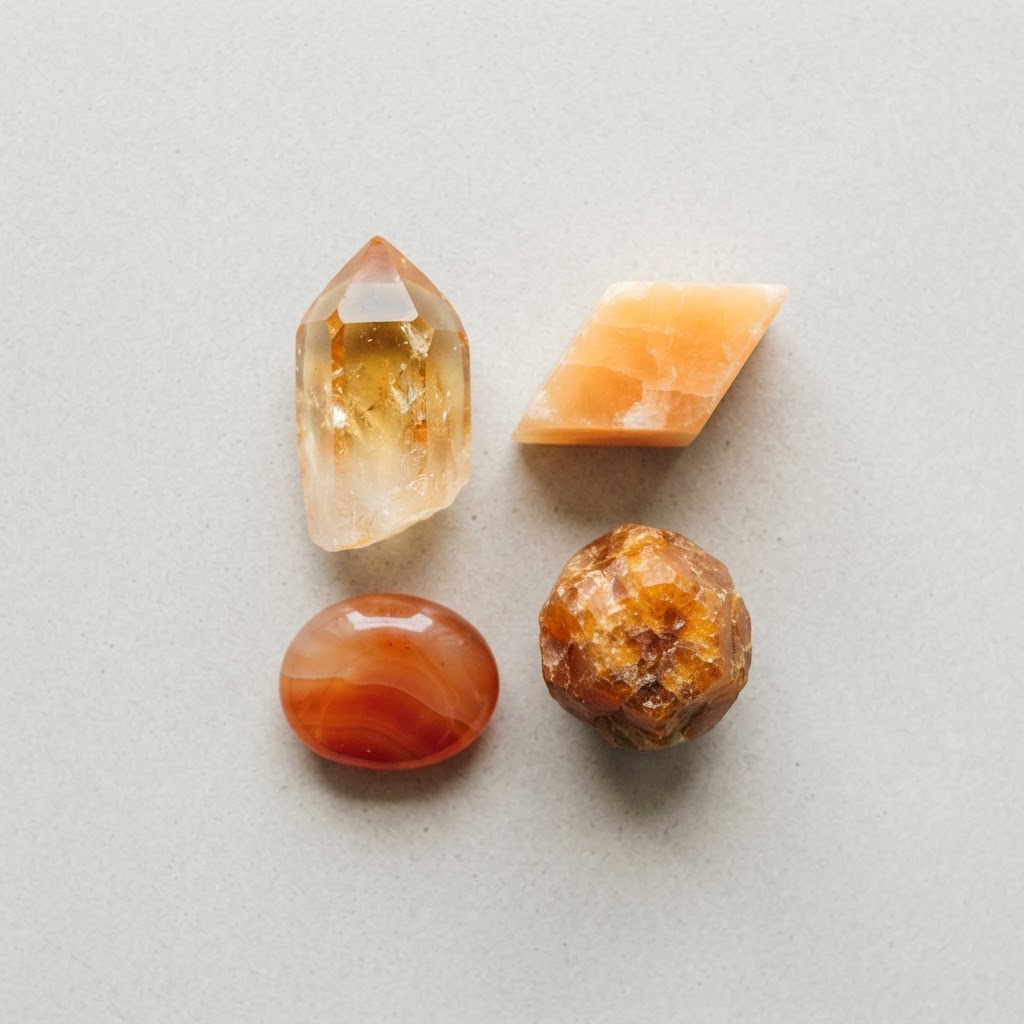
Start With Hardness
Orange is the most crowded colour in the mineral world, and colour will not get you to an answer on its own. Hardness will, faster than any other single test, because the orange stones are spread right across the Mohs scale.
A fingernail is about 2.5. A copper coin is about 3.5. A steel knife is about 5.5. Quartz is 7. So a scratch test in three steps — fingernail, coin, knife — immediately places your stone in a band, and each band contains only a handful of orange possibilities.
Below 3 you are looking at amber or orange calcite. Between 3 and 5.5 you are looking at calcite, aragonite or a soft ore mineral. Above 5.5 you are in the quartz, garnet, feldspar and corundum range, which is where most orange gem material lives.
The Translucent Oranges
If light passes through the stone, you are probably looking at citrine, carnelian, fire opal or an orange garnet. Citrine is yellow to orange quartz, hardness 7, with a white streak and a clean, glassy interior. Carnelian is orange chalcedony, hardness 6.5 to 7, translucent but with a waxy surface and a cloudy or banded interior rather than a transparent one.
Both leave a white streak and both are quartz-family materials, so the difference is texture. Citrine is a single crystal and looks transparent. Carnelian is microcrystalline and looks like coloured wax.
Fire opal is the odd one out. It is transparent to translucent orange with a water content, hardness 5.5 to 6.5, and it is noticeably lighter than quartz. Mexican fire opal is the classic material. Australian opal from Coober Pedy and Andamooka is mostly white or crystal rather than orange, so if you are fossicking in Australia, an orange translucent stone is far more likely to be carnelian or citrine.
The Orange Garnets
Two orange garnets matter: hessonite and spessartine. Hessonite is the honey-to-cinnamon orange stone sold in India as gomed, and it has a distinctive roiled, swirling interior. Spessartine is more red-orange, brighter and often cleaner, and it is manganese aluminium garnet.
Both are hardness 6.5 to 7.5 with a white streak, and both are singly refractive, which separates them from quartz. The giveaway is weight. Garnets run 3.6 to 4.3 specific gravity against quartz at 2.65, so a garnet feels noticeably heavier in the hand than a citrine of the same size.
Our gomed stone identifier guide takes hessonite apart in detail.
The Opaque Oranges
If the stone is opaque, the candidates change. Orange calcite is hardness 3 and fizzes in dilute acid — a drop of vinegar is enough — and it splits on flat rhombohedral planes. Aragonite is similar but sits at 3.5 to 4 and often has a radiating or fibrous structure.
Sunstone is different again: it is a feldspar at hardness 6 to 6.5 with sparkling metallic flecks inside, an effect called aventurescence, caused by tiny copper or hematite inclusions. Hold it at an angle and the whole stone lights up with glitter.
Ironstone and ochre are not crystals, but they are worth ruling out because they are far more common than any orange gem. Both leave a red-brown or yellow-brown streak, where every silicate here leaves white.
Orange vs Its Lookalikes
Nine stones cover almost every orange specimen an amateur will pick up.
| Stone | Hardness | Streak | How to tell it |
|---|---|---|---|
| Citrine | 7 | White | Transparent yellow-orange quartz. Clean and glassy, and light in the hand. |
| Carnelian | 6.5–7 | White | Translucent orange chalcedony. Waxy, cloudy or banded rather than transparent. |
| Hessonite garnet | 6.5–7.5 | White | Honey to cinnamon orange with a roiled, swirling interior. Heavier than quartz. |
| Spessartine garnet | 7–7.5 | White | Brighter red-orange, often cleaner than hessonite, and noticeably heavy. |
| Orange calcite | 3 | White | Soft enough for a coin to scratch, fizzes in vinegar, splits on flat planes. |
| Sunstone | 6–6.5 | White | Feldspar with sparkling metallic flecks that flash as you tilt it. |
| Amber | 2–2.5 | White | Fossil resin. Marked by a fingernail, warm to the touch, floats in strong salt water. |
| Fire opal | 5.5–6.5 | White | Transparent orange with a water content. Lighter than quartz and softer than citrine. |
| Ironstone or ochre | 4–6 | Red-brown | Earthy and porous, and the only ones here with a coloured streak. |
Where Orange Stones Turn Up
Agate Creek in north Queensland is one of Australia’s best-known sources of carnelian and agate, and the surrounding gravels produce orange chalcedony in quantity. Citrine occurs in quartz-bearing terrains across the eastern states, and orange garnets turn up in metamorphic country alongside other garnet species.
Worldwide, the major citrine sources are Brazil and Madagascar. Carnelian comes from India, Brazil and Uruguay, and the classic orange garnet localities are Sri Lanka for hessonite and Madagascar, Brazil and Namibia for spessartine. Sunstone is mined in Oregon, India and Tanzania, and fire opal is largely Mexican.
The Bottom Line
Start with hardness. Soft enough for a coin means calcite or amber. Hard enough to resist a knife means quartz, garnet or feldspar. Then check translucency: transparent means citrine or fire opal, waxy and cloudy means carnelian, opaque means calcite or sunstone.
Then weigh it. Garnets feel heavy for their size and quartz does not, which is the fastest way to separate hessonite from citrine.
If you want the other colours covered, purple crystal identifier and pink crystal identifier work through the same method, and quartz identifier covers the quartz family in full.
Frequently Asked Questions
Start with hardness. A fingernail, coin and knife test places the stone in a band, and each band contains only a few orange possibilities. Then check translucency and weight to narrow it further.