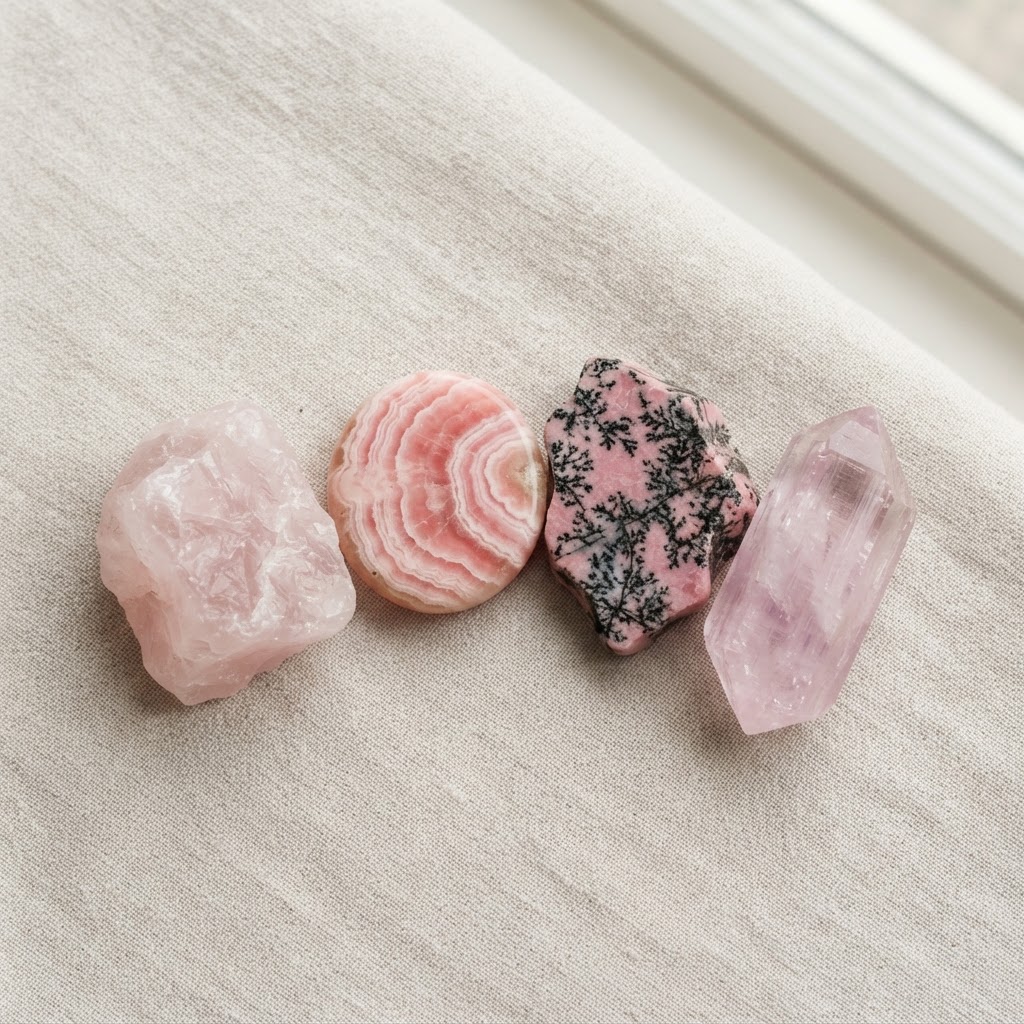
Rose Quartz Comes First
Pink is another crowded colour, and the most common answer by a wide margin is rose quartz. It is quartz at hardness 7 with a white streak, and its colour comes from trace titanium, iron or manganese together with microscopic mineral fibres inside the crystal.
The thing that makes rose quartz recognisable is not its colour but its cloudiness. It is almost always translucent to nearly opaque and milky, and it very rarely forms good crystals — it occurs as massive chunks rather than prisms. If you have a clear, faceted pink stone, it is not rose quartz.
So the first test is hardness, and the second is clarity. Hard and cloudy means rose quartz. Hard and clear means something else entirely.
The Soft Pinks
Pink calcite is hardness 3, so a copper coin scratches it, it fizzes in dilute acid, and it splits on flat rhombohedral planes. It is often a delicate pastel pink and quite pretty, and it is very commonly mistaken for rose quartz by people who have not tried to scratch it.
Rhodochrosite is manganese carbonate at hardness 3.5 to 4, and it is one of the most attractive pink minerals there is. It usually shows banded pink and white layers, or a deep raspberry pink with swirling patterns. Like calcite it fizzes in acid, and like calcite it is soft. The banding is the giveaway.
Rhodonite is the harder one, at 5.5 to 6.5. It is a manganese silicate, usually a muted pink to brownish pink with black veins of manganese oxide running through it, and it is almost never clean or transparent. Those black veins are its signature.
The Hard Pinks
Above hardness 6 the candidates are rose quartz, rhodonite, pink tourmaline, kunzite, morganite and pink sapphire.
Pink tourmaline, or rubellite when the colour is deep, is hardness 7 to 7.5 and strongly pleochroic — the colour shifts noticeably as you turn the stone. Tourmaline crystals are long prisms with fine lengthwise striations, and they are almost always visibly included.
Kunzite is pink spodumene at hardness 6.5 to 7, and it has two distinctive features. It has perfect cleavage in one direction, so it splits into flat plates, and it is strongly pleochroic. It also fades. Kunzite left in direct sunlight will lose its colour over time, which is why it is a display stone rather than a ring stone.
Morganite is pink beryl at 7.5 to 8, usually a pale peach-pink and much clearer than rose quartz. Pink sapphire is corundum at hardness 9 and the hardest thing in this group.
Pink vs Its Lookalikes
Eight stones cover almost every pink specimen that gets misidentified.
| Stone | Hardness | How to tell it from rose quartz |
|---|---|---|
| Pink calcite | 3 | Scratched by a coin. Fizzes in vinegar and splits on flat rhombohedral planes. |
| Rhodochrosite | 3.5–4 | Banded pink and white, or deep raspberry with swirls. Fizzes in acid and is much softer. |
| Rhodonite | 5.5–6.5 | Muted pink with black manganese oxide veins. Opaque and rarely clean. |
| Kunzite | 6.5–7 | Transparent and strongly pleochroic. Splits into flat plates on perfect cleavage and fades in sunlight. |
| Pink tourmaline | 7–7.5 | Long prisms with lengthwise striations, strongly pleochroic, and almost always visibly included. |
| Morganite | 7.5–8 | Pale peach-pink beryl, much clearer than rose quartz and harder than quartz. |
| Pink sapphire | 9 | Harder than everything here, specific gravity 4.0, and no cleavage. |
| Pink glass | 5–5.5 | Round gas bubbles, a curved fracture, and soft enough for a knife to mark. |
Where Pink Crystals Come From
Rose quartz is found in enormous masses in Brazil, Madagascar, South Africa, India and the United States, and it occurs in Australia too, in pegmatite country across the eastern states. It is one of the least expensive gem materials in the world, which is worth remembering when a pink stone is offered at a high price.
Rhodochrosite has two famous sources: the banded stalactitic material from Capillitas in Argentina, sometimes sold as Inca rose, and the deep red crystals from the Sweet Home mine in Colorado. Rhodonite is well known from Broken Hill in New South Wales, which has produced some of the finest pink rhodonite in the world, and it is also mined in Sweden, Russia and Japan.
Kunzite comes from Afghanistan, Pakistan, Brazil, Madagascar and California. Morganite comes from Brazil, Madagascar and Afghanistan. Pink sapphire comes from Sri Lanka, Madagascar, Myanmar and Tanzania.
The Bottom Line
Test hardness first. If a coin scratches it, you are looking at calcite or rhodochrosite, and both will fizz in acid. If it survives a knife, you are in the quartz range or above.
Then look at clarity and texture. Cloudy and massive means rose quartz. Banded pink and white means rhodochrosite. Black veins on muted pink mean rhodonite. Clear and pleochroic means kunzite or tourmaline.
For the other colours, purple crystal identifier and orange crystal identifier use the same method, and quartz identifier covers the quartz family itself.
Frequently Asked Questions
Test hardness first. A coin scratches calcite and rhodochrosite, while rose quartz at hardness 7 survives a knife. Then check clarity and texture: cloudy means rose quartz, banded means rhodochrosite, black veins mean rhodonite.