What Gomed Actually Is
Gomed — also written gomedhikam or gomedakam — is the name used across India and in the Vedic tradition for hessonite, a variety of grossular garnet. It is a calcium aluminium garnet, and it is one of the few garnets that can be recognised almost on sight once you know what you are looking for.
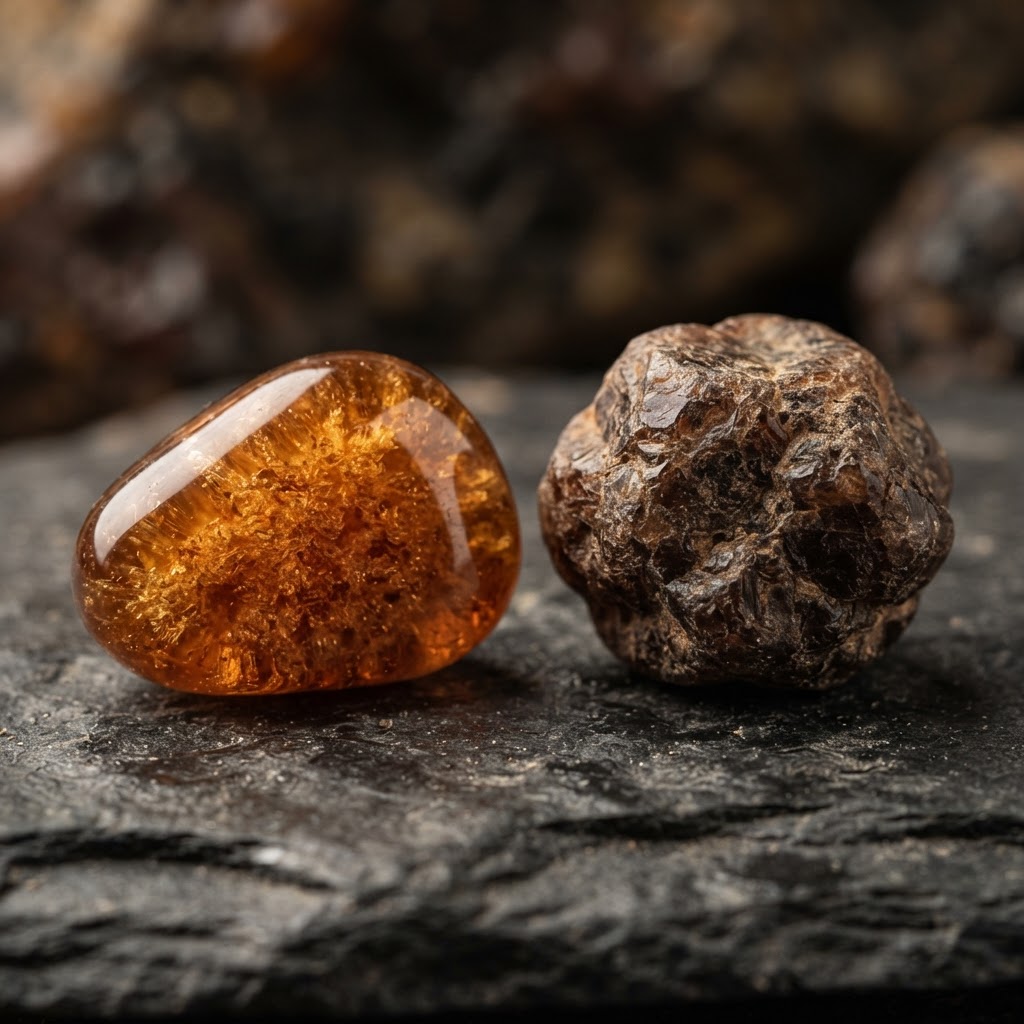
The confusion starts with the word itself. Gomed is not a mineral species, it is a trade and astrological name for one particular look: a warm, honey-to-cinnamon orange stone, usually cut as a cabochon or kept as a polished pebble, with a slightly cloudy interior. If you are holding a stone that someone sold you as gomed, the mineral you should be checking it against is hessonite garnet.
Garnets are a family rather than a single mineral. They all share the same crystal structure with different metals inside it, and hessonite sits alongside almandine, pyrope, spessartine and andradite. What makes hessonite unusual is that it is lighter than the rest of the family — around 3.6 specific gravity rather than 4.0 or more — because aluminium is a light element.
The Colour, and the Roiled Look
The colour range runs from pale yellow-orange through honey and cinnamon to a deep brownish-red. The most sought-after material is a warm, clear amber-orange, sometimes described as the colour of whisky held up to a light.
Colour alone will not identify it, because citrine, zircon and amber all land in the same part of the spectrum. What does identify hessonite, under a loupe or a 10x hand lens, is its internal texture. Hessonite is almost never clean. It carries a swirling, granular, slightly turbulent appearance that the trade calls roiled — sometimes described as a heat-wave effect — caused by included crystals and internal strain. It looks like honey that has been stirred and not quite settled.
That texture is the single most useful thing about gomed. A perfectly clean, glass-clear orange stone is almost certainly something else. If you can see the swirl, you are very likely looking at hessonite.
Gomed also has a slightly resinous or treacly surface sheen rather than the hard glassy look of quartz, and a high polish makes it look almost wet.
Hardness, Streak and Weight
Hessonite sits at hardness 6.5 to 7.5 on the Mohs scale, so a knife will not scratch it and it will not scratch quartz. It has no cleavage at all, which means it breaks with a curved, uneven fracture rather than splitting on flat planes — a useful thing to know, because garnets chip rather than cleave.
The streak is white or colourless, which is true of most garnets and most silicates, so it does not separate gomed from citrine. What does separate them is weight and refraction. Hessonite has a specific gravity of about 3.6, and citrine is 2.65. In the hand, a gomed pebble feels noticeably heavier than a quartz pebble of the same size.
Hessonite is also singly refractive, like all garnets. Look through a cut stone at a sharp edge behind it and you see one image, not two. Zircon, which is a common gomed lookalike, is strongly doubly refractive and will show visible doubling of the facet edges under a loupe.
Our raw gem identification guide covers these tests on uncut material, where you cannot rely on facet edges at all.
Gomed vs Its Lookalikes
Five stones account for most of the confusion, and each gives itself away in a different way.
| Stone | Hardness | How to tell it from gomed |
|---|---|---|
| Citrine | 7 | Much lighter in the hand (2.65 against 3.6 specific gravity). Clean and glassy inside, with no roiled texture, and doubly refractive. |
| Zircon | 7.5 | Heavier still, at 4.6–4.7. Very high double refraction, so facet edges look strongly doubled under a loupe. |
| Spessartine garnet | 7–7.5 | More red than orange, and heavier at 4.1–4.3. Often cleaner than hessonite, with a brighter, more fiery look. |
| Amber | 2–2.5 | Soft enough to mark with a fingernail, and light enough to float in strong salt water. Warm to the touch. |
| Glass | 5–5.5 | Round gas bubbles inside, a curved fracture, and no roiled texture. Noticeably lighter and softer. |
| Carnelian | 6.5–7 | Translucent orange chalcedony. Waxy rather than resinous, much lighter, and usually banded or cloudy rather than swirled. |
Where Gomed Comes From
Sri Lanka is the classic source, and the Ceylon material is what most people picture: water-worn pebbles recovered from gem gravels, already rounded and smooth, which is why so much gomed is kept as a polished pebble rather than faceted. The Ratnapura gravels have produced hessonite for centuries.
India also produces hessonite, in Odisha, Rajasthan and parts of Andhra Pradesh, along with material from Tanzania, Madagascar, Brazil, Canada and Myanmar. Hessonite forms in metamorphic rocks such as marbles and skarns, so it turns up in the same terrains as other calcium-bearing gems, and it is heavy and hard enough to survive weathering and collect in stream gravels alongside them.
If you are buying in the Indian market, the practical consequence is that a great deal of what is sold as gomed is Sri Lankan hessonite, and that is entirely normal. What matters is that it is hessonite, and that the price reflects the quality of the stone rather than the story attached to it.
Gomed in Vedic Astrology
Gomed is best known in India as the gemstone associated with Rahu in Jyotish, the Vedic astrological tradition, and it is worn for that reason far more often than for its appearance. That cultural role is real and long-standing, and it explains why the word gomed is in common use while hessonite, the mineral name, is not.
It is worth being clear about the boundary here. What a stone does for you is a matter of belief and tradition, not of anything that can be measured, and no gemstone should be treated as a substitute for medical care or financial advice. What can be measured is whether the stone is what it was sold as.
That is the part worth insisting on. If you are buying gomed for astrological reasons, the thing you are entitled to is a stone that is genuinely hessonite garnet, at a fair price, with an accurate description. A certificate from a recognised gem laboratory is the only document that establishes that.
Checking a Stone Before You Buy
Four things, in this order.
- Ask what the mineral species is, not the trade name. "Hessonite garnet" is an answer; "gomed" is a market name that tells you nothing about what you are holding.
- Look for the roiled texture with a loupe. It is hessonite’s signature, and a perfectly clean stone in this colour is a warning sign rather than a bonus.
- Weigh it in your hand against a quartz pebble of similar size. Gomed should feel noticeably heavier.
- Ask for a certificate on anything expensive. A refractometer reading of about 1.74 and a specific gravity near 3.6 confirms hessonite in a couple of minutes, and any jeweller with the equipment can do it.
The Bottom Line
Gomed is hessonite garnet: a calcium aluminium garnet at hardness 6.5 to 7.5, specific gravity around 3.6, singly refractive, and almost always carrying a swirling, roiled interior that no lookalike reproduces.
Citrine is much lighter and clean, zircon is heavier and shows strong double refraction, amber is soft enough to mark with a fingernail, and glass has bubbles. Those four checks will resolve most cases.
If you are working from a photograph rather than a stone in your hand, rock identification by photo covers what a camera can and cannot tell you, and orange crystal identifier puts gomed alongside the rest of the orange family. For a wider look at the trade names and what they map to, see precious stone identification.
Frequently Asked Questions
Yes. Gomed, gomedhikam and gomedakam are Indian trade and astrological names for hessonite, a variety of grossular garnet. Hessonite is the mineral name, and it is the one to check a stone against.