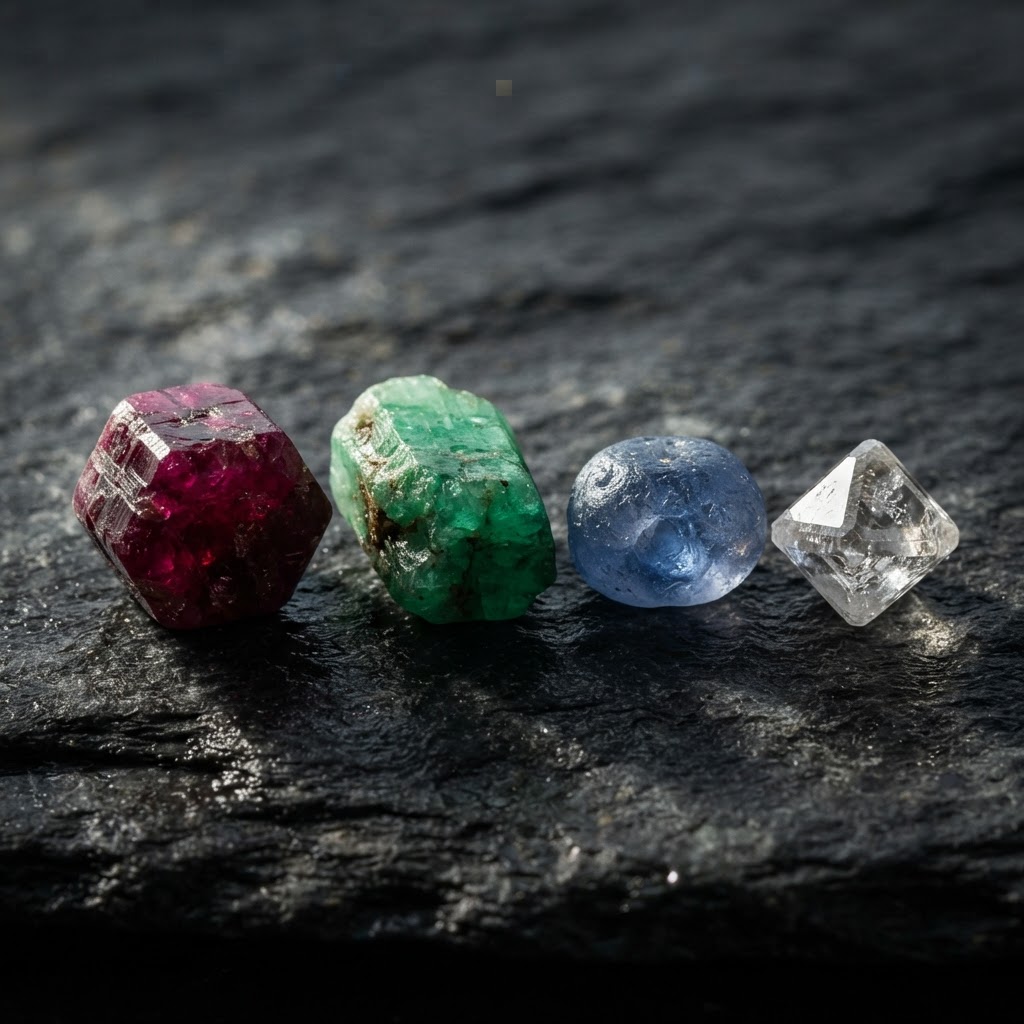
What "Precious" Actually Refers To
The word precious is a trade convention rather than a scientific category, and it traditionally covers exactly four stones: diamond, ruby, sapphire and emerald. They were grouped together because they were scarce, durable and expensive, and the grouping has survived mostly out of habit.
It is worth knowing the convention, because those four names are what people search for and what sellers use. But the useful part of gemmology starts when you stop thinking in trade labels and start thinking in mineral species, because ruby and sapphire are the same species and emerald is a variety of another one entirely.
Two Species Hide Behind Four Names
Ruby and sapphire are both corundum, which is crystalline aluminium oxide. The difference is entirely colour: red corundum is called ruby, and every other colour of corundum is called sapphire, including blue, yellow, pink, green and the rare orange-pink padparadscha. Chemically and structurally they are the same mineral at hardness 9, second only to diamond.
Emerald is green beryl, and beryl is beryllium aluminium silicate at hardness 7.5 to 8. The colour comes from traces of chromium or vanadium. The same species gives aquamarine when the trace element is iron, morganite when it is manganese, and heliodor when it is iron in a different oxidation state.
That is why colour alone is such a poor guide. A red stone could be ruby, but it could equally be spinel, garnet or red tourmaline — and spinel in particular has been mistaken for ruby for centuries, including in some of the most famous "rubies" in royal collections.
The Properties That Separate the Big Four
These are the numbers a gemmologist works with. Hardness and refractive index between them eliminate most lookalikes before any other test is needed.
| Stone | Species | Hardness | Refractive index | Key giveaway |
|---|---|---|---|---|
| Diamond | Carbon | 10 | 2.42, singly refractive | Nothing else is this hard. Sharp facet edges, no doubling. |
| Ruby | Corundum | 9 | 1.76–1.77, doubly refractive | Strong red with a distinctive glow in daylight from chromium. |
| Sapphire | Corundum | 9 | 1.76–1.77, doubly refractive | Every colour but red. Often colour-zoned in bands. |
| Emerald | Beryl | 7.5–8 | 1.57–1.58, doubly refractive | Almost always visibly included, often with internal fractures. |
| Spinel | Spinel | 8 | 1.72, singly refractive | Singly refractive like diamond, so no facet doubling. Common ruby substitute. |
| Garnet | Garnet group | 6.5–7.5 | 1.72–1.89, singly refractive | No cleavage at all. Higher dispersion than ruby in the greens. |
| Tourmaline | Tourmaline | 7–7.5 | 1.62–1.64, doubly refractive | Strongly pleochroic — different colours from different angles. |
| Zircon | Zircon | 7.5 | 1.78–1.98, doubly refractive | Very high double refraction, so facet edges look strongly doubled. |
Why Home Tests Cannot Confirm a Precious Stone
Every classic home test fails against modern simulants, and several of them damage the stone. The fog test is unreliable because cubic zirconia also clears condensation quickly. The scratch test risks chipping the stone and proves nothing, since quartz, topaz, moissanite and cubic zirconia all scratch glass.
The thermal tester that jewellers use separates diamond from cubic zirconia and glass, but it reads moissanite as diamond, because moissanite conducts heat in a similar way. Electrical conductivity testers do distinguish them. That is exactly the level of nuance a home kit cannot reach.
What you can do at home is rule things out with a loupe. Look at the facet edges. A singly refractive stone such as diamond or spinel shows single, crisp edges. A strongly doubly refractive stone such as zircon shows visible doubling, and moissanite shows it too under enough magnification. Look for the inclusions that betray glass — round bubbles never occur in natural gemstones.
Natural, Treated and Synthetic
The most important distinction in the modern market is not colour, it is origin. Laboratory-grown ruby, sapphire and emerald are chemically and optically identical to natural stones, because they are the same material grown under controlled conditions rather than in the ground.
Synthetic ruby has been made by flame fusion since around 1900, and synthetic emerald has been produced commercially since the 1930s. The result is that a great deal of affordable "ruby" and "emerald" jewellery is synthetic, and it is perfectly legitimate as long as it is described as such. What matters is that the price reflects it, because a laboratory-grown stone sells for a small fraction of a natural one of the same size and clarity.
Treatments are a separate question again. Emeralds are routinely oiled or resin-filled to hide surface-reaching fractures, and this must be disclosed because the filling can dry out or be damaged by cleaning. Sapphires are commonly heated to improve colour, which is accepted throughout the trade. Diffusion treatment, where colour is driven into the surface layer only, is more problematic because a re-polish removes it.
Emerald Has Its Own Rules
Emerald is the one precious stone where inclusions are expected rather than penalised. Almost every natural emerald has visible internal fractures and inclusions, and gemmologists refer to this as the jardin, or garden. A perfectly clean natural emerald of any size is extremely rare and priced accordingly.
That creates a useful rule of thumb. If an inexpensive emerald looks completely clean and flawless, either it is synthetic, it is a different green stone such as tsavorite garnet, chrome tourmaline, peridot or green glass, or it is heavily fracture-filled. All four possibilities are common, and only magnification will tell them apart.
When to Pay for a Real Test
Get a professional assessment if the stone is set in jewellery, if it came with any claim of being precious, if it was inherited, or if it is large and clean enough to be worth more than a few hundred dollars. A jeweller can confirm the species with a refractometer in a couple of minutes and for very little money.
For anything genuinely valuable, the document that matters is a grading report from a recognised laboratory, which confirms both the identity and whether the stone is natural or laboratory-grown. That report is what establishes value. A verbal opinion, however expert, does not.
If your stone is rough rather than cut, the whole picture changes, because cut stones lose much of the evidence a gemmologist would use. raw gem identification explains why. Our diamond identifier guide covers the diamond case in detail, and semi precious gemstones identifier covers everything outside the big four.
The Bottom Line
Ruby and sapphire are both corundum at hardness 9, separated only by colour. Emerald is green beryl at 7.5 to 8, and is almost always included. Diamond is carbon at hardness 10 and the only common gem that is singly refractive and conducts heat extremely well.
Those facts rule out most lookalikes, and spinel is the one that catches people out most often. But no home test can prove a precious stone, and the distinction between natural and laboratory-grown cannot be seen with the naked eye at all. Use the tests here to decide whether a stone is worth taking further, then take it to someone qualified.
Frequently Asked Questions
You can rule out lookalikes but you cannot confirm one. Use a loupe to check whether facet edges are doubled, which separates singly refractive stones like diamond and spinel from doubly refractive ones like zircon and moissanite. Anything valuable needs a gemmologist.