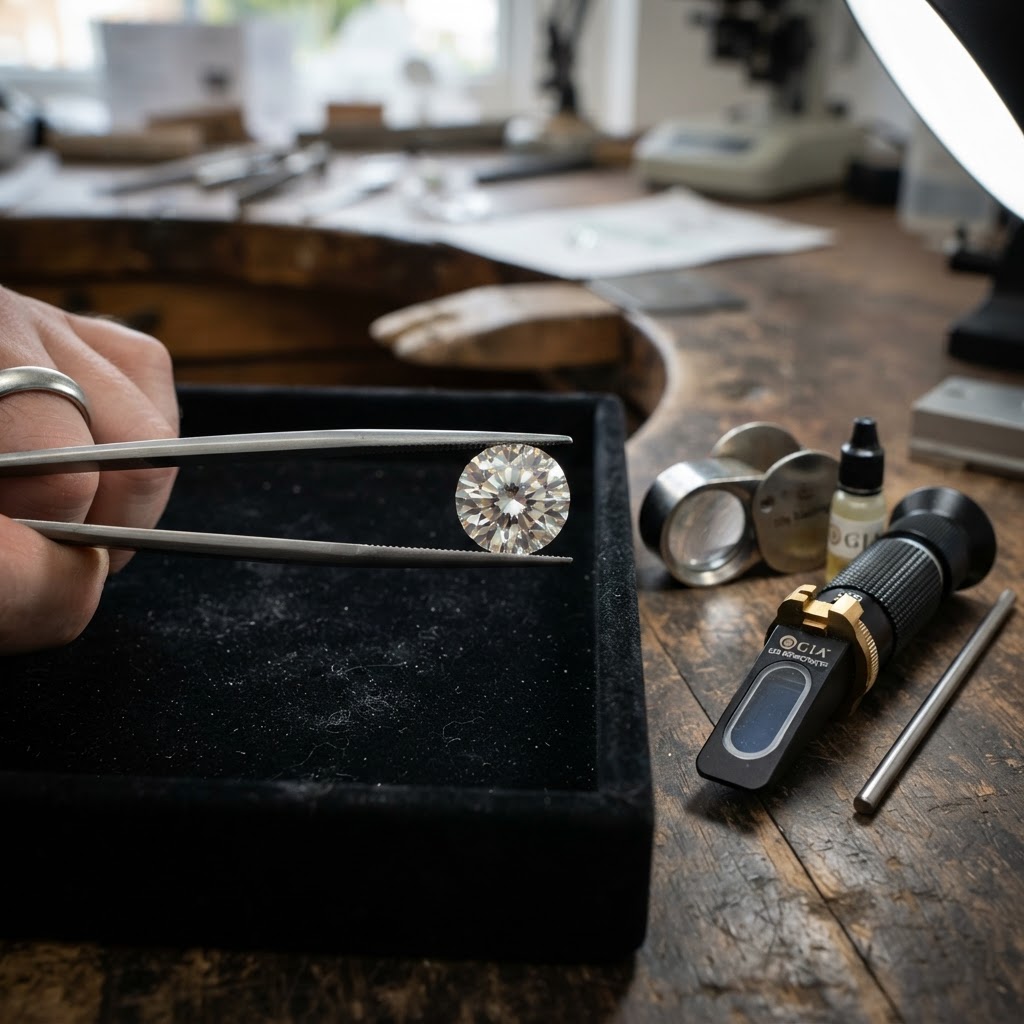
The Honest Answer First
No test you can do at home will prove a stone is a diamond. Every method sold as a home diamond test either damages the stone, fails against modern simulants, or both. What you can do at home is rule things out — and ruling things out is genuinely useful, because most stones that people hope are diamonds are not.
If a stone might be worth money, stop testing it yourself and take it to a jeweller or a gemmologist. They have a thermal and electrical tester, a refractometer and a microscope, and they will give you an answer in minutes for very little money.
What Makes Diamond Different
Diamond is carbon crystallised under enormous pressure. That gives it a set of properties nothing else in common use shares completely.
It is hardness 10 on the Mohs scale, and nothing else in nature comes close — corundum, the next hardest common gem, is 9. It has a refractive index of 2.42, far higher than quartz at 1.54, which is why a cut diamond bends and returns light so efficiently. It is singly refractive, so you never see the doubled facet edges that give away zircon or moissanite. And it conducts heat extremely well, which is the basis of the standard jeweller’s thermal tester.
The Field Tests and What They Prove
Here is what each commonly suggested test actually tells you.
| Test | What it proves | Worth doing? |
|---|---|---|
| Fog test — breathe on it | Nothing reliable. Simulants also clear quickly. | No |
| Read a newspaper through it | A high refractive index blurs the print, but CZ and moissanite blur it too. | Partly |
| Scratch test on glass | Quartz and CZ also scratch glass. Damages the stone. | No |
| Weigh it against a known stone | Specific gravity separates some simulants, but needs an accurate scale. | Partly |
| Look for doubled facet edges | Rules out zircon, moissanite and most glass. Useful. | Yes |
| Thermal tester | Separates diamond from CZ and glass. Misled by moissanite. | Only with the right tester |
| Gemmologist with refractometer | Confirms identity and can distinguish natural from synthetic. | Yes — for anything valuable |
Diamond vs Quartz: The Hardness Gap
Quartz is the most common stone mistaken for diamond, usually because a clear, well-formed crystal looks convincing in the hand. The gap between them is enormous: quartz is hardness 7, diamond is 10. A quartz point will not mark a diamond at all, while a diamond will scratch quartz, glass, steel and everything else you own.
Practically, the difference shows in the surface. Diamond keeps a mirror-polished face indefinitely. Quartz picks up tiny abrasions and a slightly frosted look on facet edges with wear. Under a loupe, a real diamond’s facet edges are razor-sharp; quartz and glass show rounded or chipped ones.
Diamond vs Moissanite: The Test That Fails
Moissanite is silicon carbide, and it is the simulant that catches people out. It is hardness 9.25, so it stands up to wear almost as well as diamond. It disperses light more strongly than diamond, which gives it noticeably more rainbow fire in photographs. It is doubly refractive, so a loupe often shows doubled facet edges — that alone is usually enough to identify it.
The important trap is the thermal tester. Moissanite conducts heat similarly to diamond, so a basic thermal tester will read it as diamond. Electrical conductivity testers distinguish them, because moissanite conducts electricity and diamond does not. If you are buying and the seller only used a thermal pen, that is not sufficient.
Diamond vs Glass and Paste
Glass and paste imitations are easy to spot once you know what to look for. They are soft — about 5 to 5.5 — so the facet edges round off quickly and the surface collects scratches. They often contain round bubbles, which never occur in diamond, and they are noticeably less brilliant because their refractive index is much lower.
Cubic zirconia sits between the two cases. It is harder than glass at 8 to 8.5 and reasonably convincing when new, but it is much denser than diamond and looks glassy rather than steely. Worn CZ shows abraded facet edges within a year or two, where diamond does not.
Why the Scratch Test Is a Bad Idea
The scratch test is the single most damaging piece of advice in gemmology. Scratching a stone across glass can chip the girdle or break off a point, and it proves almost nothing, because quartz, CZ, moissanite and topaz all scratch glass too.
Worse, it is often applied to the wrong stone. If the stone turns out to be a genuine diamond of any size, you have just devalued it. And if it is a simulant, you have learned nothing you could not have learned with a loupe and thirty seconds of patience.
When to Get a Real Test
Get a professional assessment if the stone is set in jewellery, if it came with any claim of being a diamond, or if it is large and clean enough to be worth more than a few hundred dollars. A jeweller can confirm the identity and, for a fee, arrange certification from a laboratory such as GIA, which is the document that actually establishes value.
If your stone is rough rather than cut, the picture changes completely — cut stones lose the evidence a gemmologist would use. raw gem identification explains why. And for a broad comparison of the stones you are likely to encounter, semi precious gemstones identifier covers the main groups.
The Bottom Line
Diamond is hardness 10, singly refractive, and extraordinarily good at conducting heat. Those three facts rule out most simulants. What they cannot do is prove a stone is natural rather than laboratory-grown, and that distinction matters enormously to value.
Use the tests here to narrow things down, then take anything promising to a professional. It is cheap, quick, and the only answer worth relying on.
Frequently Asked Questions
You can rule out most imitations, but you cannot prove a stone is a diamond at home. Simulants such as moissanite pass the common thermal tester. Anything valuable needs a gemmologist with a refractometer.