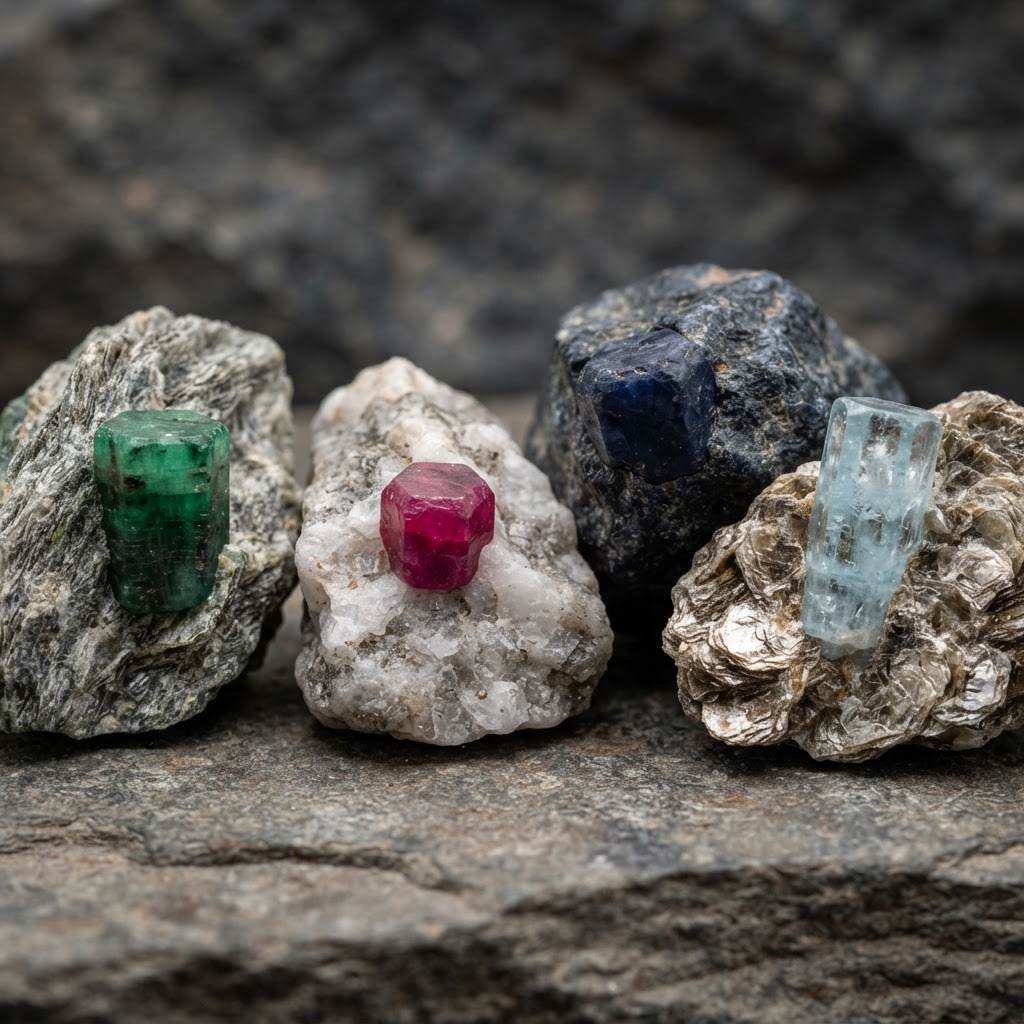
Rough Gems Look Nothing Like the Photos
Every photo of an emerald you have seen is of a cut, polished stone under studio lighting. Raw emerald rough is a dull green hexagonal crystal embedded in grey schist, often cracked, often muddy, and frequently no more than a centimetre across. If you are expecting sparkle, you will walk straight past it.
This is why raw gem identification is really about reading crystal form and host rock rather than colour. The shape of the crystal and the material it sits in narrow the field far more than the colour does.
What You Can Actually See on a Rough Gem
Four things matter on uncut material.
- Crystal form. Hexagonal prisms mean beryl or corundum. Flat tabular crystals suggest corundum. Blocky, striated prisms suggest tourmaline.
- Colour and colour zoning. Uneven colour distribution is normal in natural rough and is one of the signs that a stone is genuine rather than synthetic.
- Host rock. Emeralds occur in schist and pegmatite; rubies and sapphires in marble or basalt; peridot in volcanic rock; garnet in metamorphic rock.
- Transparency at the edges. Hold it to light. Gem rough is usually translucent at the thinnest edges even when the centre looks opaque.
The Gem Families and Their Rough Forms
Knowing the crystal habit of each species is the fastest way to sort rough material.
| Gem | Rough form | Hardness | Typical host rock |
|---|---|---|---|
| Emerald | Green hexagonal prisms, heavily fractured | 7.5–8 | Schist and pegmatite |
| Aquamarine | Blue-green hexagonal prisms, cleaner than emerald | 7.5–8 | Pegmatite |
| Ruby | Red tabular or barrel-shaped crystals | 9 | Marble and basalt |
| Sapphire | Blue to green barrel or spindle shapes | 9 | Basalt and marble |
| Tourmaline | Elongated prisms with lengthwise striations | 7–7.5 | Pegmatite |
| Garnet | Rounded dodecahedral crystals, often in mica schist | 6.5–7.5 | Metamorphic rock |
| Peridot | Small olive-green grains in volcanic rock | 6.5–7 | Basalt and mantle rock |
| Topaz | Colourless to pale prisms with perfect cleavage | 8 | Pegmatite |
Matrix Is Your Best Clue
A gem crystal on its own is hard to place. A gem crystal still attached to its host rock is much easier, because the matrix narrows the geological setting and therefore the species.
Emerald in grey schist, garnet in shiny mica schist, peridot grains in dark basalt, sapphire in white marble — these pairings are characteristic. If you are collecting rough, keep the matrix attached. Breaking a crystal out of its host rock often destroys the single most useful piece of evidence you had.
Why Rough Gems Are Harder to Identify Than Crystals
Counterintuitively, rough gem material is often harder to identify than an ordinary crystal, because the valuable species are rare and heavily included, while the common lookalikes are abundant. Green tourmaline, chrome diopside, green zircon and peridot all turn up as small green crystals in the same kinds of host rock as emerald.
Hardness helps. Emerald and aquamarine are beryl at 7.5 to 8; tourmaline is 7 to 7.5; peridot is 6.5 to 7; diopside is 5.5 to 6.5. Those differences are measurable with a scratch test even on a small crystal.
Field Tests That Narrow a Rough Gem
Start with hardness on an unimportant corner. Then check crystal form — a hexagonal cross-section is a strong pointer to beryl or corundum. Then look at the colour zoning: sharp, geometric colour banding is natural; perfectly even colour in a large crystal is more common in synthetics.
Do not use acid on gem rough. It will not help and it may damage the surface. And do not try to heat-test anything — thermal shock will crack a crystal that was perfectly saleable before you started.
When to Get It Looked At
If the stone is a clean, well-formed crystal of a plausible gem species, get it assessed. A lapidary club or gemmologist will tell you in minutes whether it is worth anything, and the cost of that assessment is trivial compared with the cost of getting it wrong.
For cut stones the situation is different, because cutting removes most of the identifying features. Our gemstone identification app guide covers why. And if your rough material is not a gem at all but a common crystal, crystal identification app is the better starting point.
The Bottom Line
Raw gem identification depends on crystal form, host rock and hardness — not on colour. A hexagonal green prism in schist is a very different proposition from a green pebble in a river.
Keep the matrix attached, test hardness on a corner, and get anything promising professionally assessed before you cut it.
Frequently Asked Questions
Read the crystal form first — hexagonal prisms suggest beryl or corundum, elongated striated prisms suggest tourmaline. Then check the host rock and test hardness on an unimportant corner.