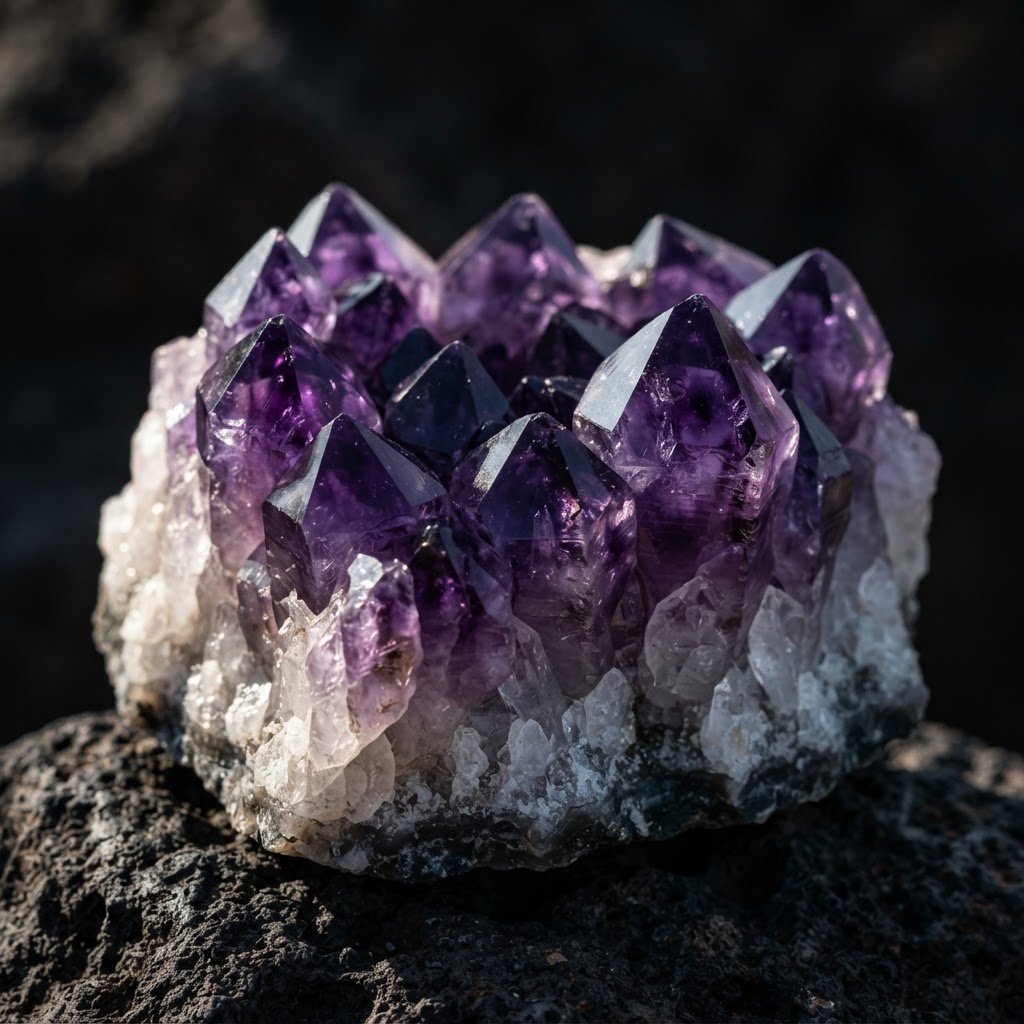
What Happens When You Tap the Shutter
A crystal identifier app is doing pattern recognition, not chemistry. The image is broken into features — dominant colours, edges, surface texture, the ratio of transparent to opaque areas, and the geometry of any visible faces — and compared against labelled reference images.
That is why results are confident-sounding but variable. The model has seen thousands of amethyst photographs and thousands of fluorite photographs, and when a purple crystal looks a particular way it will lean hard towards amethyst. It has no idea that fluorite cleaves and amethyst does not.
The Three Things Crystal Apps Get Right
It is worth being fair about what these tools do well, because it is more than most people assume.
- Colour families. Distinguishing a purple crystal from a green one is trivial for a model and easy to get wrong by eye under indoor lighting.
- Habit and shape. Pointed prisms, cubic forms, botryoidal lumps and radiating sprays are all reliably read.
- Transparency and lustre. Glassy, waxy, pearly and earthy surfaces are separated well, and lustre is one of the more diagnostic visible properties.
Where They Get Wrong
Apps fail most often on minerals that look alike but differ in hardness — which is exactly the case that matters most. Amethyst and fluorite, calcite and quartz, halite and clear quartz: all pairs that a photo may not separate and a scratch test settles instantly.
They also struggle with heavily included, dyed or tumbled material. Dyed agate and dyed quartz are common in souvenir shops, and no image model can tell you a stone has been dyed. Tumbled stones lose the crystal form that carries most of the identification.
How to Judge Accuracy for Yourself
Test the app on crystals you already know before you trust it on one you do not. Photograph a piece of amethyst, a piece of clear quartz, and a piece of fluorite, and see whether it gets all three right and how confident it sounds.
Then check whether it hedges. A good tool gives you a ranked list with properties attached. A bad one gives you a single confident answer with no reasoning, which is the one thing you cannot verify.
Colour Families and Why They Trip Apps Up
Several minerals share a colour family, and apps have to pick between them using shape alone.
| Colour | Common minerals | The separating test |
|---|---|---|
| Purple | Amethyst, fluorite, lepidolite, charoite | Hardness. Amethyst is 7, fluorite 4, lepidolite 2.5–3. |
| Green | Malachite, jade, peridot, aventurine, serpentine | Hardness and acid. Malachite fizzes; jade does not. |
| Yellow | Citrine, calcite, sulphur, topaz | Hardness ranges from 2 for sulphur to 8 for topaz. |
| Clear | Quartz, halite, calcite, topaz, glass | Taste, cleavage and hardness. Halite is salty and soft. |
| Black | Obsidian, tourmaline, hematite, jet, onyx | Streak. Hematite leaves red-brown; obsidian leaves white. |
How to Take a Photo That Gives You a Usable Answer
Photograph outdoors in shade or on an overcast day. Flash flattens the surface and destroys the internal colour zoning that identifies things like amethyst and fluorite. Fill the frame with the crystal, but include a coin so the app has a sense of scale.
Take three shots: the whole specimen, a single crystal face, and a close-up of any interesting internal feature. Then, before you accept the result, ask what the app cannot see — and go test that.
What to Keep in Your Pocket Alongside the App
A steel nail, a copper coin, a small piece of unglazed tile and a quartz point. That is a complete field kit for hardness and streak, it weighs almost nothing, and it turns an app suggestion into a confirmed identification.
If you find yourself doing this often, the crystal identification app guide covers the full workflow, and quartz identifier goes deeper on the single most commonly confused mineral family.
The Bottom Line
Crystal identifier apps are good at colour, shape and lustre and bad at everything you cannot see. Used as a shortlist generator they are excellent value. Used as an oracle they will mislead you, particularly on the lookalike pairs where it matters most.
Photograph carefully, expect a shortlist rather than an answer, and finish the job with a scratch test. That is the whole method.
Frequently Asked Questions
For colour, shape and lustre they are very accurate. For separating lookalikes that differ in hardness — amethyst and fluorite, quartz and calcite — they cannot be accurate, because that information is not in the photo.