What Ruby Is
Ruby is red corundum, which is crystalline aluminium oxide. That is the same mineral as sapphire — the only difference is colour. Red corundum is ruby; every other colour is sapphire. Hardness 9, second only to diamond, and no cleavage at all.
That hardness is why rough ruby looks the way it does. Corundum survives weathering that destroys almost everything around it, so what you find in a creek or a gemfield is usually a rounded, water-worn pebble that has been tumbling for millions of years.
It is also why corundum turns up in places you would not expect. It forms in aluminium-rich metamorphic rocks such as marble, and in some basalts, and because it is so hard and so dense it concentrates in stream gravels downstream of wherever it formed.
What Rough Ruby Actually Looks Like
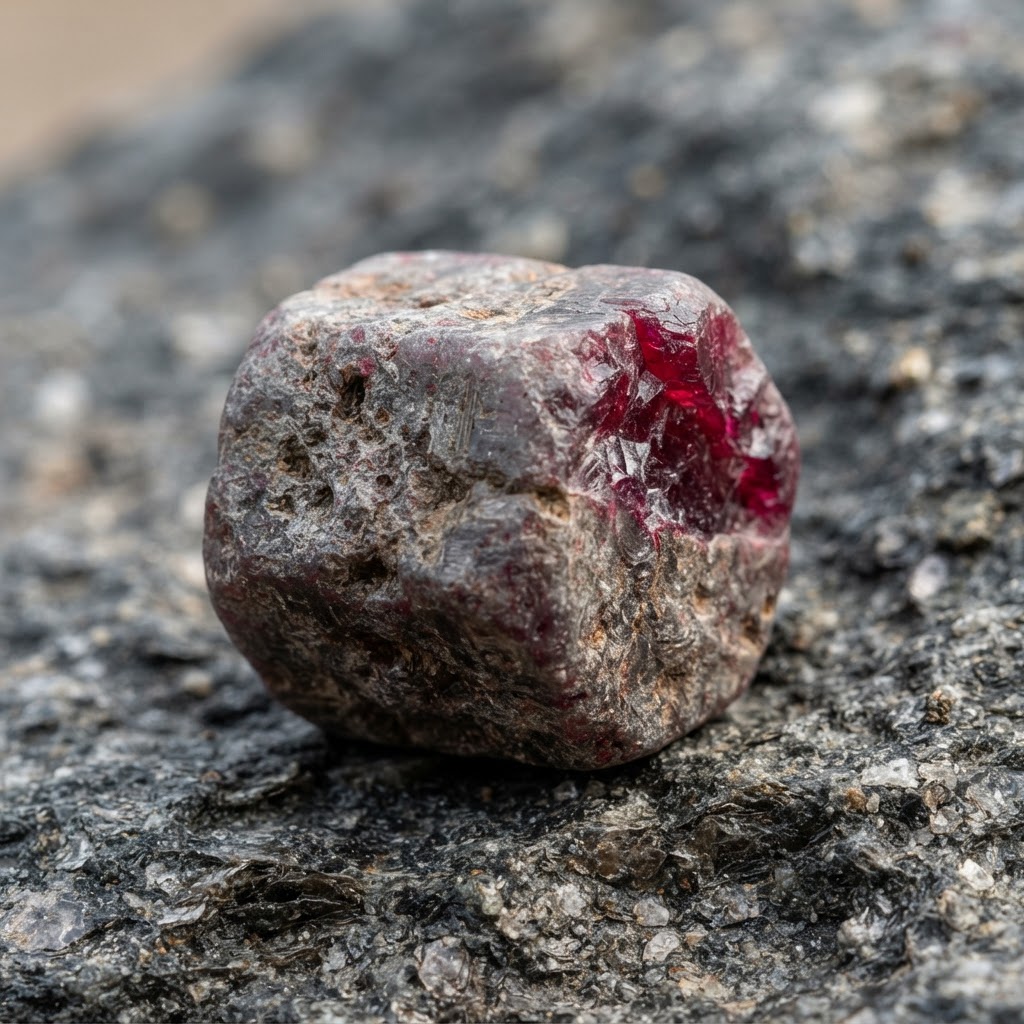
This is where most people go wrong. Rough ruby usually does not look red. Fresh corundum crystals have a dull, pitted, greyish or brownish exterior — a surface often described as sandblasted — and the colour only appears where the stone is broken or where a crystal face has survived.
Hold a rough ruby crystal and turn it. The colour shifts. Corundum is strongly pleochroic, so a ruby can look orange-red from one direction and purplish-red from another. That shift is one of the best field signs you have.
The crystal shape helps too. Corundum crystallises in the hexagonal system, and rough crystals are usually barrel-shaped, tapering, or flat tabular hexagons with rounded edges. They are rarely perfect, but they are rarely shapeless either.
Many rough rubies also fluoresce. Chromium, which gives ruby its colour, makes the stone glow a strong red under long-wave ultraviolet light. A cheap UV torch is one of the most useful things you can carry.
Hardness 9 and What It Means in Practice
Ruby is harder than everything you are likely to have with you. A knife does nothing. A steel file does nothing. Quartz, at hardness 7, does nothing. The only common materials that will mark corundum are diamond and another piece of corundum.
There is a catch: hardness is not toughness. Corundum has no cleavage, but some material has parting — planes of weakness along twinning — and rough crystals can split along them. It also chips. Hard stones break rather than scratch, so handle a crystal you think might be valuable with care.
The streak is white or colourless, which rules out iron oxides but does not separate ruby from garnet or spinel. Specific gravity does. Ruby sits at about 4.0, garnet at 3.6 to 4.3, spinel at 3.6, and quartz at 2.65.
Ruby vs Its Lookalikes
Spinel is the one that catches almost everyone, including collectors with decades of experience.
| Stone | Hardness | How to tell it from ruby |
|---|---|---|
| Red garnet | 6.5–7.5 | Softer, so corundum will scratch it. Singly refractive with no pleochroism, and usually a deeper, more brownish red with none of ruby’s glow. |
| Spinel | 8 | Singly refractive, so no facet doubling, and no pleochroism. Specific gravity 3.6 rather than 4.0. Hard to separate by eye. |
| Red tourmaline | 7–7.5 | Much lighter at 3.0 specific gravity, strongly pleochroic in a different way, and usually shows long striations down the prism faces. |
| Red zircon | 7.5 | Very high double refraction, so facet edges look strongly doubled. Noticeably heavier at 4.6–4.7. |
| Red glass or slag | 5–5.5 | Round gas bubbles inside, a curved shell-like fracture, and soft enough for a knife to mark. |
| Cuprite | 3.5–4 | Soft enough to be scratched easily, and usually a deep crimson with a metallic or adamantine lustre. |
The Queensland Gemfields
If you are in Australia, the place to know is the central Queensland gemfields around Rubyvale, Sapphire and Anakie, west of Emerald. This is one of the world’s significant sapphire-producing areas and it produces ruby as well, along with zircon and other heavy minerals in the gravels.
The material occurs in ancient volcanic and alluvial deposits, and the standard amateur method is to wash gravel through a sieve and examine the concentrate — the same gravity principle that works for gold. Rubies and sapphires are dense, so they stay behind when the light material washes away.
Fossicking in Queensland requires a fossicking licence, and there are designated fossicking areas. You cannot simply dig anywhere, and the rules differ between states. Check the current requirements before you travel.
New South Wales has its own sapphire country around Inverell and Glen Innes, and there is corundum in Western Australia and the Northern Territory as well.
What Rough Ruby Is Worth
Be realistic here. Most rough ruby is opaque, heavily included or too small to cut, and it is worth nothing beyond its interest as a specimen. Gem-quality rough ruby is rare, and the difference between a pretty red pebble and a valuable stone is decided by clarity, colour and size, not by the fact that it is corundum.
If you think you have found something significant, the next step is not a buyer. It is a gem laboratory or a qualified gemmologist, who can confirm the species and whether the stone is natural, treated or synthetic. Synthetic ruby has been made by flame fusion since around 1900 and is cheap and widespread, and telling it from natural material requires magnification and experience.
For the wider picture, precious stone identification sets ruby alongside diamond, sapphire and emerald, and raw gem identification covers the methods that work on uncut material.
The Bottom Line
Rough ruby is red corundum at hardness 9, with no cleavage, specific gravity around 4.0, a white streak, strong pleochroism and, usually, a dull weathered exterior hiding the colour inside.
If a knife marks it, it is not ruby. If it is singly refractive with no colour shift, it is probably spinel or garnet. If it glows red under UV and scratches quartz without effort, you have corundum, and the question becomes quality rather than identity.
For the blue side of the same mineral, see blue stone identifier, and for the opaque red stones you might pick up alongside it, rough jasper identifier.
Frequently Asked Questions
Rough ruby is red corundum at hardness 9 with no cleavage, specific gravity around 4.0 and a white streak. It is strongly pleochroic, so the colour shifts as you turn it, and it often glows red under long-wave ultraviolet light.