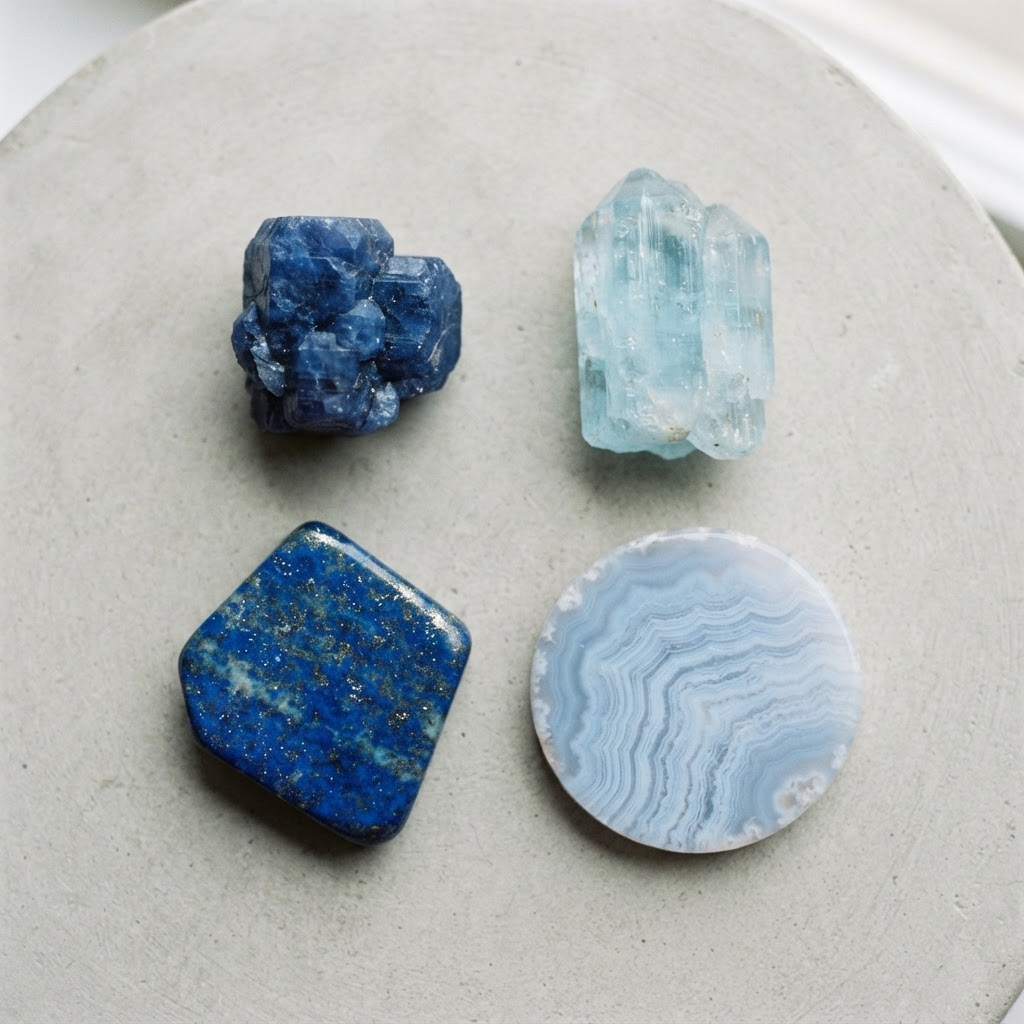
The First Split Is Opaque or Translucent
Blue stones divide more cleanly than any other colour, and the dividing line is whether light passes through. The translucent blues are almost all hard silicates and oxides. The opaque blues are rocks and soft carbonates, and they behave completely differently.
Hold the stone against a window. If light comes through, you are looking at sapphire, topaz, aquamarine, blue lace agate or blue quartz. If it does not, you are looking at lapis lazuli, sodalite, azurite, turquoise or blue calcite, and those five have almost nothing in common with the first group.
That single observation removes half the candidates before you have done anything else.
The Translucent Blues
Sapphire is corundum at hardness 9, and it is the hardest common blue stone. It is doubly refractive, has no cleavage, and has a specific gravity around 4.0. It is also strongly pleochroic, so a blue sapphire looks distinctly greener or more violet from different angles.
Blue topaz is hardness 8 and noticeably lighter at 3.5 specific gravity. It has perfect basal cleavage, which means it splits on one flat plane and is a poor choice for a ring. Much commercial blue topaz is colourless topaz that has been irradiated and heated, which is a normal and accepted treatment.
Aquamarine is blue beryl at hardness 7.5 to 8, and it is almost always paler and slightly greenish compared with sapphire or topaz. It has no cleavage and a specific gravity of 2.7, making it much lighter than either.
Blue lace agate is banded pale blue chalcedony at hardness 6.5 to 7, translucent and waxy, with delicate white lacy banding. It is a rock material rather than a single crystal, so it never shows facet edges.
The Opaque Blues
Lapis lazuli is not a mineral, it is a rock. It is a mixture of lazurite with calcite and pyrite, and the pyrite is what gives it the golden flecks that make it instantly recognisable. Hardness 5 to 6, opaque, and usually a deep saturated blue. The best material has a uniform blue with minimal calcite and a scattering of pyrite.
Sodalite is a feldspathoid at hardness 5.5 to 6, usually a more muted blue with white veining, and it is often fluorescent orange under ultraviolet light, which is a neat way to tell it from lapis. It also usually lacks pyrite.
Azurite is copper carbonate at hardness 3.5 to 4 with a striking deep blue and a blue streak — one of the few minerals that streaks in its own colour. It fizzes in dilute acid and slowly alters to green malachite, so you often find the two together.
Turquoise is a hydrated copper aluminium phosphate at hardness 5 to 6, opaque, waxy, and blue-green to sky blue. It is much softer than it looks and is easily damaged by acids and cosmetics.
Blue calcite is hardness 3, so a copper coin scratches it, and it fizzes in vinegar. It splits on flat rhombohedral planes and is often a soft, pale blue.
Blue vs Its Lookalikes
Nine stones cover almost every blue specimen an amateur will pick up.
| Stone | Hardness | Translucency | How to tell it |
|---|---|---|---|
| Sapphire | 9 | Translucent | Hardest common blue stone. Strongly pleochroic and heavy at specific gravity 4.0. |
| Blue topaz | 8 | Translucent | Perfect basal cleavage, so it splits on one flat plane. Lighter than sapphire at 3.5. |
| Aquamarine | 7.5–8 | Translucent | Paler and slightly greenish. No cleavage and light at 2.7 specific gravity. |
| Blue lace agate | 6.5–7 | Translucent | Banded pale blue chalcedony with white lace patterns. Waxy and never faceted. |
| Lapis lazuli | 5–6 | Opaque | A rock, not a mineral. Deep blue with golden pyrite flecks and white calcite patches. |
| Sodalite | 5.5–6 | Opaque | Muted blue with white veining. Often fluorescent orange under UV, and no pyrite. |
| Azurite | 3.5–4 | Opaque | Deep blue with a blue streak. Fizzes in acid and alters to green malachite. |
| Turquoise | 5–6 | Opaque | Waxy blue-green to sky blue. Soft and easily damaged by acids and cosmetics. |
| Blue calcite | 3 | Opaque | Scratched by a coin. Fizzes in vinegar and splits on flat rhombohedral planes. |
Where Blue Stones Come From
Australian sapphire comes from the central Queensland gemfields around Rubyvale and Sapphire, and from the New England region around Inverell and Glen Innes in New South Wales. These are among the world’s significant sapphire sources, and the material is typically a deep, dark blue, often described as ink-blue.
Worldwide, the classic sapphire sources are Sri Lanka, Myanmar, Kashmir and Madagascar. Aquamarine comes from Brazil, Pakistan, Madagascar and Namibia. Blue topaz comes from Brazil, Nigeria and Sri Lanka.
Lapis lazuli has been mined in Afghanistan for thousands of years, at Sar-e-Sang in Badakhshan, and that material is still considered the finest. Chile and Russia also produce it. Turquoise comes from Iran, the southwestern United States and Egypt, and azurite occurs in copper deposits worldwide, including at Broken Hill and Burra in Australia.
Buying a Blue Stone
Two warnings are worth carrying into any purchase. The first is dyed material: blue lace agate, sodalite and low-grade lapis are all commonly dyed, and dye shows up as colour concentrated in cracks. The second is that the word sapphire is used loosely in jewellery for any blue stone, so ask for the species rather than the trade name.
If a stone is translucent, hard and expensive, get a refractometer reading. It takes a jeweller two minutes and it separates sapphire from topaz, aquamarine and spinel without guesswork.
For the red side of the same mineral, see rough ruby identifier, and precious stone identification covers sapphire alongside the other classic stones.
The Bottom Line
Split by translucency first. Then test hardness: below 3.5 means azurite or blue calcite, 5 to 6 means lapis, sodalite or turquoise, 7 to 8 means aquamarine or topaz, and 9 means sapphire.
Check the streak on the opaque ones. Azurite streaks blue, which almost nothing else does. And look for pyrite flecks: they mean lapis lazuli and nothing else in this group.
If you are working from a photo rather than a stone, rock identification by photo explains what the camera can and cannot resolve, and beach gemstones identification covers what to look for on a shoreline.
Frequently Asked Questions
Split by translucency first. Translucent blues are sapphire, topaz, aquamarine or blue lace agate. Opaque blues are lapis lazuli, sodalite, azurite, turquoise or blue calcite. Then test hardness to separate them.