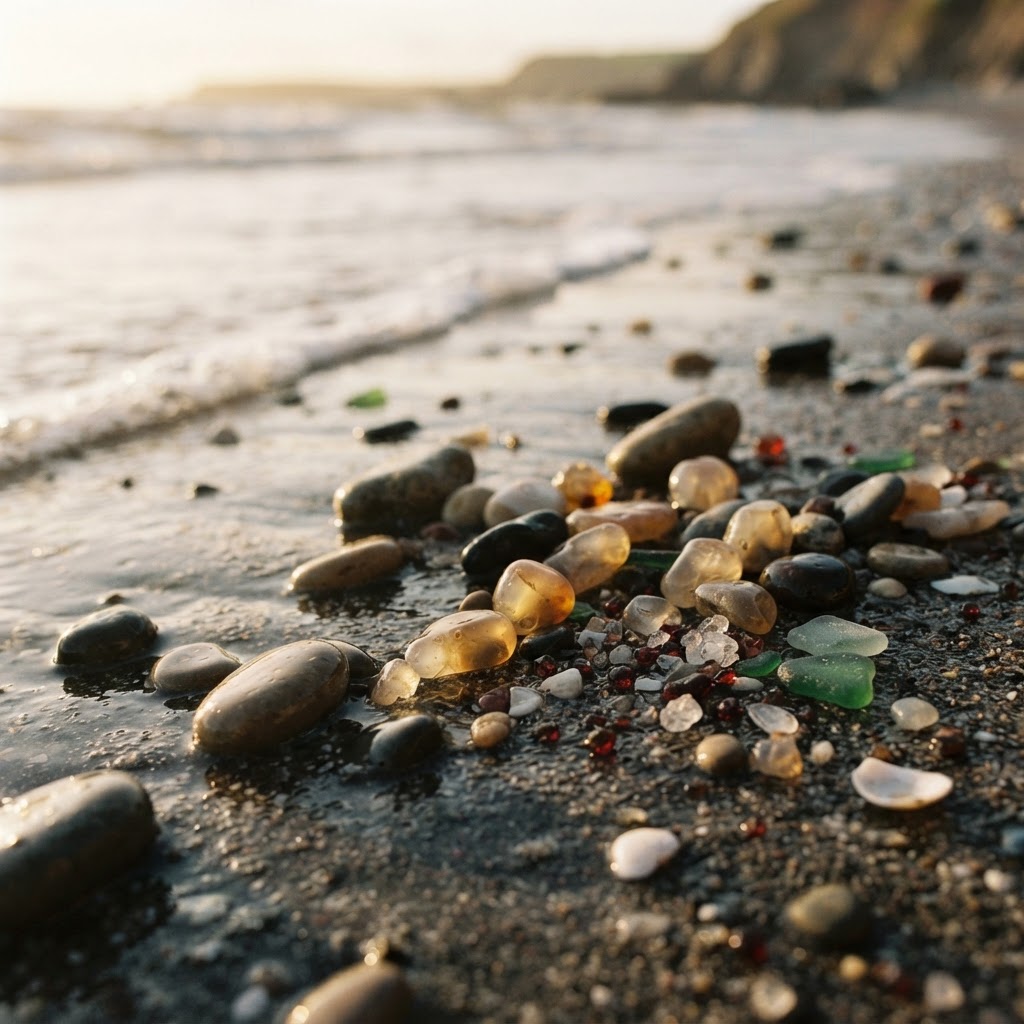
The Beach Sorts Stones for You
A beach is a sorting machine. Every wave lifts the sand, the pebbles and the gravel and drops them in order of size and weight. That is why the coarse material ends up in one band and the fine sand in another, and it is the single most useful thing a beachcomber can know.
The stones worth picking up are almost never in the dry sand. They sit in the gravel band just above the high tide line, or in the darker strip of heavier material left behind after a storm. Walk the line where the small pebbles start, not the middle of the beach.
Why Wet Stones Look Better Than Dry Ones
Every beachcomber has had the experience of picking up a glowing, richly coloured stone and finding it dull and grey by the time they get home. Nothing has changed except the water.
A wet surface fills the tiny pores and scratches on a stone and stops light scattering off them, so more light passes into the material and comes back coloured. The same stone dry scatters light at the surface instead. If you are assessing a find, either keep it wet or accept that you are looking at a version of the stone that is genuinely less colourful than it will look polished.
The Beach Finds You Are Most Likely Holding
These eight account for the overwhelming majority of interesting stones found on a beach.
| Find | Hardness | How to tell it |
|---|---|---|
| Agate | 6.5–7 | Translucent chalcedony, often banded or with a waxy glow when wet. Light passes through the edges. |
| Jasper | 6.5–7 | Opaque chalcedony, solid red, yellow, brown or green. Hard and waxy, no light through it. |
| Sea glass | 5–5.5 | Frosted, rounded shard with no crystal structure. Softer than quartz and often flawless inside. |
| Garnet | 7–7.5 | Tiny deep red to purple grains in the heavy dark sand. Gemmy and glassy under a loupe. |
| Peridot | 6.5–7 | Pale olive-green grains, often in black volcanic sand. Glassy, never banded. |
| Amber | 2–2.5 | Warm honey-brown, very light, warm to the touch. Floats in very salty water. |
| Chert or flint | 6.5–7 | Dull grey to black, breaks with a curved fracture and a pale edge. Common in chalk areas. |
| Quartz pebble | 7 | Milky white or clear, glassy, translucent. Usually rounded and frosted. |
Agate and Jasper: The Two You Will Find Most
Agate and jasper are the same mineral — microcrystalline quartz, or chalcedony — separated only by whether light passes through. Agate is translucent and often banded. Jasper is opaque. Both are hardness 6.5 to 7, both feel waxy rather than glassy, and both survive wave action far better than most rocks, which is exactly why they are so common on shingle beaches.
Hold a candidate up against the sky. If light glows through the thinner edges, you have agate. If it stays solid and dark, it is jasper. Banding, if present, confirms it either way. Our rough agate identification guide goes through the field signs in more detail.
Sea Glass Is Not a Gemstone
Sea glass is the most collected beach find in the world and it is not a mineral at all. It is broken glass — bottles, windows, jars — that has been tumbled by the sea long enough for the sharp edges to round off and the surface to frost over.
You can tell it from a genuine gemstone in two ways. First, hardness: glass sits at about 5 to 5.5, so a quartz pebble at 7 will scratch it. Second, structure: sea glass is completely uniform inside, with no grain, no crystal faces and often no internal flaws at all, where a natural stone of the same colour almost always has some texture or inclusion. Hold it up to a bright light and look for the tiny bubbles that betray glass.
Peridot and Garnet: The Gem Grains
Two gemstones turn up as individual grains rather than pebbles, and both are worth looking for in the dark heavy sand that concentrates at the top of the beach.
Peridot is the gem variety of olivine, a mineral that makes up much of the Earth’s upper mantle. It reaches the surface in basalt, and on a handful of beaches — Papakōlea in Hawaii is the famous one — the erosion of that basalt has produced entire green sand beaches. The grains are pale olive-green, glassy and hardness 6.5 to 7.
Garnet arrives from the opposite direction. It forms in metamorphic rocks, and as those rocks erode, the garnet survives as small, hard, deep red crystals. At hardness 7 to 7.5 they outlast almost everything around them and gradually collect in the heaviest fraction of the sand. A loupe makes them obvious: they are the only grains that look like cut stones.
Reading the Tide Line
Storm beaches are the best beaches. A big swell strips sand off the shore and dumps the coarse material it has been carrying, so the day or two after heavy weather is when new gravel appears.
Work the line where the pebbles change size, and look for the darkest strip of sand — that is where the dense minerals have settled. Turn stones over rather than scanning them from above; agate in particular hides its best face on the underside. And go early. The best material is usually picked over within a day on a popular beach.
The Bottom Line
Beach gemstones are identified by translucency first and hardness second. Light through the edge means agate or quartz. Solid and waxy means jasper. Frosted and uniform means sea glass. Tiny glassy red or green grains in heavy sand mean garnet or peridot.
If you want to check a find properly, tumbled stones identifier covers polished and wave-worn material, and gemstone identification app explains what a photo can and cannot settle.
Frequently Asked Questions
Agate, jasper, chert and quartz pebbles are by far the most common. Garnet and peridot turn up as small grains in heavy dark sand, and amber washes up on some coasts after storms. Sea glass is common but is not a gemstone.