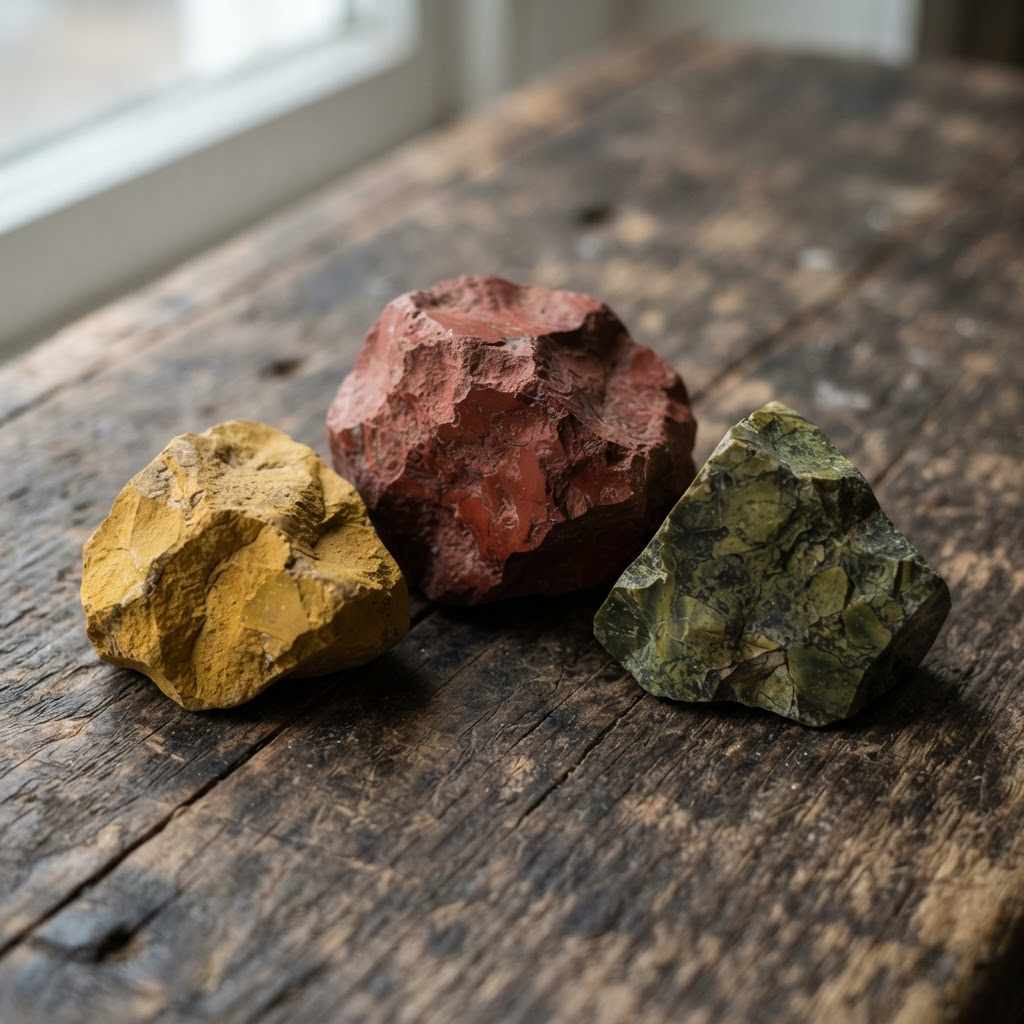
What Jasper Is
Jasper is opaque chalcedony, which means it is quartz in its microcrystalline form. The crystals are far too small to see, packed tightly together, which is why jasper breaks with a smooth curved surface instead of showing grains.
The difference between jasper and agate is not chemistry. They are the same material. Agate is translucent and usually banded; jasper is opaque. That single word — opaque — is the whole distinction, and it is the first thing to check on a rough specimen.
Because jasper is quartz, it is hard. Hardness 6.5 to 7, so a knife will not mark it and it will scratch glass. That hardness is what lets jasper survive in river gravel and on beaches long after the rock it came from has broken down.
The Surface and the Streak
Rough jasper almost never looks like the polished material in a shop. Freshly broken it is dull to waxy, with a matte surface that soaks up light rather than reflecting it. Weathered surfaces are duller still, often with a pale rind.
The lustre is the giveaway. Hold the stone at an angle to a window. Jasper has a waxy or greasy sheen, quite unlike the glassy flash of a quartz crystal and completely unlike the metallic shine of a sulphide. A hard, waxy, opaque surface with a curved fracture is chalcedony territory.
The streak is white, which confirms it is a silicate rather than an iron oxide. Rub the specimen across the unglazed back of a tile and you get a white or colourless powder, even from a deep red or black jasper. That is a useful check, because a black jasper and a piece of hematite look similar until you test them.
Jasper Against Agate
Hold the stone up against a bright sky or a torch. Agate lets light through, at least at the edges, and often shows banding, lace or mossy patterns in the translucent parts. Jasper blocks it completely. A stone that is opaque in the middle but glows around the rim is a jasper-agate transition, which is common and perfectly normal.
This matters practically because the two names carry different values in the lapidary market. If you are collecting for tumbling or cabbing, translucent material with pattern is worth keeping separate from the opaque.
Jasper Against Chert, Sandstone and Ironstone
The lookalikes on a riverbank are mostly about texture and streak, not colour.
| Material | Hardness | How to tell it from jasper |
|---|---|---|
| Chert | 6.5–7 | The same material, formed as nodules in limestone. Duller, greyer and less colourful. The line between chert and jasper is convention, not chemistry. |
| Sandstone | 6–7 | Gritty. You can feel individual grains with a fingernail and it crumbles at the edges. Jasper is smooth and breaks with a clean curved surface. |
| Ironstone | 4–6 | Heavier, and leaves a red-brown or yellow-brown streak rather than white. Often earthy and porous. |
| Obsidian | 5–5.5 | Volcanic glass. Glossy and uniform inside, with a glassy rather than waxy lustre. Softer than jasper. |
| Granite | 6–7 | Coarse interlocking crystals you can see individually. Jasper has no visible grain at all. |
| Hematite | 5–6.5 | Metallic and much heavier, with a red-brown streak. A black jasper leaves white. |
Named Jaspers and Where They Come From
Jasper comes in an enormous range of colours, and the names usually describe the pattern rather than the geology. Red and yellow jaspers get their colour from iron oxides. Picture jasper shows landscape-like banding from layered sediment. Brecciated jasper is broken fragments cemented back together by more silica. Orbicular jasper, often sold as ocean jasper, has circular spots.
One name is worth flagging. Dalmatian stone, or dalmatian jasper, is not chalcedony at all. It is a quartz and feldspar rock with black spots of a sodium amphibole, and it is softer and more porous than real jasper. The name is a marketing convention that has stuck.
Australia has excellent jasper. Mookaite, from the Mooka Creek area of Western Australia, is a distinctive red, yellow and cream jasper prized by lapidary workers. Agate Creek in north Queensland produces jasper alongside its agate and carnelian, and jasper is common in the Pilbara and in gravels across the eastern states.
Elsewhere, the classic sources are India, Brazil, Madagascar, South Africa and the western United States, where picture jasper from Oregon and Idaho is well known.
Working a Rough Specimen
Jasper is one of the friendliest stones for a beginner lapidary, because it is hard, tough and has no cleavage, so it will not split on you. The main hazard is that many jaspers contain fine fractures, which show up as pale lines across the surface. Hold the stone up to a light before you commit to cutting it.
Iron-stained jasper can be cleaned, but be careful with acid on anything you intend to keep. A soak in warm soapy water and a soft brush removes dirt without risk. Oxalic acid will lift some iron staining, but it is a controlled substance in many places and it will damage your skin and eyes if you are careless with it.
If you are identifying rather than working, our rough agate identification guide covers the translucent side of the same family, and beach gemstones identification covers what to look for on a shoreline.
The Bottom Line
Jasper is opaque microcrystalline quartz at hardness 6.5 to 7, with a waxy or dull surface, a white streak and a curved fracture. It is hard enough to scratch glass and light enough to feel ordinary in the hand.
Check translucency first: if light passes through, you have agate. Check the streak second: white means silicate, red-brown means iron oxide. Check the texture third: visible grains mean sandstone, and a glassy uniform interior means obsidian.
If you want the surface read by a camera before you commit, rock identification by photo explains which shots carry the most information, and mineral identifier covers the streak and hardness method in full.
Frequently Asked Questions
Check translucency, streak and lustre. Jasper is opaque, leaves a white streak, and has a waxy or dull surface with a curved fracture. It is hardness 6.5 to 7, so a knife will not mark it.