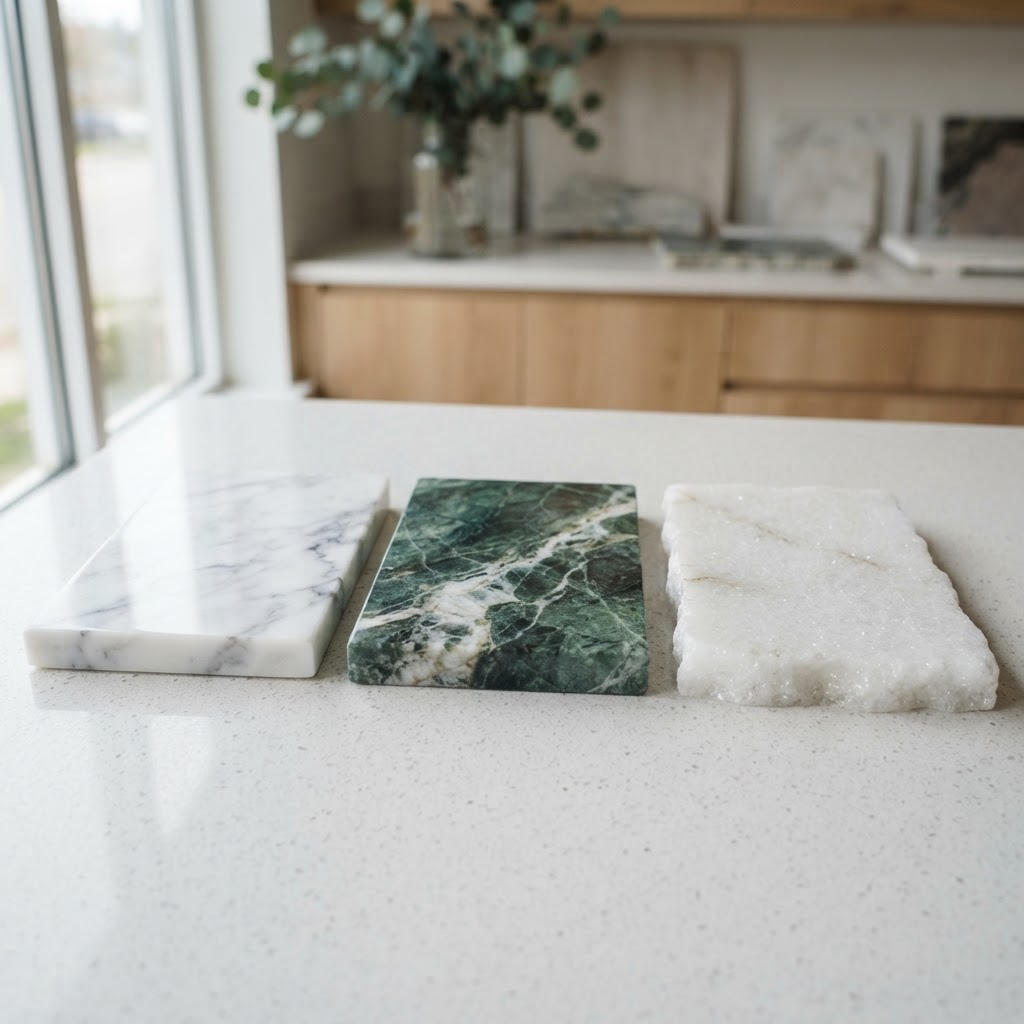
What Marble Is
Marble is metamorphosed limestone or dolomite. Bury a limestone deep enough and heat it enough, and the calcite recrystallises into a mosaic of interlocking grains. The chemistry barely changes; the texture changes completely.
That is the key to identifying it. Marble is still calcium carbonate, so it still fizzes in dilute acid exactly as limestone does. What has gone is the sedimentary structure. Fossils are destroyed, bedding is obliterated, and what is left is a uniform, sugary, crystalline rock.
Hardness is 3 to 4, because the mineral is calcite. That is soft. Marble scratches easily, which is why it stains and etches in kitchens despite being a premium surface material.
The Two Tests That Settle It
Acid first. A drop of dilute hydrochloric acid on marble produces vigorous fizzing, the same as on limestone. Vinegar works too, more slowly. If your rock does not fizz, it is not marble, and the entire silicate world — quartzite, granite, sandstone — is ruled out.
Hardness second, and this is the one that separates marble from the rock it is most often confused with. Quartzite looks very similar, but it is a metamorphosed sandstone made of quartz at hardness 7. Quartz scratches marble without effort. Marble does not scratch quartz, and it does not scratch glass.
Put those two together and you have a decisive pair of tests: fizzes in acid, scratches easily. Only a carbonate can do both.
Marble vs Its Lookalikes
Four rocks are regularly mistaken for marble, and the acid test settles three of them.
| Rock | Hardness | How to tell it from marble |
|---|---|---|
| Quartzite | 7 | Does not fizz in acid. Much harder, and it will scratch glass and marble both. Also breaks across fused grains rather than into a calcite mosaic. |
| Limestone | 3–4 | Sedimentary, so it retains bedding and often fossils. Same hardness and same vigorous fizz, so use the structure rather than the acid. |
| Dolomitic marble | 3.5–4 | Fizzes only weakly in cold dilute acid. Scratch or powder the surface and it reacts readily. Often more buff or grey-brown. |
| Granite | 6–7 | Does not fizz, and much harder. Interlocking crystals of several minerals — feldspar, quartz, mica — rather than a single-mineral mosaic. |
Why Marble Looks the Way It Does
Pure marble is white, because pure calcite is white. The colours and veins come from impurities that were in the original limestone and were redistributed during metamorphism.
Grey and black veining usually comes from graphite, carbon or iron-bearing minerals concentrated along the flow paths the rock took while it was being deformed. Green comes from serpentine, chlorite or talc. Pink and red come from iron oxides. Yellow and cream come from limonite.
Those veins often follow the direction the rock was squeezed, which is why marble has a directional, banded appearance that limestone usually does not. It is a metamorphic fabric rather than a sedimentary one.
Where Marble Comes From
Carrara in Tuscany is the most famous marble in the world, quarried since Roman times and the source of Michelangelo’s material. Vermont in the United States, Greece, Turkey, India and China are all major producers, and the variety of colours and patterns available commercially is enormous.
Australia has marble in several places. The Chillagoe area in Queensland has marble, and there is marble in New South Wales and Tasmania. Most Australian commercial marble, however, is imported.
One caution about Australian place names: Marble Bar in Western Australia is not named for marble at all. It was named in the 1890s for a bar of jasper that crosses the Coongan River. It is a good reminder that a name is not evidence.
Using and Caring for Marble
Marble has been a sculpture and building material for millennia because it is soft enough to carve, translucent enough to glow in thin sections, and available in large sound blocks.
In a kitchen or bathroom, though, its softness is a genuine limitation. Acids etch the surface — lemon juice, vinegar, wine and many cleaning products will all dull a polished marble finish permanently. It also stains, because calcite is porous and absorbs oils and pigments.
If you are testing a surface you care about, do not use acid on it. Test an offcut, or use a scratch test in an inconspicuous corner.
The Bottom Line
Marble is recrystallised limestone or dolomite: a sugary, interlocking mosaic of calcite, hardness 3 to 4, with no fossils and no bedding, which fizzes vigorously in dilute acid and scratches easily.
Quartzite looks like marble but does not fizz and is much harder. Limestone fizzes but retains bedding and fossils. Dolomitic marble fizzes weakly unless powdered. Granite does not fizz and is much harder.
For the sedimentary parent, see limestone identifier. Sandstone identifier covers the rock that becomes quartzite, granite identifier covers the other common polished stone, and mineral identifier explains the acid and hardness tests in full.
Frequently Asked Questions
Two tests. It fizzes vigorously in dilute acid because it is calcium carbonate, and it scratches easily because it is hardness 3 to 4. It should also show a sugary, interlocking crystalline texture with no fossils and no bedding.