What Limestone Is
Limestone is a sedimentary rock made mostly of calcium carbonate, and most of that calcium carbonate started life inside a living thing. Shells, coral skeletons, the microscopic plates of plankton — all of it is calcium carbonate, and when those materials accumulate on a sea floor and get buried and cemented, they become limestone.
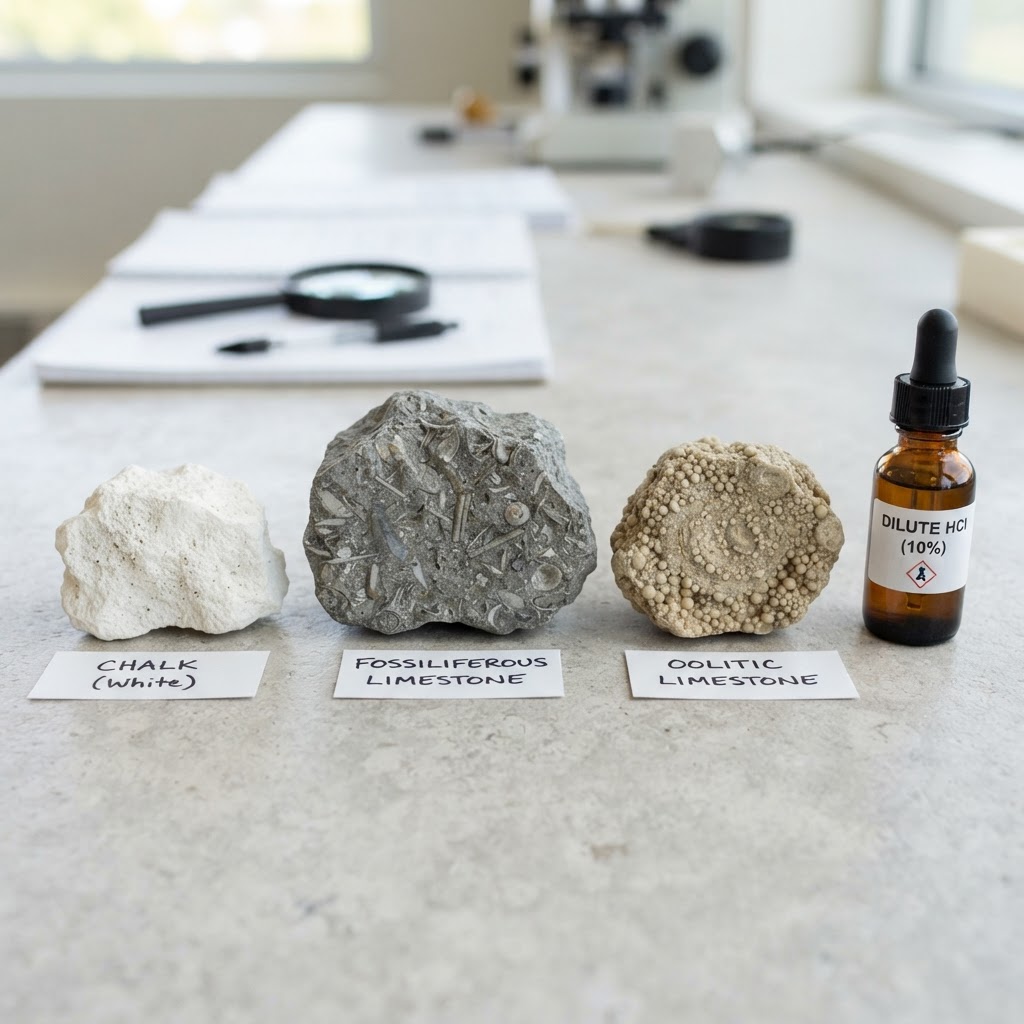
Some limestone forms chemically instead, precipitating directly from warm, carbonate-saturated water. Oolitic limestone is the best-known example: it is made of tiny concentric spheres called ooids, each one built up layer by layer as it rolled around on a shallow sea floor.
Hardness is 3 to 4, because the main mineral is calcite. That is soft — a copper coin will scratch it and so will a knife, easily.
The Acid Test
This is the test that identifies limestone more decisively than anything else in geology. Put a drop of dilute hydrochloric acid on the rock and it fizzes vigorously, sometimes almost violently, as carbon dioxide is released.
You do not need laboratory acid. Household vinegar works, just more slowly and with smaller bubbles. On a piece of chalk or a shell-rich limestone, vinegar will produce visible fizzing within a few seconds.
The test is decisive in both directions. If it fizzes, you are looking at a carbonate. If it does not, you are not, and the whole family of siliceous rocks — sandstone, chert, granite, basalt — is ruled out in one go.
One important caveat: dolomite, the magnesium carbonate, also fizzes, but only weakly and sometimes not at all in the cold dilute acid you are using. The standard trick is to scratch or powder the surface first. Dolomite powder fizzes readily; solid dolomite barely reacts. That is how geologists separate limestone from dolostone in the field.
What Else to Look At
Look for fossils. Limestone is the best fossil-hunting rock there is, because calcium carbonate preserves shell and coral material beautifully. Crinoid stems, brachiopods, corals, ammonites and shell fragments are all common, and a rock full of them is limestone with near certainty.
Look at the texture. Chalk is soft, white and powdery, made of microscopic plankton plates. Coquina is a mass of visible shell fragments cemented together. Oolitic limestone shows tiny uniform spheres, like fish roe. Crystalline limestone has a sugary, interlocking look.
Look at the colour and the bedding. Limestone is usually pale — white, cream, grey, buff — though it can be dark where it contains organic matter. Bedding planes, flint nodules and solution features such as fluted surfaces are all common in limestone country.
Limestone vs Its Lookalikes
Five rocks get mistaken for limestone, and the acid test settles most of them.
| Rock | Hardness | How to tell it from limestone |
|---|---|---|
| Dolomite (dolostone) | 3.5–4 | Fizzes only weakly in cold dilute acid. Scratch or powder the surface and it fizzes readily. Slightly harder and often more buff or grey-brown. |
| Marble | 3–4 | Metamorphic, so it is recrystallised: a sugary interlocking mosaic with no fossils and no bedding. It fizzes just as vigorously as limestone. |
| Sandstone | 6–7 | Gritty, with visible sand grains, and it does not fizz. Harder than limestone by a long way. |
| Chert | 6.5–7 | Much harder, does not fizz, and breaks with a smooth curved fracture. Often occurs as nodules within limestone. |
| Chalk | 1–2 | A variety of limestone rather than a lookalike, but much softer and finer. It writes on a board and crumbles easily. |
Limestone Country and What It Does
Limestone dissolves in weakly acidic rainwater, which is why limestone country looks different from everything around it. Caves, sinkholes, underground rivers, fluted rock pavements and dry valleys are all part of what geologists call karst.
In Australia, the Nullarbor Plain is an enormous limestone plateau, and the name literally means treeless, because water sinks straight through the rock and there is nothing to support trees. The Naracoorte Caves in South Australia and the Jenolan Caves in New South Wales are both in limestone, and the limestone coast of South Australia and the Chillagoe area in Queensland are well known.
Elsewhere, the White Cliffs of Dover, the karst of Croatia and Slovenia, the Yucatán Peninsula and the limestone plateaus of southern China are all classic limestone landscapes.
Limestone is also economically important. It is the raw material for cement and lime, it is used as a flux in steelmaking, it is crushed for road base and agricultural lime, and it is cut as dimension stone for building. Many of the world’s older public buildings are limestone.
Field Method
If you want a reliable answer in the field, carry three things: a small bottle of dilute acid or vinegar, a copper coin, and a hand lens.
Test the acid first. If it fizzes vigorously, you have a carbonate and you can move on to the dolomite check — scratch the surface and test again. If the fresh surface fizzes strongly, it is limestone. If it only fizzes after scratching, it is dolomite.
Then look for fossils and bedding with the lens. Fossils and bedding mean sedimentary, which means limestone. A sugary mosaic with no fossils means metamorphic, which means marble.
The Bottom Line
Limestone is calcium carbonate at hardness 3 to 4 that fizzes vigorously in dilute acid. It often contains fossils, and it is usually pale and bedded.
Dolomite fizzes weakly unless you powder it. Marble is the metamorphic version with no fossils or bedding. Sandstone is harder and gritty. Chert is much harder and does not fizz.
For the metamorphic version, see marble identifier. Sandstone identifier covers the other great sedimentary rock, chert vs flint identification explains the nodules inside limestone, and rocks with holes identification covers the solution features that give limestone country its look.
Frequently Asked Questions
The acid test. Dilute hydrochloric acid, or vinegar, produces vigorous fizzing on limestone as carbon dioxide is released. It is also soft at hardness 3 to 4, and it often contains fossils and shows bedding.