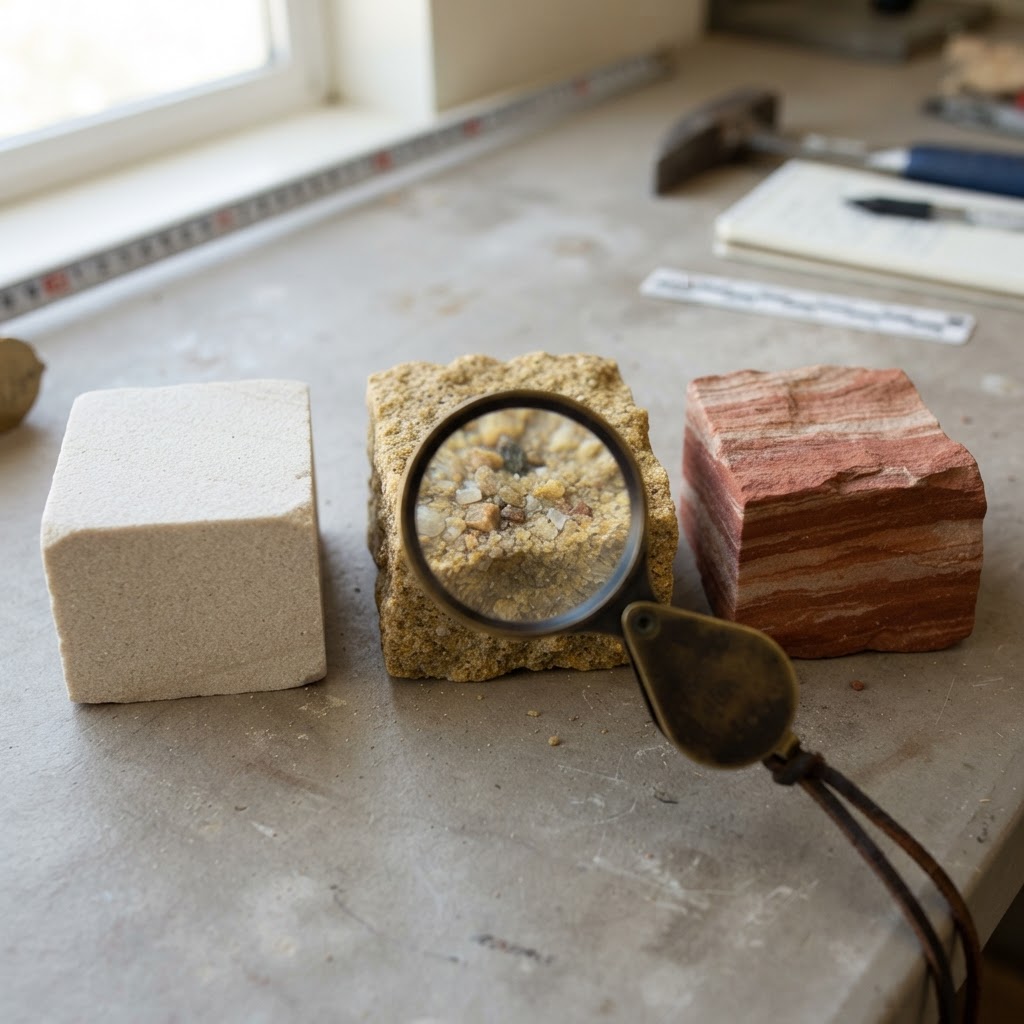
What Sandstone Is
Sandstone is a sedimentary rock made of sand-sized grains cemented together. The grains are usually quartz, because quartz survives weathering better than almost anything else, but they can also include feldspar, mica, rock fragments and heavy minerals.
The grain size range that defines sand is 0.06 to 2 millimetres. Anything finer is silt or clay, and anything coarser is a granule or pebble. That range is the definition, and it is why sandstone feels gritty rather than smooth or powdery.
The cement between the grains can be silica, calcite, iron oxide or clay. Which cement is present matters, because it controls the colour and much of the hardness. Silica-cemented sandstone is tough and hard; clay-cemented sandstone crumbles.
The Grit Test
Rub the rock against your fingers, or scratch it with a fingernail. Sandstone feels like sandpaper. You can feel the individual grains, and if you rub hard enough, grains will come loose and leave grit on your skin.
That gritty feel is the fastest field test there is, and it separates sandstone from every fine-grained rock at once. Limestone feels smooth or powdery. Shale feels smooth and often slightly greasy. Chert feels smooth and waxy. Only sandstone and a few coarse igneous rocks feel gritty.
A hand lens makes it decisive. Under magnification you can see the individual rounded or angular grains and, often, the cement between them.
Reading Grain Size
Grain size tells you how far the sediment travelled and how energetic the water was. Geologists use the Wentworth scale, and the sandstone divisions are straightforward.
| Grade | Grain size | What it tells you |
|---|---|---|
| Very fine sandstone | 0.06–0.125 mm | Grains feel smooth rather than gritty. Deposited in quiet water. |
| Fine sandstone | 0.125–0.25 mm | Lightly gritty, and you can just feel the grains. Low-energy environments. |
| Medium sandstone | 0.25–0.5 mm | Distinctly gritty. The most common grade, deposited by moderate currents. |
| Coarse sandstone | 0.5–1 mm | Clearly gritty and you can see grains with the naked eye. Strong currents or beach settings. |
| Very coarse sandstone | 1–2 mm | Grains are obvious and it is nearly a conglomerate. High-energy deposition. |
Sorting, Rounding and What They Mean
Two more things are worth reading in a sandstone. Sorting describes how uniform the grains are. A well-sorted sandstone has grains all the same size, which usually means the sediment was transported a long way by wind or water and the different sizes were separated out. A poorly sorted sandstone has a mix of sizes, which means a short transport distance or a rapid deposit.
Rounding describes the shape of the grains. Angular grains are young and have not been battered much. Well-rounded grains have been rolled around for a long time and are typical of beach and desert sands.
Put together, sorting and rounding tell you a lot about where the sand came from and how it got there. A well-sorted, well-rounded sandstone is likely to be a beach or dune deposit from a long-lived system. A poorly sorted, angular sandstone came from somewhere close by and was buried fast.
Sandstone vs Its Lookalikes
Five rocks get confused with sandstone, and two of them are metamorphic versions of it.
| Rock | Hardness | How to tell it from sandstone |
|---|---|---|
| Quartzite | 7 | Metamorphosed sandstone. The grains are fused together so it breaks across them rather than around them, giving a sugary surface with no loose grit. Much harder. |
| Granite | 6–7 | Igneous, with interlocking crystals in all directions rather than cemented grains. The crystals are not sand grains, and there is no cement between them. |
| Greywacke | 6–7 | A poorly sorted sandstone with a muddy matrix. Darker, dirtier and more mixed than a clean sandstone, and the grains are held in a fine mud rather than a mineral cement. |
| Limestone | 3–4 | Smooth or powdery rather than gritty, much softer, and it fizzes vigorously in dilute acid. |
| Siltstone | 4–6 | Finer than sand, so it feels smooth and slightly soapy rather than gritty. Individual grains are not visible even with a lens. |
Colour Comes From the Cement
Sandstone colour is usually the cement talking, not the grains. Quartz grains are pale, so a clean quartz sandstone is white, cream or light grey.
Red and brown come from iron oxide — hematite and goethite — coating the grains or filling the pore space. This is why so much sandstone in arid country is red, and why the colour can vary in bands that follow the original bedding.
Yellow is usually limonite, a hydrated iron oxide. Green can come from glauconite, a mineral that forms on the sea floor. Black and dark grey usually mean organic matter or a clay content, and very dark sandstone is often greywacke.
Where Sandstone Is Found
Sandstone forms wherever sand accumulates and is buried: river channels, deltas, beaches, dunes, shallow seas and deserts. It is one of the most widespread sedimentary rocks there is.
Australia has spectacular sandstone. The Hawkesbury Sandstone of the Sydney Basin is the rock under Sydney and the source of the city’s characteristic golden sandstone buildings. The Blue Mountains, the Grampians in Victoria, the Kimberley and Katherine Gorge in the Northern Territory are all sandstone country.
Uluru is the famous one, and it is worth being precise: Uluru is an arkose, which is a sandstone with a high feldspar content rather than almost pure quartz. It is still a sandstone, and it is still a sedimentary rock, but the feldspar content is why it is often described separately.
Sandstone is also a major building stone and a significant reservoir rock for groundwater and for oil and gas, because the pore spaces between grains can hold fluids.
The Bottom Line
Sandstone is a sedimentary rock of cemented sand grains, gritty to the touch, with grains between 0.06 and 2 millimetres and visible under a lens. Hardness depends on the cement, from soft and crumbly to quartz-hard.
Quartzite is the metamorphic version with fused grains. Granite has interlocking crystals, not grains. Greywacke is dirtier and poorly sorted. Limestone fizzes and is much softer.
For the metamorphic version, see marble identifier. Limestone identifier covers the other great sedimentary rock, petrified wood identifier explains how wood gets preserved in sandstone country, and rocks with holes identification covers the tafoni and root casts you find in sandstone.
Frequently Asked Questions
It feels gritty, like sandpaper, and you can see or feel individual sand grains. The grains are between 0.06 and 2 millimetres, it does not fizz in acid, and a hand lens shows the grains and the cement between them.