Holes Are Evidence, Not Decoration
A hole in a rock is a record of something. Something was there and is not any more, or something pushed the rock aside while it was still soft. Working out which of those happened is the whole exercise.
There are really only a handful of mechanisms, and each leaves a different signature: the shape of the hole, the smoothness of its walls, whether it is lined, whether it is paired, and what kind of rock it is in.
Once you know the rock type, you have usually halved the possibilities before you look at the holes at all.
Gas Bubbles in Lava
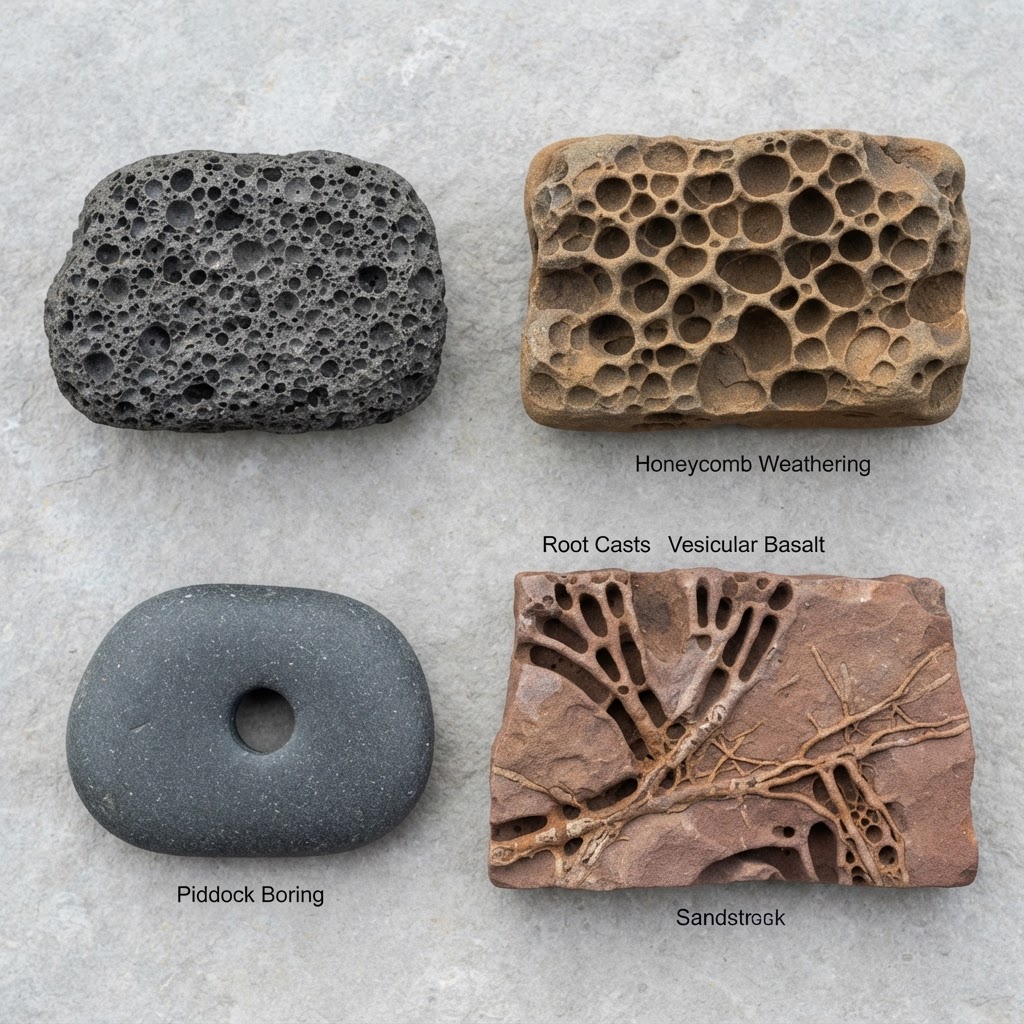
The most common holes in a hard rock are vesicles: gas bubbles trapped in lava as it cooled. They are round to oval, smooth-walled, and often clustered or stretched in one direction, following the way the lava flowed.
Basalt is the usual host, and heavily bubbled basalt is called vesicular basalt. If the bubbles are later filled with minerals — agate, quartz, zeolites, calcite — the fillings are called amygdales, and a basalt full of them is amygdaloidal.
The giveaway is the rock itself. Vesicles only occur in volcanic rock, so if your specimen is fine-grained and dark or grey with no visible crystals and no bedding, gas bubbles are the likely answer.
Pumice is the extreme version: so many vesicles that the rock floats.
Holes Made by Living Things
On beaches and soft sea cliffs, perfectly round holes are usually borings. Piddocks — a type of bivalve — grind into clay, shale and soft limestone and live inside the hole, leaving a smooth-walled, often flask-shaped boring, frequently in pairs or clusters.
Sponges, worms and other borers leave smaller, more irregular holes. Trace fossils such as Skolithos are vertical tubes in sandstone, packed so densely in some rock that it is called pipe rock.
The signature here is smooth, round, deliberate-looking holes in a rock that is softer than the borer. A hole that is too perfectly circular for weathering, especially a paired one, points to a boring.
Holes Made by Roots and by Dissolving
Root casts, or rhizoliths, form when a root grows through soft sediment and then decays, leaving a tube that is later filled or left open. They branch, they taper, and they often have a rough, root-textured lining rather than a smooth wall.
In limestone and other carbonate rocks, holes form by solution. Rainwater slightly acidified by carbon dioxide dissolves the rock away, and the result is pits, flutes, and eventually the cave systems of karst country.
Tafoni is the name for the honeycomb weathering you see on sandstone and granite sea cliffs and desert outcrops: dozens of rounded hollows of similar size, often with a lip or overhang. It is caused by salt crystallising inside the rock and by moisture cycling in and out, and it is a surface effect rather than a structural one.
Holes From Something Falling Out
Sometimes the hole is where a harder object used to be. A pebble weathering out of a conglomerate leaves a socket. A fossil shell dissolving out of limestone leaves a mould. A concretion that has fallen out of shale leaves a smooth, rounded hollow that fits it exactly.
This is the easiest type to recognise, because the hole and the missing object have matching shapes. If you find a loose pebble nearby that drops straight into the hollow, you have your answer.
Drill holes and blast holes are the human version, and they are worth ruling out on any rock near a quarry, road cutting or building site. Look for a uniform diameter, a straight bore, and tool scars around the rim.
Telling Them Apart
Match the host rock first, then read the shape of the hole.
| Hole type | Host rock | Signature |
|---|---|---|
| Gas vesicles | Basalt and other lava | Round to oval, smooth-walled, often clustered or flow-aligned. May be mineral-filled. |
| Piddock borings | Clay, shale, soft limestone | Near-perfect circles, smooth walls, often paired. Common on beaches. |
| Trace fossil tubes | Sandstone | Vertical or U-shaped tubes, sometimes densely packed, with a burrow lining. |
| Root casts | Sandstone, fossil soils | Branching, tapering tubes with rough, root-textured walls. |
| Solution pits | Limestone and dolomite | Irregular pits and flutes, often enlarged along cracks. |
| Tafoni | Sandstone, granite | Honeycomb hollows of similar size on exposed faces, often with overhanging lips. |
| Weathering sockets | Conglomerate, shale | Hollow matching the shape of a pebble or concretion that has fallen out. |
| Drill or blast holes | Any | Straight, uniform diameter, often with tool or wedge marks. |
Where to Look
Beach and sea-cliff country is the best place to see borings and tafoni together, and the Victorian and New South Wales coastlines have plenty of both. Basalt with gas bubbles is everywhere across the Newer Volcanics of western Victoria and the Atherton Tablelands in Queensland.
Limestone solution features are best developed in the Nullarbor and in the limestone country of New South Wales and Tasmania.
Always check whether collecting is allowed. Most coastal rock platforms and national parks prohibit removing material.
The Bottom Line
Identify the rock first, then read the hole. Vesicles only occur in lava, borings only in soft rock, and solution only in carbonate.
Smooth round paired holes on a beach mean a borer. Branching rough-walled tubes mean a root. Honeycomb hollows on a sea cliff mean tafoni. A hollow that matches a nearby pebble means the pebble fell out.
For the volcanic end of this, see black stone identification and granite identifier. Geode rock identification covers the mineral-filled version of a vesicle, and thunder egg identifier explains how those fillings form.
Frequently Asked Questions
Four main processes: gas bubbles trapped in cooling lava, borings made by living things such as piddock clams, dissolving by weak acid in limestone country, and weathering that removes a softer object and leaves a socket.