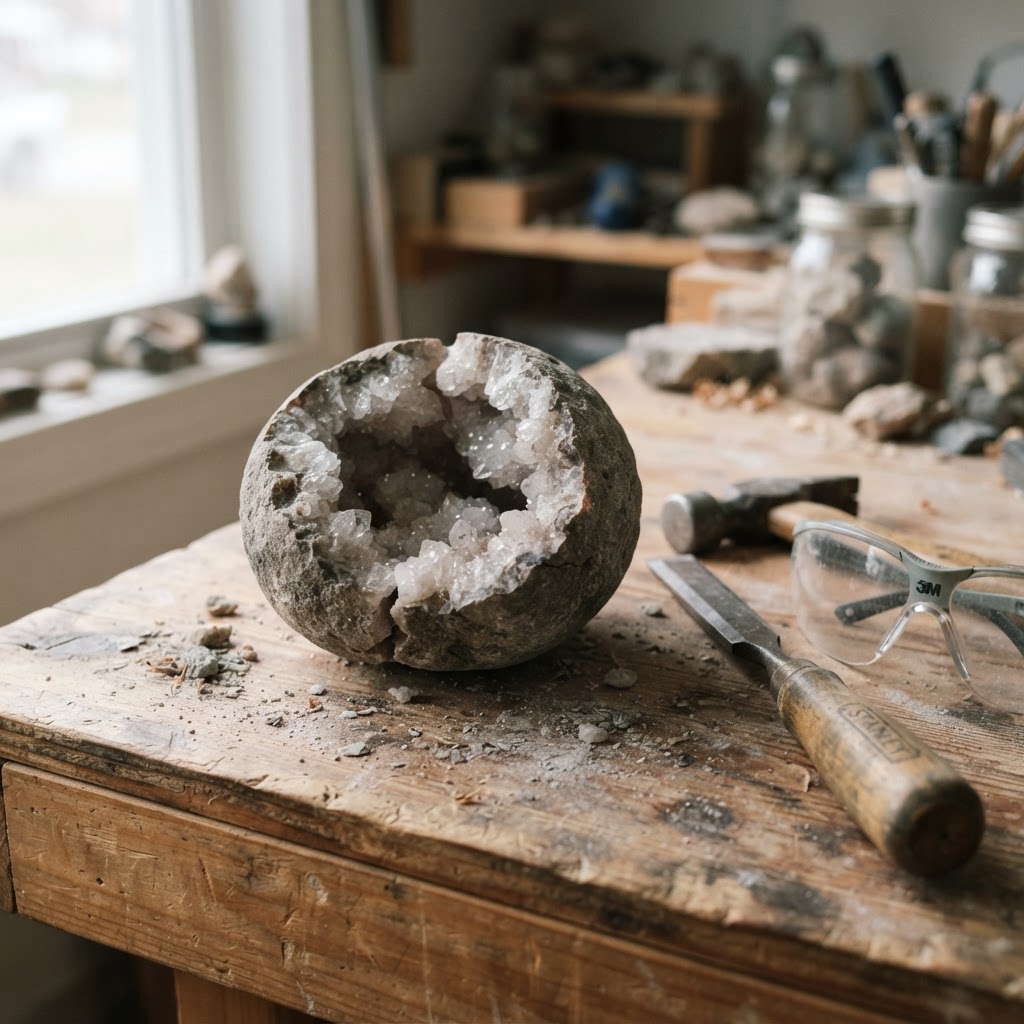
A Geode Is a Hollow Rock — and That Is the Whole Trick
A geode is a rounded rock with a cavity inside that has been lined with crystals. Everything about identifying one in the field comes back to that single fact: the middle is empty, and the empty space is why the rock feels wrong in your hand.
People walk past geodes constantly because the outside is usually plain — a rough, dull, grey-brown rind with nothing to look at. The trick is not to look at the outside. It is to weigh the stone, and to listen to it.
The Four Field Signs of an Unopened Geode
Run through these in order. Two or more together is a strong signal.
- It is too light for its size. A geode is mostly air inside, so a stone that looks like a solid lump of quartz but weighs noticeably less than it should is a candidate. Compare it against a similar-sized pebble.
- It sounds hollow when tapped. Hold it loosely in your fingertips and tap it with a coin or another stone. A geode gives a dull, hollow thud; a solid nodule gives a flat click.
- It is round and lumpy with a smooth outer rind. Most geodes are roughly spherical or egg-shaped with a hard, waxy, chalcedony-like skin that is smoother than the surrounding rock.
- It does not match the rock around it. A lone rounded stone sitting in a bed of limestone or shale, with a different texture to everything nearby, is worth a second look.
Geodes, Nodules and Concretions
These three get mixed up constantly, and only one of them is hollow.
| Name | Inside | How to tell it apart |
|---|---|---|
| Geode | Hollow, lined with crystals | Lighter than expected and hollow-sounding. Often a smooth chalcedony rind. |
| Nodule | Solid mineral, no cavity | Heavier for its size and gives a solid click when tapped. |
| Concretion | Solid, often layered around a nucleus | Usually in sedimentary rock, often with concentric layers and an odd internal shape. |
| Septarian nodule | Solid with internal cracks filled with crystal | Heavy, with a cracked or veined surface. The crystals are in the cracks, not a cavity. |
| Thunderegg | Solid, filled with agate or crystal | Heavier, and almost always from rhyolite or volcanic ash. Needs cutting, not cracking. |
Why Geodes Are Hollow in the Middle
A geode starts life as a void. In volcanic terrain that void is often a gas bubble trapped in cooling lava. In sedimentary terrain it is more likely to be a cavity left by a dissolved fossil, a root, or a lump of soluble mineral that has since washed away.
Over a long period, mineral-rich groundwater seeps through the surrounding rock and into the cavity. Silica precipitates first, coating the inside of the void with a hard, dense layer of chalcedony — that becomes the rind. As the water chemistry changes, more silica, or calcite, or occasionally barite, arrives and starts to grow crystals inward from the walls. The last bit of open space is where the largest, best-formed crystals sit, because they had the most room.
That is why the crystals in a good geode point inward and why the centre is where the prize is. It also explains why some geodes are almost entirely filled: if the mineral supply ran for long enough, the cavity closed up completely and you end up with a solid nodule instead.
Where Geodes Are Found
Geodes need a cavity, a mineral supply and time, so they turn up in two main geological settings. The first is basalt and other volcanic rock, where gas bubbles provide the voids. The great amethyst geodes of Uruguay and southern Brazil come from exactly this setting, and they are mined from basalt flows.
The second is sedimentary rock, particularly limestone and shale. The Keokuk geodes of the American Midwest are the classic example — plain-looking brown lumps in shale and limestone that open onto quartz, calcite, dolomite or pyrite. Chalk and limestone country in England, France and Germany also produces them. If you are walking farmland with limestone outcrops, or dry creek beds in volcanic country, you are in the right place.
How to Open a Geode Without Ruining It
Do not hit it with a hammer and hope. A geode cracked badly shatters the crystals inside and you lose the specimen.
The safest amateur method is to score a line around the geode with a hacksaw or a tile saw, then place a wide chisel on the score line and tap gently with a hammer, working around the circumference. The rind will give along the line and the two halves will part cleanly. If you have access to a pipe cutter or a lapidary saw, that is better still. A chain pipe cutter tightened gradually around the geode works remarkably well and is the method many collectors use.
Wear eye protection and a dust mask. Silica dust is genuinely harmful to the lungs, and cracking a geode throws fine fragments. Do it outdoors or in a well-ventilated space, and never let a child open one unsupervised.
What Is Inside: Quartz, Amethyst, Calcite and More
Quartz is the most common lining, either as clear rock crystal, milky white, or the pale grey of chalcedony. Amethyst — purple quartz — is the variety everyone hopes for, and it forms in the same way with a trace of iron and a dose of natural radiation.
Calcite is the other common lining, especially in sedimentary-hosted geodes, and it is easy to tell from quartz: calcite is hardness 3 and fizzes in dilute acid, where quartz is hardness 7 and does nothing. Less commonly you will find dolomite, barite, celestine, pyrite, marcasite or millerite. A geode with several minerals in it is a genuinely good find.
The Bottom Line
An unopened geode is a rounded, plain-looking rock that is too light and sounds hollow when tapped. If it is heavy and clicks, you have a nodule or concretion instead.
Once it is open, quartz identifier will name the lining, and mineral identifier covers the calcite and dolomite cases. If your find turns out to be a solid banded stone rather than a hollow one, rough agate identification is the better guide.
Frequently Asked Questions
Weigh it and tap it. A geode is noticeably lighter than a solid rock of the same size and gives a hollow thud when tapped. It is usually round with a smooth, hard outer rind that does not match the surrounding rock.