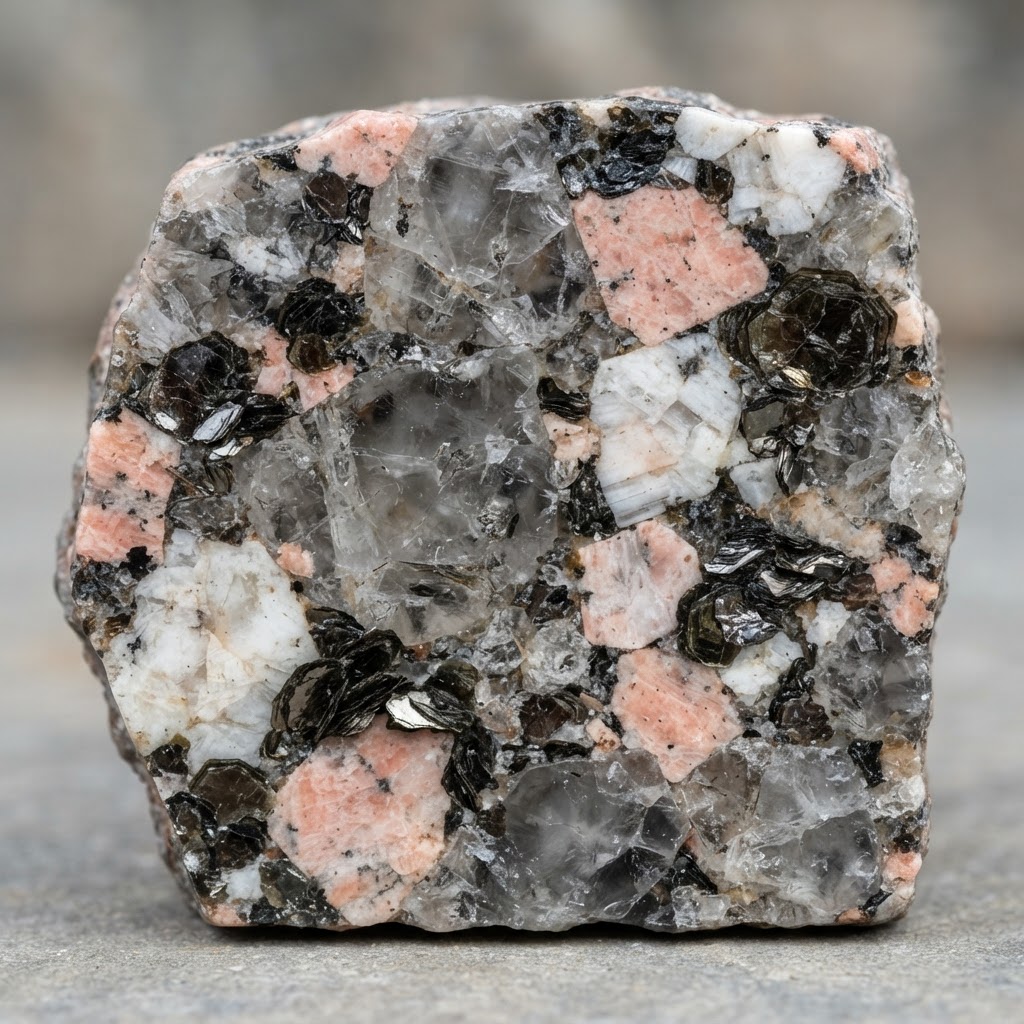
Granite Is Defined by Its Crystals
Granite is an igneous rock, which means it solidified from molten material. What makes it granite rather than basalt or obsidian is speed: granite cooled slowly, deep underground, over tens of thousands of years. Slow cooling gives crystals time to grow, and that is why you can see them.
So the single defining feature of granite is that its crystals are large enough to identify with the naked eye. If you cannot see individual crystals, you are not looking at granite. That one rule eliminates most of the confusion immediately.
The Three Minerals You Need to See
Granite is essentially three minerals locked together, and once you can spot all three you can identify it in seconds.
- Feldspar — the most abundant. Usually white, cream, pink or grey, and it makes up roughly half the rock. It has flat, shiny cleavage faces and is hardness 6.
- Quartz — grey, glassy and translucent, filling the gaps between the feldspar. Hardness 7, no cleavage, so it looks like frozen glass with a curved break.
- Mica — the shiny black or silver flakes. Biotite is black, muscovite is silvery. Both are soft at hardness 2.5 to 3 and flake off in thin sheets.
Granite and Its Lookalikes
These are the rocks granite gets confused with, and the tests that separate them.
| Rock | Hardness | Fizzes in acid? | How to tell it from granite |
|---|---|---|---|
| Granite | 6–7 | No | Visible interlocking crystals of quartz, feldspar and mica. No layering. |
| Granodiorite | 6–7 | No | Nearly identical in the hand — more plagioclase, less potassium feldspar. A geologist’s distinction. |
| Diorite | 6–7 | No | Similar texture but grey and white with no pink. Little or no quartz. |
| Gabbro | 6–7 | No | Coarse like granite but dark — mostly dark grey to black minerals. |
| Basalt | 6 | No | Same minerals, but the crystals are too small to see. Dark and fine-grained. |
| Marble | 3–4 | Yes, strongly | Softer, often sugary or crystalline, and fizzes readily in dilute acid. |
| Quartzite | 7 | No | Almost all quartz, no feldspar or mica. Sugary, sparkling texture. |
| Sandstone | 6–7 | Sometimes | Granular and often gritty, with visible bedding or layers. Usually softer. |
Granite vs Marble: The Acid Test
Marble is metamorphosed limestone, which means it is made of calcite or dolomite — carbonate minerals. Carbonates react with acid. Silicates do not. That single difference gives you the cleanest test in rock identification.
Put a drop of vinegar on the rock and wait a minute. On marble, or on limestone, you will see tiny bubbles form along the surface where the acid is dissolving the carbonate. On granite, nothing happens at all. If you have dilute hydrochloric acid from a hardware or pool shop it reacts far more vigorously, but vinegar is enough for a visible reaction on a freshly broken face.
Hardness backs it up. Marble is 3 to 4 and a copper coin will mark it; granite is 6 to 7 and a steel blade will not touch it. Marble also never shows the glassy grey quartz grains that granite always has.
Granite vs Quartzite and Sandstone
Quartzite is metamorphosed sandstone, and because it is almost pure quartz it is harder and more uniform than granite. Look for feldspar. If every grain is grey, glassy and translucent, with no creamy or pink feldspar and no black mica flakes, you have quartzite. The texture is also different: quartzite has a sugary, sparkling look where the original sand grains have fused together.
Sandstone is the un-metamorphosed version. It is made of sand grains cemented together, so it usually feels gritty when you rub it, and it often shows flat bedding planes or colour banding from the layers it was deposited in. It is softer than granite, and sandstone with a carbonate cement will fizz weakly in acid.
Is It Actually Granite? The Granite Family
Geologists are strict about the word. Granite has a specific range of quartz and feldspar proportions, and most of what the building trade calls granite is not granite at all.
Commercial granite countertops include granodiorite, gabbro, anorthosite, gneiss and even schist, because the trade uses the word to mean any hard, polished, crystalline rock. The black "granites" are usually gabbro or basalt. The white and grey speckled ones are often granodiorite. None of this matters much for identification in the field, but it explains why two "granite" worktops can look nothing alike.
The broader family also includes syenite, which has little or no quartz, and the striking rapakivi granite, where large round pink feldspar crystals are wrapped in a thin white rim of plagioclase. If you find rapakivi, you have found something genuinely distinctive.
Where Granite Comes From
Granite forms where continental crust melts and the resulting magma rises but stalls before reaching the surface, cooling slowly at depth. That is why it is found in the cores of mountain ranges and in large masses called batholiths, which are only exposed after millions of years of erosion have stripped the rock above them.
The Cornubian batholith of southwest England, the Sierra Nevada batholith in California and the granite country of Scotland are all classic examples. Wherever you find granite at the surface today, you are standing on rock that was once several kilometres underground.
The Bottom Line
Granite is a coarse-grained igneous rock with visible crystals of quartz, feldspar and mica. It does not fizz in acid, it has no layering, and it will not be scratched by a steel blade.
If the crystals are too small to see, you have basalt instead. If it fizzes, you have marble or limestone. For the wider method, stone identifier app walks through classifying any rock, and mineral identifier covers naming the individual crystals you can see.
Frequently Asked Questions
Look for large, visible interlocking crystals of three minerals: creamy or pink feldspar, grey glassy quartz and shiny black or silver mica flakes. It should not fizz in acid and should not be scratched by a steel blade.