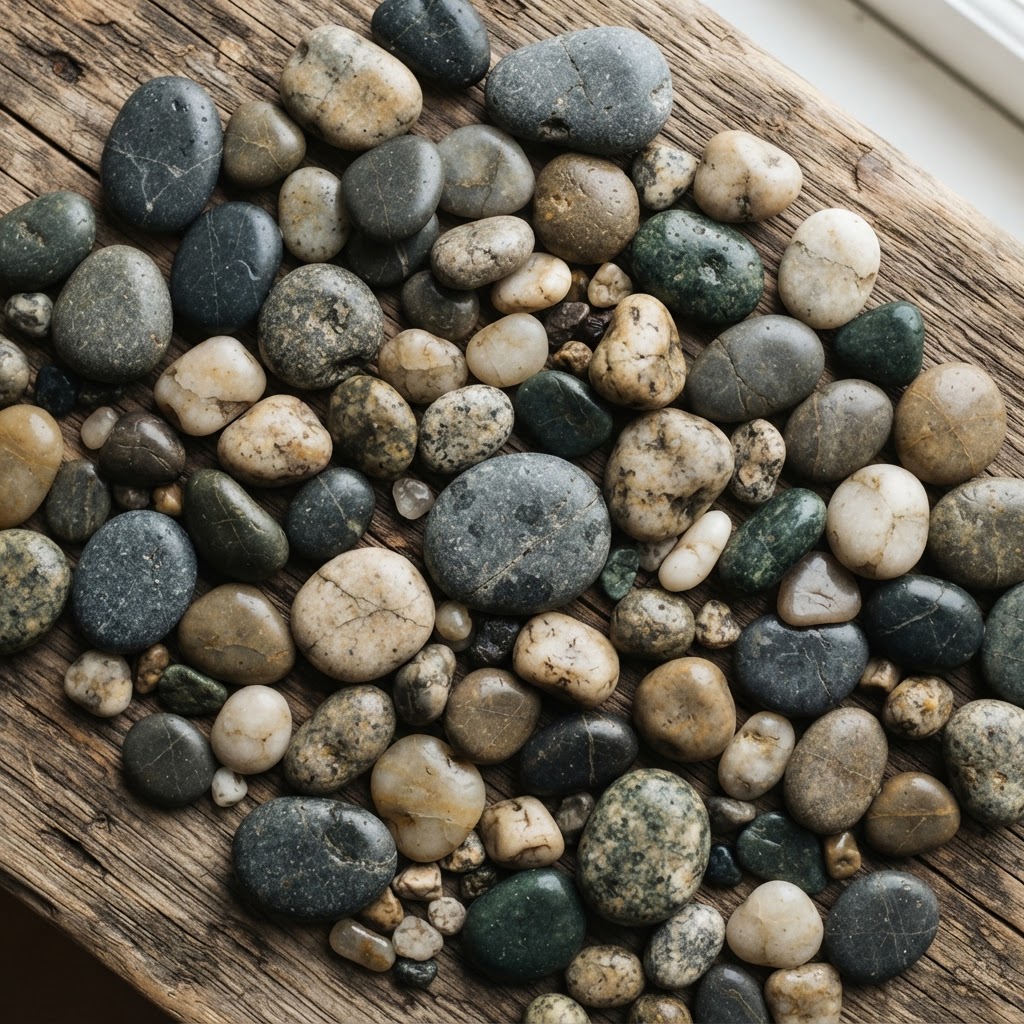
Most Stones Are Not Special — and That's the Point
The stone you picked up on a walk is probably granite, basalt, sandstone, limestone or quartzite. That is not a disappointing answer. Those five rocks make up most of the Earth’s crust, they record genuinely interesting geological history, and knowing which one you are holding tells you how and where it formed.
The trick is to stop looking at the stone as a whole and start asking a few narrow questions about it. Three questions will classify the large majority of stones you will ever pick up.
Three Questions That Classify Almost Any Stone
Work through these in order and you will land in one of three families.
- Is it crystalline, gritty, or layered? Visible interlocking crystals point to igneous or metamorphic. A gritty, sand-like feel points to sedimentary. Flat parallel sheets point to slate or schist.
- Can you see the grains? Coarse visible crystals mean slow cooling deep underground. Fine or glassy texture means fast cooling at the surface.
- Does it fizz in acid? A drop of vinegar will bubble faintly on limestone or marble. Nothing else in your collection will.
Grain Size Tells You Where It Formed
Grain size is the single most informative thing about an igneous rock, because it records cooling speed. Magma that cools slowly, kilometres underground, gives its minerals time to grow into crystals you can see. That is granite. Lava that erupts and cools in hours has no time to grow crystals, so you get basalt, which looks like a uniform dark grey mass.
Push the same logic further and you get obsidian. Erupt and cool so fast that no crystals form at all, and you get glass. That is why obsidian breaks into smooth curved shards instead of splitting along mineral faces.
The Stones People Pick Up Most Often
These seven cover the overwhelming majority of amateur finds.
| Stone | What gives it away | Formed by |
|---|---|---|
| Granite | Speckled, coarse, pink or white feldspar plus grey quartz | Slow-cooled magma underground |
| Basalt | Dark, fine-grained, uniform, sometimes with gas bubbles | Fast-cooled lava at the surface |
| Sandstone | Gritty, feels like cemented sand, often layered | Compacted sand grains |
| Limestone | Pale, soft, fizzes in acid, may contain shells | Compacted shell and coral debris |
| Slate | Dull grey, splits into flat sheets | Shale altered by heat and pressure |
| Quartzite | Very hard, glassy, fractures through the grains | Sandstone altered by heat and pressure |
| Marble | Soft, sugary texture, fizzes in acid | Limestone altered by heat and pressure |
Is It a Meteorite? Almost Certainly Not
This is the most common question about unidentified stones, and the honest answer is that meteorites are extremely rare. The usual candidate is a piece of industrial slag, an ironstone concretion, or a lump of hematite.
Meteorites have specific features. Most are magnetic. Most have a dark fusion crust from burning through the atmosphere, and most show small rounded chondrules inside when cut. A dense, dark, magnetic stone with no crust and no internal structure is far more likely to be slag from an old furnace than a visitor from space.
Fossils, Concretions and Other Confusing Objects
Stones that look deliberately made are usually concretions — mineral cement that grew around a nucleus inside sedimentary rock. They can be perfectly round, or oddly symmetrical, and they fool almost everyone once.
Fossils are easier to rule in or out than you would expect. Look for symmetry, repeating patterns, or a structure that could not form by chance. A shell impression in limestone is obvious once you see the ribbing. A random lump with a crack through it usually is not a fossil, no matter how suggestive it looks.
How to Photograph a Stone for a Useful Answer
Wash it first. Dust and mud hide the texture that carries the identification. Then photograph it dry, in daylight, from about 30 centimetres, with the whole stone in frame and a coin beside it for scale.
Add a second shot of a broken or cut face if you have one. A weathered exterior is a poor guide to what is inside. For the full step-by-step method, see rock identification by photo.
The Bottom Line
Identifying an ordinary stone is a process of elimination, and it takes about two minutes once you know the questions. Crystalline or gritty, coarse or fine, fizzes or does not. Answer those three and you will usually have your rock.
Then confirm it with a scratch test. For stones that turn out to be crystals rather than rock, crystal identification app covers the extra tests involved.
Frequently Asked Questions
Decide first whether it is crystalline, gritty or layered. Then check grain size and whether it fizzes in acid. Those three answers place it in a family, and a scratch test confirms it.