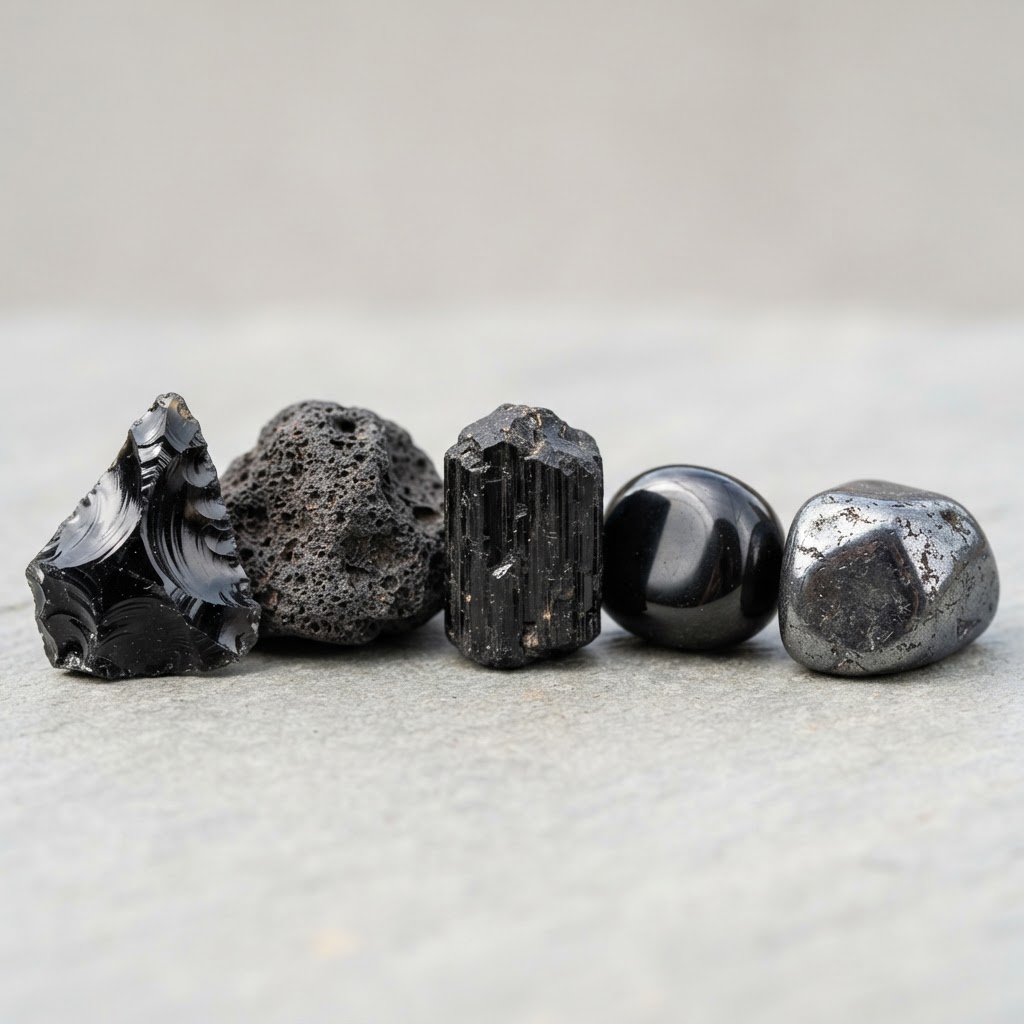
Black Hides Everything
Every other colour gives you something to work with. Black gives you almost nothing, because the features that would normally separate one stone from another — colour variation, visible crystal faces, translucency — are all absorbed by the dark surface.
That is why the streak test matters more for black stones than for any other group. It is the fastest way to get a colour signal out of a material that refuses to give you one.
The Streak Test Is the Whole Game
Rub the stone firmly on the unglazed back of a bathroom tile and look at the powder it leaves. The powder is the true colour of the mineral, unaffected by the surface weathering or coatings that make the exterior misleading.
For black stones this is decisive. Hematite leaves a red-brown streak. Magnetite leaves black. Obsidian and basalt leave white or pale grey. Jet leaves a brown streak. Two minutes with a tile will separate five stones that look identical in your hand.
The Black Stones You Are Most Likely Holding
These are the blacks that turn up most often in collections and on walks.
| Stone | Hardness | Streak | How to tell it |
|---|---|---|---|
| Obsidian | 5–5.5 | White | Glossy volcanic glass. Breaks into sharp curved shards. |
| Basalt | 6 | Grey | Matte, fine-grained and uniform. Often has small gas bubbles. |
| Black tourmaline (schorl) | 7–7.5 | White | Prisms with fine lengthwise striations. No cleavage. |
| Hematite | 5–6 | Red-brown | Metallic grey-black surface, red-brown streak, often kidney-shaped. |
| Magnetite | 5.5–6.5 | Black | Strongly magnetic. The streak is black, unlike hematite. |
| Jet | 2.5–4 | Brown | Fossilised coal. Very light, warm to the touch, burns with a coal smell. |
| Onyx | 6.5–7 | White | Banded black chalcedony, usually polished. Waxy, not glassy. |
| Slate | 3–4 | Grey | Splits into flat sheets. Dull and clearly layered. |
Obsidian vs Basalt: Glass vs Rock
These two look similar and are geologically related — both come from rapid cooling of lava — but they are structurally completely different. Basalt is a rock made of tiny interlocking crystals. Obsidian is a glass with no crystal structure at all.
You can tell them apart in the hand. Obsidian is glossy and reflective, like a black mirror, and it breaks into curved shards with edges sharp enough to cut. Basalt is matte, feels slightly gritty, and breaks with a rougher, more irregular surface. Obsidian is also softer, around 5 to 5.5, while basalt is about 6.
Hematite, Magnetite and the Iron Oxides
Hematite and magnetite are both iron oxides and both can look like dull black metal, but two tests separate them instantly. Magnetite is strongly magnetic — a fridge magnet will snap onto it. Hematite is only weakly magnetic at most, and its streak is red-brown rather than black.
Both are common and both have a long history of use. Hematite was ground as red pigment by cultures worldwide, and magnetite was the original lodestone that gave us the compass.
Jet, Onyx and the Black Stones That Are Not Minerals
Jet is not a mineral. It is fossilised driftwood, a form of lignite coal, and it behaves like coal — it is light, it feels warm, and it burns. It has been carved into jewellery since at least the Bronze Age and was hugely popular in Victorian mourning jewellery.
Onyx is the opposite case. It is black chalcedony, a genuine mineral and a variety of quartz, and it is usually polished so smooth that it looks like glass or plastic. Its hardness of 6.5 to 7 is the giveaway: it is hard, and jet is not.
Is It a Meteorite?
Black stones prompt this question more than any other kind, and the answer is almost always no. Meteorites are extremely rare. If a black stone is magnetic, the far more likely candidates are magnetite or industrial slag from an old furnace.
Real meteorites usually show a dark fusion crust from atmospheric entry and often contain small rounded chondrules visible on a cut face. A heavy, magnetic, black rock with no crust and no internal structure is almost certainly terrestrial.
The Bottom Line
Black stones are identified by streak first and surface behaviour second. Glassy and sharp-edged means obsidian. Matte and uniform means basalt. Magnetic means magnetite. Red-brown streak means hematite. Light and warm means jet.
For the minerals that form crystals rather than rock, mineral identifier covers the full set of diagnostic properties. And if you want a shortlist before you test anything, rock identification by photo explains how to photograph dark specimens properly.
Frequently Asked Questions
Do the streak test first — rub it on unglazed tile and check the powder colour. Then test hardness and magnetism. Those three checks separate almost every common black stone.