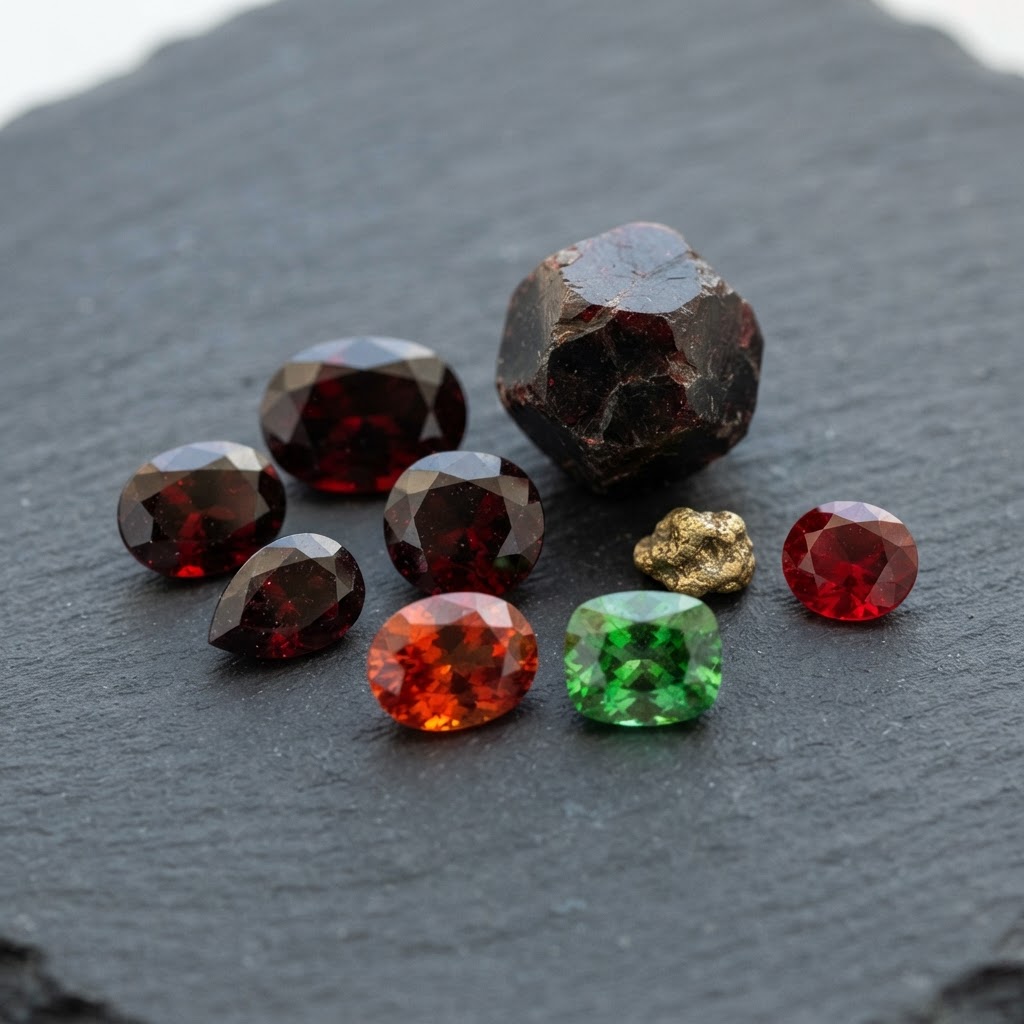
Garnet Is a Family, Not a Stone
Garnet is a group of minerals, not a single one. They all share the same crystal structure — a cubic lattice — but different metals sit inside it, and which metal is present determines the colour.
Almandine is the common deep red garnet, iron and aluminium, and it is the one in most jewellery and most gravel. Pyrope is magnesium and aluminium, a brighter blood red. Spessartine is manganese and aluminium, and it is orange to red-orange. Grossular is calcium and aluminium, and it includes hessonite, the honey-orange stone sold in India as gomed, as well as green tsavorite. Andradite is calcium and iron, and it includes demantoid, the brilliant green garnet. Uvarovite is calcium and chromium, and it is the rare emerald-green one.
So garnet comes in red, orange, yellow, green, brown, purple and black. The one thing it never is, is blue.
The Two Properties That Define It
First, garnet is singly refractive. Its cubic structure means light passing through it does not split into two rays. That has two consequences you can observe: no pleochroism, so the colour does not change as you turn the stone, and no facet doubling, so a facet edge behind the stone stays a single line under a loupe.
That eliminates ruby immediately. Ruby is doubly refractive and strongly pleochroic, so a ruby looks orange-red from one direction and purplish-red from another. A garnet looks the same colour from every angle.
Second, garnet has no cleavage. It breaks with a conchoidal or uneven fracture. Combined with its hardness of 6.5 to 7.5, that makes it durable, which is why garnet is used as an industrial abrasive as well as a gem.
Specific gravity runs from 3.5 to 4.3 depending on the variety, so garnet is noticeably heavy in the hand — heavier than quartz by a wide margin, and about the same as corundum.
Garnet vs Its Lookalikes
Six stones compete with garnet, and two of them are the classic traps.
| Stone | Hardness | How to tell it from garnet |
|---|---|---|
| Ruby | 9 | Doubly refractive and strongly pleochroic, so the colour shifts as you turn it. Much harder, so ruby scratches garnet. Specific gravity 4.0. |
| Red spinel | 8 | Singly refractive like garnet, so no facet doubling and no pleochroism. Specific gravity 3.6, lower than almandine, and refractive index 1.718 against garnet at 1.78 or more. |
| Red zircon | 7.5 | Very high double refraction, so facet edges look strongly doubled. Much heavier at 4.6 to 4.7. |
| Red tourmaline | 7–7.5 | Strongly pleochroic and much lighter at 3.0 to 3.2. Usually shows striations down the prism. |
| Red glass | 5–5.5 | Isotropic like garnet, but far lighter at specific gravity 2.4 to 2.5 and soft enough for a knife to mark. Usually contains round bubbles. |
| Cuprite | 3.5–4 | Much softer, and usually a deep crimson with a metallic or adamantine lustre. A knife marks it easily. |
The Crystal Shape
In the rough, garnet is easy to recognise once you have seen a few. It crystallises in the cubic system and almost always forms dodecahedra or trapezohedra — chunky, many-sided solids that look like a ball that has been flattened in places.
They have no cleavage planes, so a broken garnet crystal shows a curved, uneven surface rather than flat faces. And the crystal faces themselves often carry a distinctive surface texture.
In metamorphic rocks, garnet is one of the classic index minerals, and it grows as these chunky red-brown crystals in schist and gneiss. If you are looking at a shiny mica schist and there are dark red, roughly spherical crystals embedded in it, those are almost certainly garnets.
Where Garnet Comes From
Garnet is common, which is why it is affordable. India, Sri Lanka, Madagascar, Tanzania, Brazil, Namibia, Russia and the United States all produce significant quantities, and the material in the finest colours comes from East Africa and Sri Lanka.
One of the more charming sources is Arizona, where pyrope garnets at Garnet Hill are brought to the surface by ants. The ants excavate nests in the garnet-bearing rock and carry the garnets out, and Navajo people have collected them from the ant hills for generations. They are known as ant hill garnets.
Australia has plenty of garnet. Almandine is common in the metamorphic rocks of the eastern states and in the Precambrian terranes of Western Australia and the Northern Territory, and the Harts Range in the Northern Territory is well known for garnet. Australian garnet is also mined commercially as an industrial abrasive, because its lack of cleavage makes it fracture into sharp, hard grains.
That industrial use is worth knowing about, because it means garnet is not rare. If someone is selling you a "rare red garnet" at a high price, the story does not match the geology.
The Bottom Line
Garnet is a family of cubic silicates at hardness 6.5 to 7.5 and specific gravity 3.5 to 4.3. It is singly refractive with no pleochroism, has no cleavage, and comes in red, orange, yellow, green, brown and black — but never blue.
Ruby is doubly refractive, pleochroic and much harder. Spinel is singly refractive like garnet, so it needs a refractive index reading to separate. Zircon is much heavier and shows strong doubling. Glass is much lighter and softer.
For the closely related stones, see rough ruby identifier and gomed stone identifier. Peridot identifier covers the green side of the family, crystal identifier app covers the photo-first approach, and precious stone identification puts garnet alongside the classic gems.
Frequently Asked Questions
Pleochroism and hardness. Ruby is doubly refractive and strongly pleochroic, so its colour shifts from orange-red to purplish-red as you turn it, while garnet looks the same from every angle. Ruby is also hardness 9 and will scratch garnet at 6.5 to 7.5.