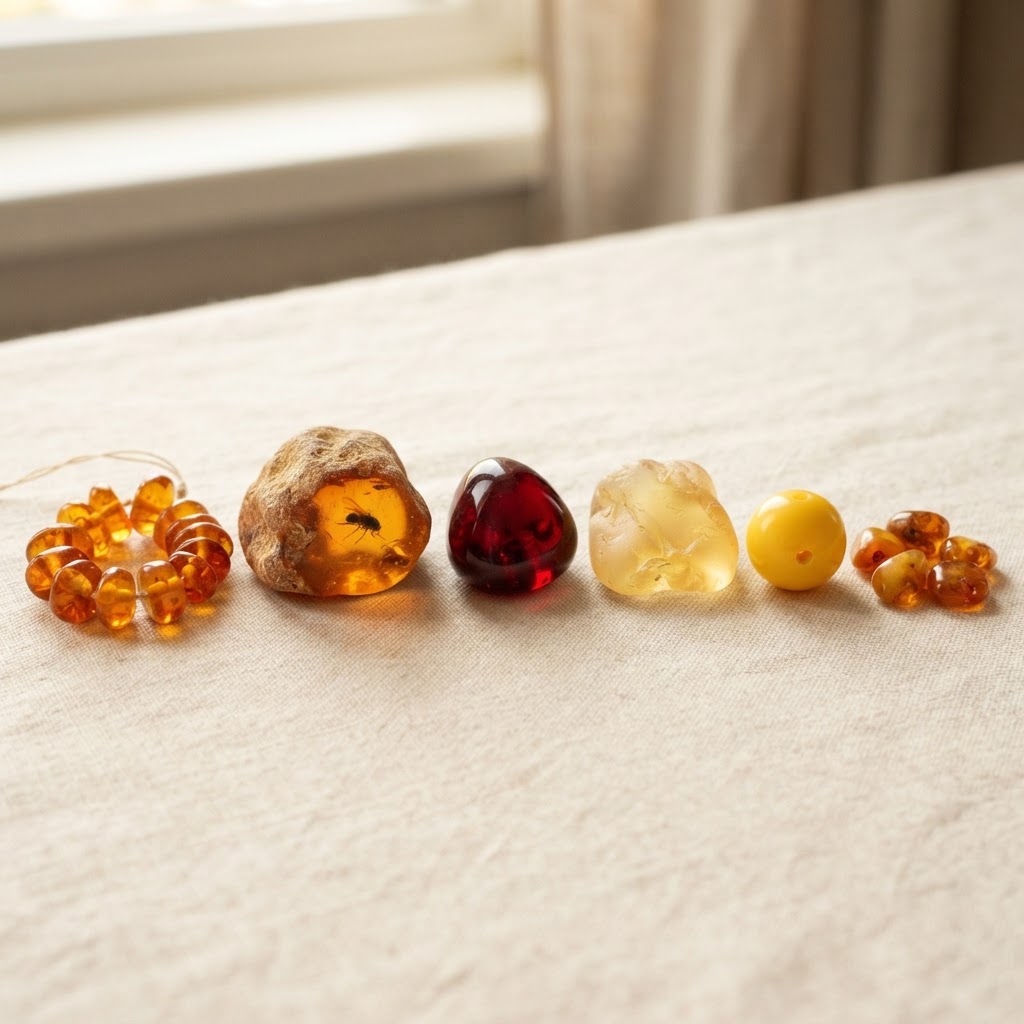
What Amber Is
Amber is fossilised tree resin. It is not a mineral and it is not a rock — it is organic, it is amorphous, and it is genuinely the hardened sap of trees that lived tens or hundreds of millions of years ago.
Most amber comes from conifers, though some deposits come from flowering trees. The resin was exuded to seal wounds, it hardened, and then it was buried in sediment and slowly polymerised over millions of years into a stable, durable material.
That origin explains everything about its properties. Amber is soft at 2 to 2.5 on the Mohs scale, it is warm to the touch, it is light at specific gravity 1.05 to 1.10, and it burns with a resinous smell. It is also one of the very few gem materials that will float in salt water.
The Salt Water Test
This is the classic test, and it works because amber is unusually light. Dissolve enough salt in water to make a saturated solution — roughly one part salt to four parts water by volume — and most plastics will sink while amber floats.
The numbers explain it. Amber has a specific gravity of 1.05 to 1.10. Saturated salt water is about 1.1 to 1.2. Most plastics and glass sit above that, so they sink. Amber sits right on the boundary, so a genuine piece bobs at the surface.
There is a catch, and it is a big one: copal also floats. Copal is much younger resin — thousands to a few million years old rather than tens to hundreds of millions — and it has not fully polymerised. It looks like amber, it floats like amber, and it is sold as amber constantly. The salt water test tells you that a piece is resin. It does not tell you whether it is amber or copal.
Amber vs Copal
Copal is the single biggest problem in the amber market. It is real tree resin, it is sometimes genuinely old, and it is soft, sticky and unstable compared with amber.
The practical differences are these. Copal is softer and it crazes, clouds and eventually becomes brittle with age. It is also more susceptible to solvents: a drop of acetone or alcohol on copal will make the surface tacky within seconds, while amber resists much longer. Under ultraviolet light, amber usually fluoresces a milky blue-white or yellow-green, while copal often fluoresces a brighter, more intense milky blue.
Copal also smells different when heated. A heated needle pressed into amber gives a resinous, pine-like smell; copal gives a lighter, more turpentine-like note.
The age difference is what matters commercially. Baltic amber is Eocene, roughly 40 to 50 million years old. Dominican amber is 15 to 40 million. Burmese amber is Cretaceous, around 99 million years old, and it is prized for its inclusions. Copal is typically less than a few million years old and often far younger than that.
Amber vs Its Lookalikes
Six materials are sold as amber, and two of them are forms of real amber.
| Material | Hardness | How to tell it from amber |
|---|---|---|
| Copal | 1.5–2 | Much younger resin. Softer, crazes readily, goes tacky with a drop of acetone, and often fluoresces more brightly under UV. |
| Plastic (Bakelite, celluloid, resin) | 2–3 | Sinks in saturated salt water. Feels cold rather than warm, and a heated needle gives a chemical smell rather than pine resin. |
| Ambroid or pressed amber | 2–2.5 | Reconstituted from amber chips fused under heat and pressure. Real amber, but you can often see flow lines or a cloudy, swirled internal structure. |
| Glass | 5–5.5 | Much harder, cold to the touch, and it sinks. Usually contains bubbles and feels dense. |
| Copal-amber mix | 2–2.5 | A blend of copal and amber or resin, sold as amber. It behaves like copal under solvent and is usually softer than true amber. |
| Celluloid | 2–3 | A very early plastic used for imitation amber. It smells of camphor when rubbed, and it is more prone to yellowing and cracking than amber. |
The Tests, and Which Ones to Avoid
Start with the safe ones. Weigh it — amber is light for its size. Feel it — amber is warm to the touch, unlike glass and most stone. Rub it on wool and hold it near small paper scraps: amber develops a static charge and will attract them. That property gave us the word electricity, from the Greek elektron, meaning amber.
Look at it under ultraviolet light if you have a torch. Amber usually glows a milky blue-white, greenish or yellow-green.
Then the destructive tests, which you should only ever run on a piece you do not mind damaging. The hot needle test — heat a needle and press it into a hidden spot — will give a pine resin smell for amber, a chemical smell for plastic, and a lighter turpentine note for copal. The solvent test with a drop of acetone will make copal tacky but leave amber largely unaffected.
Do not run the hot needle test on someone else’s jewellery. Buy from a dealer who will, or who offers a return policy.
Where Amber Comes From
The Baltic region is the world’s dominant source. Deposits around Kaliningrad in Russia, and in Poland, Lithuania, Latvia and Estonia, produce succinite, the classic Baltic amber, which is Eocene in age. Amber washes out of the sea bed and onto beaches after storms, and the Baltic coast has been a source of amber since the Stone Age.
The Dominican Republic produces amber from the Miocene, notable for its blue and green varieties and for excellent insect inclusions. Myanmar produces Burmese amber from the Cretaceous, which is scientifically important because it preserves Cretaceous insects and even dinosaur-era feathers. Mexico, Canada and the United States also have deposits.
Inclusions are the reason many people collect amber at all. Insects, spiders, plant fragments, hairs and occasionally feathers and small vertebrates have been preserved in amber with three-dimensional fidelity, and Burmese amber in particular has revolutionised the study of Cretaceous terrestrial life.
The Bottom Line
Amber is fossilised tree resin at hardness 2 to 2.5 and specific gravity 1.05 to 1.10. It is warm to the touch, light for its size, floats in saturated salt water, develops a static charge when rubbed, and usually fluoresces milky blue-white under UV.
Copal is much younger resin that also floats but is softer and goes tacky with solvent. Plastic sinks and smells chemical when heated. Glass is much harder and cold. Ambroid is real amber that has been melted and pressed back together.
For other organic and light materials, see jet stone identifier and gomed stone identifier. Raw gem identification covers uncut material, brown gemstone identification covers the brown stones amber is confused with, and tumbled stones identifier explains how to identify polished pieces.
Frequently Asked Questions
Check the weight, the warmth and the salt water float test. Real amber is light at specific gravity 1.05 to 1.10, warm to the touch, and it floats in saturated salt water while most plastics sink. It also develops a static charge when rubbed on wool.