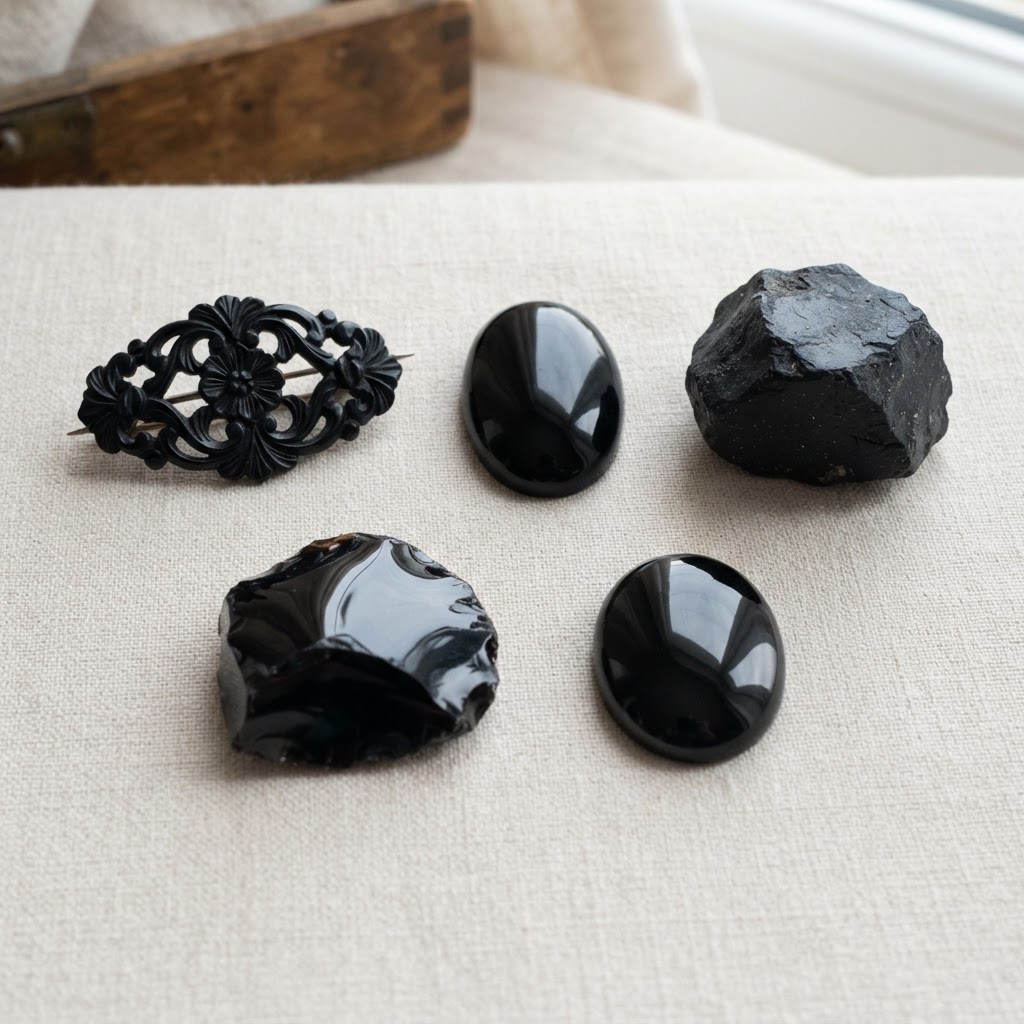
What Jet Is
Jet is fossilised wood. Specifically, it is a form of lignite — brown coal — formed from driftwood of a particular kind of conifer that was buried in marine mud during the Jurassic period, around 180 million years ago.
The classic deposit is at Whitby in Yorkshire, and Whitby jet is the reference material. The wood fell into mud, was buried without oxygen, and was compressed and chemically altered until it became a hard, dense, uniform black material that takes an exceptional polish.
Jet is not a mineral and not a rock. It is organic, like amber and coal, and that origin shows in its properties: it is very light, it is warm to the touch, it burns, and it is soft.
The Numbers
Specific gravity is 1.30 to 1.35, which is remarkable. Jet is barely heavier than water, and it is by far the lightest of the black materials it is confused with. Black glass is around 2.4 to 2.6. Onyx and black chalcedony are 2.6. Black tourmaline is 3.1.
Hardness is 2.5 to 4 depending on the source and the quality, so a knife scratches it easily and a fingernail may mark poorer material. That softness is why jet jewellery from the Victorian era often shows wear, and why jet should not be stored with harder stones.
The streak is brown, which is a useful test. Rub a piece across the unglazed back of a tile and you get a brown streak, because jet is coal. Black glass and onyx leave no streak, and anthracite leaves a black one.
Jet is also warm to the touch, because it is organic and a poor conductor of heat. Glass and stone feel cold.
Why It Was So Popular
Jet has been used since prehistory — it turns up in Bronze Age burials in Britain — but its great moment was the Victorian era. Queen Victoria wore jet jewellery after the death of Prince Albert in 1861, and mourning jewellery became a fashion that lasted for decades.
Whitby boomed. Workshops turned out brooches, necklaces, earrings, crosses and beads by the thousand, and jet became one of the first genuinely mass-market gem materials.
That popularity produced an entire industry of imitations. "French jet" is not jet at all — it is black glass, usually moulded, and it was made in enormous quantities. Black glass, vulcanite, gutta-percha, celluloid and later Bakelite all competed with real jet, and they are still found in antique shops labelled as jet.
Jet vs Its Lookalikes
Six black materials are sold as jet, and the weight test settles most of them immediately.
| Material | Hardness | Specific gravity | How to tell it from jet |
|---|---|---|---|
| Black glass (French jet) | 5–5.5 | 2.4–2.6 | Much heavier, cold to the touch, and it chips with a glassy curved fracture. May contain bubbles. |
| Black onyx or chalcedony | 6.5–7 | 2.6 | Much heavier and much harder, so it scratches glass. Stone cold rather than warm. |
| Anthracite coal | 2.5–3 | 1.4–1.8 | Slightly heavier, more brittle, and it leaves a black streak rather than a brown one. Often has a metallic sheen. |
| Vulcanite (ebonite) | 2–3 | 1.1–1.2 | Hardened rubber. Even lighter than jet, feels rubbery, and a heated needle gives a rubbery smell rather than coal. |
| Celluloid or Bakelite | 2–3 | 1.3–1.4 | Plastics. They smell chemical when heated or rubbed, and Bakelite has a distinctive acrid odour when warmed. |
| Black horn | 2.5–3 | 1.2–1.3 | Organic like jet, but it shows a fibrous or layered structure and smells of burnt hair when heated. |
The Tests
Weigh it first. Jet is so light that a genuine piece feels almost wrong in the hand — much lighter than glass of the same size. If it feels like stone, it is not jet.
Feel the temperature. Jet warms quickly in the hand and stays warm, while glass and onyx stay cold.
Streak it. Brown streak on unglazed tile means jet. No streak means glass or stone. Black streak means anthracite.
Then the destructive test, on a hidden spot only: heat a needle and press it into the piece. Jet gives a coal smell and may smoke slightly. Vulcanite smells of rubber. Plastic smells chemical. Horn smells of burnt hair. Do not run this on a piece you care about.
One more check worth making: look for mould lines and seams. French jet and later plastics were moulded, so they often carry a seam or a sprue mark. Real jet was carved, so it shows tool marks rather than mould lines.
Where Jet Comes From
Whitby in North Yorkshire is the classic and most famous source, and Whitby jet is still worked by a small number of craftspeople. The material occurs in the Jurassic shales around the town, and it is collected from the beach and from the cliffs.
Other sources include Spain, France, Germany, Poland, Turkey and the United States, particularly Colorado and Utah. Not all of it is Jurassic; some is younger and some older.
Australia has extensive brown coal deposits, notably the Latrobe Valley lignites in Victoria, but these are soft, wet, low-rank coals that crumble rather than taking a polish, and they are not jet. There is no significant Australian jet industry. If you see Australian material sold as jet, be sceptical.
The Bottom Line
Jet is fossilised driftwood, a form of lignite, at hardness 2.5 to 4 and specific gravity 1.30 to 1.35. It is very light, warm to the touch, leaves a brown streak, and smells of coal when heated.
Black glass is twice as heavy and cold. Onyx is much harder. Anthracite streaks black. Vulcanite smells of rubber. Plastics smell chemical and often show mould lines.
For related materials, see black stone identification and amber identification. Apache tears identification covers the other light black pebble people pick up, and tumbled stones identifier explains how to identify polished pieces.
Frequently Asked Questions
Weigh it and streak it. Real jet is very light at specific gravity 1.3 and warm to the touch, and it leaves a brown streak on unglazed tile. Black glass is about twice as heavy and cold, and leaves no streak.