What an Apache Tear Actually Is
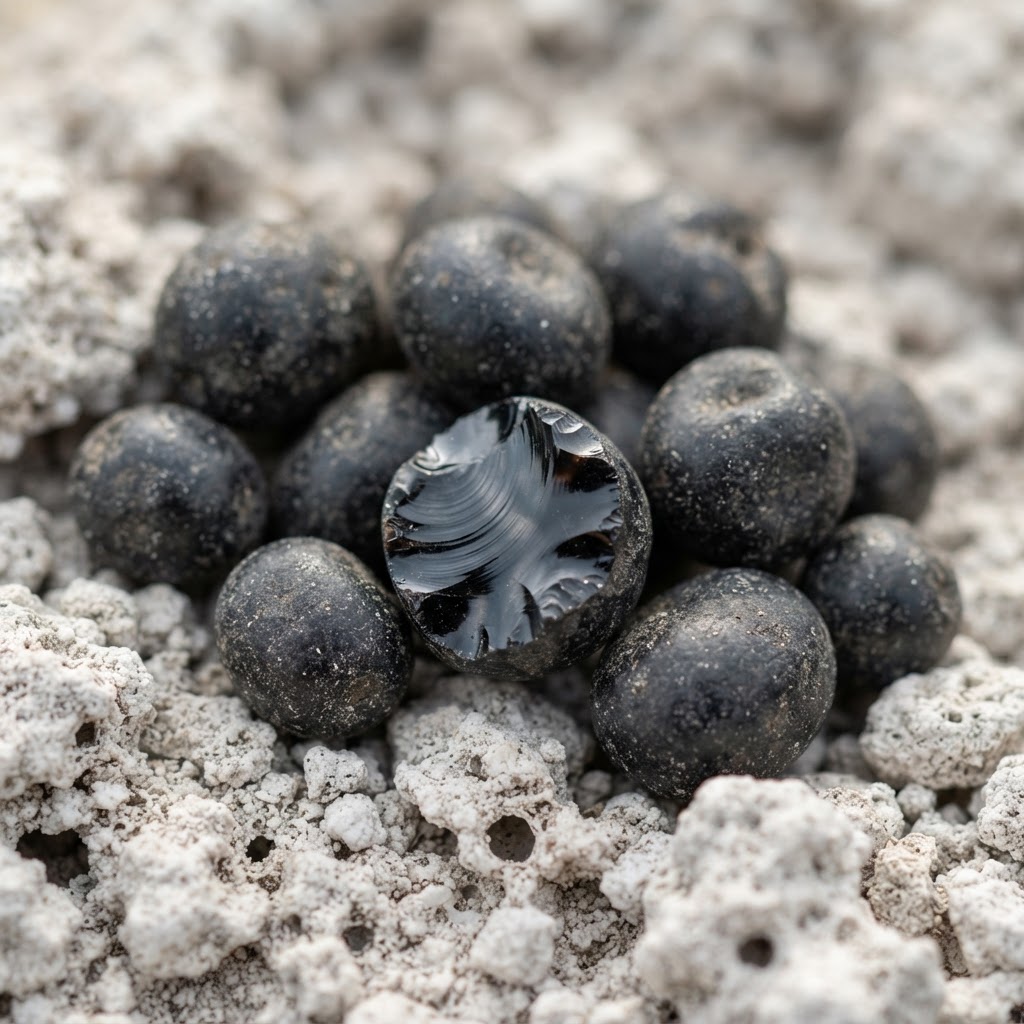
Apache tears are small rounded nodules of obsidian — volcanic glass — usually between about one and five centimetres across. They are not a mineral and not a separate rock type. They are pebbles of the same black glass that forms when lava cools too fast for crystals to grow.
The classic locality is around Superior in Arizona, where the nodules sit inside a soft, pale, crumbly rock called perlite. Perlite is hydrated volcanic glass that breaks down far faster than obsidian, so as it weathers away the tough glass pebbles fall out. That is the whole mechanism: the host rock rots, the obsidian survives, and you are left holding a handful of smooth black tears.
Similar material turns up in Nevada, Utah, New Mexico, Idaho and Oregon, and nodules of this kind occur anywhere obsidian and perlite are found together.
The name comes from an Apache story about women weeping for warriors lost over a cliff, their tears turning to stone. It is a good story and worth telling, but it is a story rather than a geological explanation.
The Two Tests That Settle It
First, obsidian is glass. Look at a broken surface: it is smooth, curved and shiny, with the shell-like fracture that glassmakers call conchoidal. Those curves are the giveaway. A broken Apache tear looks like a piece of a shattered bottle because, chemically and physically, it very nearly is one.
Second, hold a thin edge up to a strong light. Real obsidian is translucent, and most Apache tears show a smoky grey-brown glow at the thinnest part. Black chert, jet and hematite stay stubbornly opaque no matter how thin the edge.
Hardness is 5 to 5.5, which is awkward, because a steel knife sits at about 5.5 too. Do not rely on a knife. Use quartz instead: quartz at hardness 7 scratches obsidian easily, and obsidian will not scratch quartz.
Why They Look Different From a Raw Obsidian Chunk
Apache tears are rounded and smooth because they have been tumbled inside the weathering perlite. Freshly broken obsidian is all sharp edges and flat, glassy faces. An Apache tear has had those edges worn off, and the surface often carries a dull, frosted patina.
That rounded shape is why people mistake them for ordinary black pebbles. The trick is to look for one chipped corner. As soon as a tear chips — and they chip easily — you see the glassy interior and the curved fracture underneath.
They are also light. Obsidian has a specific gravity of about 2.35 to 2.6, close to quartz and noticeably lighter than most dark rocks. A hematite pebble of the same size will feel roughly twice as heavy.
Apache Tears vs Their Lookalikes
Seven materials account for almost every black pebble that gets mistaken for an Apache tear.
| Material | Hardness | How to tell it from an Apache tear |
|---|---|---|
| Black chert or flint | 6.5–7 | Harder than obsidian, so it scratches glass. Opaque even at thin edges, and waxy or dull rather than glassy. |
| Jet | 2.5–4 | Much softer and much lighter. Warm to the touch, dull rather than glassy, and it leaves a brown streak on unglazed tile. |
| Black glass slag | 5–5.5 | Industrial waste glass. Usually has round gas bubbles, and may carry a green or blue tint in thin edges. Often found near old smelters. |
| Hematite | 5–6.5 | Metallic rather than glassy, far heavier, and it leaves a red-brown streak. |
| Basalt | 6 | Dull, grey-black and granular. You can see tiny crystals with a hand lens, where obsidian is perfectly uniform. |
| Black tourmaline | 7–7.5 | Crystalline, with flat faces and lengthwise striations. Harder than quartz. |
| Pumice | 6 | Full of gas holes and light enough to float. Same volcanic origin, completely different texture. |
Where to Find Them
Look for pale, crumbly, almost chalky volcanic rock with black pebbles embedded in it. That is perlite, and Apache tears are what falls out of it. In Arizona the deposits around Superior are the best known, and roadside collecting is popular there.
Australia has obsidian in a few places. The Newer Volcanics of western Victoria and the Glass House Mountains area in Queensland both produced volcanic glass, but Apache tears as such are an Arizona signature. If you are fossicking in Australia you are more likely to meet obsidian as black glassy flakes and bands than as rounded nodules.
Wherever you collect, check the rules first. Some sites are on private land or inside protected areas, and removing material is not always allowed.
Working and Keeping Them
Apache tears are usually tumbled rather than faceted, because they are glass and they chip. A rock tumbler handles them well if you cushion them, and they polish to a deep, wet-looking black.
Left raw, they are fragile at the edges. Store them so they are not knocking against harder stones, and keep them out of a pocket with keys.
One warning worth repeating: obsidian and its dust are a respiratory hazard when cut or ground. If you are working them, use water and wear a mask.
The Bottom Line
An Apache tear is a rounded nodule of obsidian at hardness 5 to 5.5, with a curved glassy fracture and translucent smoky edges. It is lighter than most dark rocks and much softer than chert.
Check for translucency at a thin edge and for the shell-like fracture. Those two signs will separate it from chert, jet, slag and hematite almost every time.
For the related materials, see chert vs flint identification and black stone identification. Mineral identifier covers the hardness and streak method in full, and rocks with holes identification explains the other great source of black volcanic pebbles.
Frequently Asked Questions
They are nodules of obsidian, which is volcanic glass rather than a mineral. They form when lava cools too quickly for crystals to grow, and they are released from soft perlite as it weathers away.