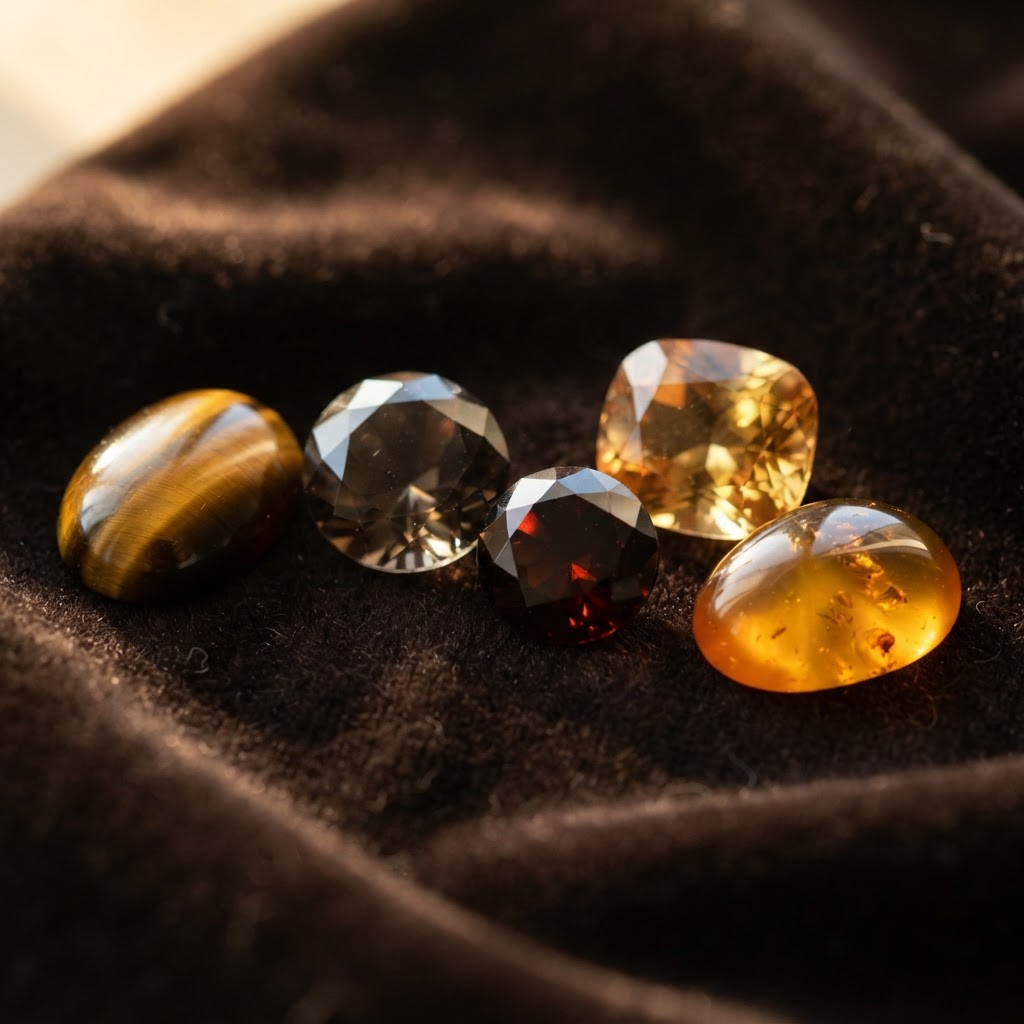
Brown Gems Are Everywhere and Almost Nobody Identifies Them
Brown is the most common colour in semi-precious jewellery and the least identified. Tiger’s eye, smoky quartz, citrine, garnet, amber and brown tourmaline are all sold in every bead shop and market stall, and most buyers never learn which is which.
The good news is that the brown gems separate cleanly by hardness and by surface behaviour. One scratch test and one tilt of the stone will usually settle it.
Separating the Brown Gems by Hardness
Hardness splits the brown gems into three clear bands. The soft group — amber and jet — sits below 4 and scratches with a fingernail or a copper coin. The middle group — goethite, aragonite and some treated material — sits between 4 and 6 and scratches with a steel blade. The hard group — quartz varieties, garnet, tourmaline and topaz — sits at 6.5 and above and will not be marked by a blade at all.
Once you know which band you are in, the sheen test and the transparency test finish the job.
The Brown Gemstones at a Glance
These are the brown gems you will actually encounter.
| Gem | Hardness | How to tell it |
|---|---|---|
| Tiger’s eye | 6.5–7 | Opaque golden-brown with a single moving band of light. Usually cut as a cabochon. |
| Smoky quartz | 7 | Translucent grey-brown, cut as faceted stones or beads. Glassy surface. |
| Citrine | 7 | Transparent yellow to amber, faceted. Most is heat-treated amethyst. |
| Garnet | 7–7.5 | Deep red-brown, faceted, with noticeably high brilliance for its price. |
| Amber | 2–2.5 | Honey to cognac brown, very light, warm to the touch, often with inclusions. |
| Brown tourmaline | 7–7.5 | Transparent brown, faceted, often with visible inclusions and strong pleochroism. |
| Topaz | 8 | Pale brown to sherry-coloured, hard and heavy, with one direction of perfect cleavage. |
| Brown jasper | 6.5–7 | Opaque and patterned, cut as cabochons. Often banded or mottled. |
Tiger's Eye: The Easiest Brown Gem to Identify
Tiger’s eye is the one brown gem you can identify from across a room. The chatoyant band of light that slides across the surface as you tilt the stone is unmistakable, and nothing else in the brown group does it.
It is quartz that replaced parallel fibres of crocidolite asbestos while preserving the fibre structure, which is what produces the sheen. The blue version is hawk’s eye and the red version is bull’s eye, usually produced by heat treatment. All are hardness 6.5 to 7.
Amber Is Not a Gemstone — and That Matters
Amber is fossilised tree resin, not a mineral. That is not pedantry — it changes how you test it. Amber is only 2 to 2.5 on the Mohs scale, so a fingernail will mark it. It feels warm rather than cold. It is light enough to float in saturated salt water. And it burns with a resinous smell if you touch a hot needle to it.
Because it is soft and light, amber is frequently imitated with plastic and with copal, which is much younger resin. If a piece feels cool and heavy, it is not amber.
Smoky Quartz, Citrine and Heat Treatment
These two are the same mineral — quartz — differing only in colour, and both are hardness 7. Smoky quartz gets its grey-brown tone from natural radiation acting on aluminium impurities. Citrine is yellow, and most commercial citrine is amethyst or smoky quartz that has been heated to around 500 degrees Celsius.
That matters for value rather than identification. A treated stone is still genuine quartz, but it should not be sold or priced as rare natural citrine.
What Brown Gems Are Worth
Most brown gems are inexpensive. Tiger’s eye, smoky quartz and citrine are abundant and cost very little. Garnet is modestly priced unless the colour is exceptional. Amber varies enormously depending on age, clarity and whether it contains inclusions — insect-bearing amber is a collector market with its own rules.
Fine brown tourmaline and topaz are the exceptions, and both are worth having assessed before you buy or sell. For the reasoning behind that, see gemstone identification app.
The Bottom Line
Brown gemstones come down to hardness and sheen. Soft and warm means amber. Opaque with a moving band means tiger’s eye. Transparent and glassy means quartz or garnet. Hard, heavy and pale brown means topaz.
If your stone is rough rather than polished, brown crystal identification covers the crystalline forms. And for the full method behind any identification, crystal identification app walks through the tests.
Frequently Asked Questions
Tiger’s eye and smoky quartz. Both are inexpensive, widely sold in jewellery, and easy to identify — tiger’s eye by its moving band of light, smoky quartz by its translucent grey-brown colour.