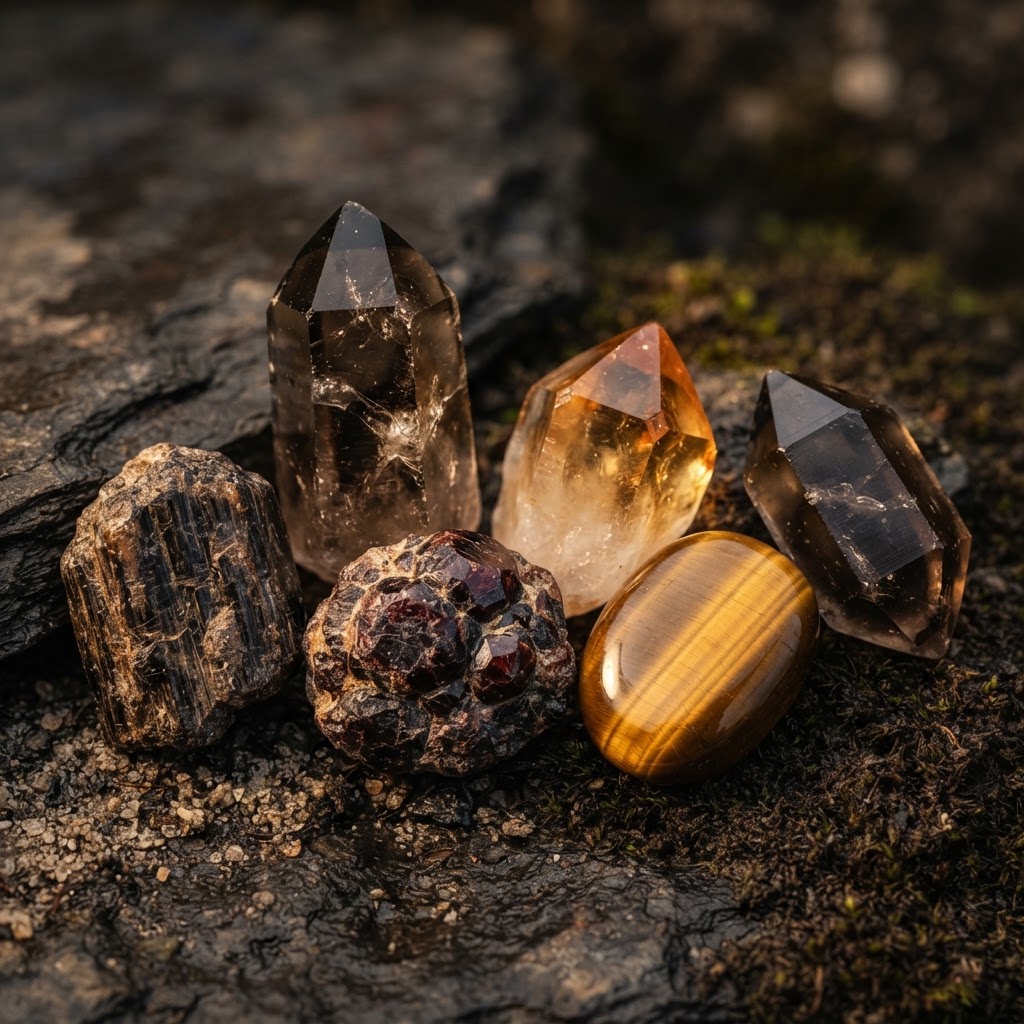
Brown Is the Most Underrated Colour in Mineralogy
Brown crystals get overlooked because brown does not look precious. That is a mistake. Brown is the colour of some of the most collected minerals in the world — smoky quartz, tiger’s eye, citrine, garnet, dravite tourmaline — and it is also the colour that iron takes in a huge range of geological settings.
Because so many brown minerals exist, colour alone will not get you far. The trick is to use transparency and surface behaviour as your first two filters.
Why So Many Minerals Turn Out Brown
Most brown in minerals comes from iron, either as a trace element substituting into a crystal structure or as iron oxide staining the material. Goethite, hematite and limonite are all iron oxides or hydroxides, and between them they colour an enormous amount of the rock you see every day.
The other common route is radiation. Smoky quartz gets its brown-grey colour when natural radiation from surrounding rock displaces electrons in aluminium impurities inside the quartz lattice. That is why smoky quartz is so often found near granite and other rocks containing traces of uranium and thorium.
Start With Whether It Is Transparent or Opaque
Hold the crystal up to a light. Transparent to translucent brown points to smoky quartz, citrine, garnet or dravite tourmaline — all of which are hard, glassy minerals. Opaque brown points to tiger’s eye, goethite, jasper or aragonite.
That one split cuts the list roughly in half. The second filter is hardness, and the third is whether the surface does anything unusual when you tilt it.
The Brown Crystals You Are Most Likely Holding
These eight account for almost every brown crystal an amateur will pick up.
| Crystal | Hardness | How to tell it |
|---|---|---|
| Smoky quartz | 7 | Translucent grey-brown quartz, often in pointed hexagonal crystals. No cleavage. |
| Citrine | 7 | Transparent yellow to amber-brown quartz. Most commercial citrine is heated amethyst. |
| Tiger’s eye | 6.5–7 | Opaque golden-brown with a silky moving band of light across the surface. |
| Garnet (almandine) | 7–7.5 | Deep red-brown, translucent, with a glassy surface and no cleavage. |
| Dravite tourmaline | 7–7.5 | Brown tourmaline with lengthwise striations along the crystal faces. |
| Goethite | 5–5.5 | Opaque brown iron ore, often with a radiating or stalactitic structure. |
| Aragonite | 3.5–4 | Brownish clusters of radiating crystals that fizz in dilute acid. |
| Amber | 2–2.5 | Warm honey-brown, very light, feels warm to the touch. Not a mineral at all. |
Smoky Quartz: The One Everyone Finds
Smoky quartz is the most common brown crystal in the world and the most likely answer when someone brings in a translucent brown pointed crystal. It is quartz, so it is hardness 7, has no cleavage, and breaks with a curved glassy fracture. It is also very often sold as an inexpensive semi-precious stone.
The colour varies from a pale champagne through to almost black. The darkest material, sometimes called morion, is still quartz — just with a heavier dose of natural irradiation. Heating smoky quartz turns it yellow and it is then sold as citrine, which is one of the reasons the citrine market is so confusing.
Tiger's Eye and the Stones With a Moving Sheen
Tiger’s eye is unmistakable once you have seen it. The stone is a pseudomorph — quartz that replaced fibrous crocidolite asbestos while keeping the fibre structure intact. Those parallel fibres reflect light as a single moving band that shifts across the surface as you tilt the stone. That effect is called chatoyancy, from the French for "cat’s eye".
The same effect in other stones produces other trade names. When the fibres are blue, it is hawk’s eye. When they are red-brown, it is bull’s eye, which is usually tiger’s eye that has been heat-treated. All of them are quartz, all are hardness 6.5 to 7, and all are opaque.
Testing a Brown Crystal
Run a scratch test first — it separates smoky quartz and citrine at 7 from goethite at 5.5 and aragonite at 3.5. Then check cleavage: tourmaline and quartz both lack cleavage, but garnet has none and a distinctive dodecahedral shape instead.
If the stone is opaque and brown with no sheen, check for acid reaction. Aragonite fizzes readily, which rules it in or out immediately. If it is warm and very light for its size, it may be amber — which is fossilised resin rather than a mineral, and belongs to a different category entirely.
The Bottom Line
Brown crystals are identified by transparency first, hardness second, and any unusual surface effect third. Translucent and glassy means quartz or garnet. Opaque with a moving band means tiger’s eye. Opaque and dull means an iron oxide or a carbonate.
If it turns out to be quartz, quartz identifier covers the rest of the family. If it is polished or faceted rather than rough, brown gemstone identification deals with the cut and treated versions.
Frequently Asked Questions
Smoky quartz. It is quartz coloured brown-grey by natural radiation acting on aluminium impurities, and it is found in granite areas worldwide. Most translucent brown pointed crystals are smoky quartz.