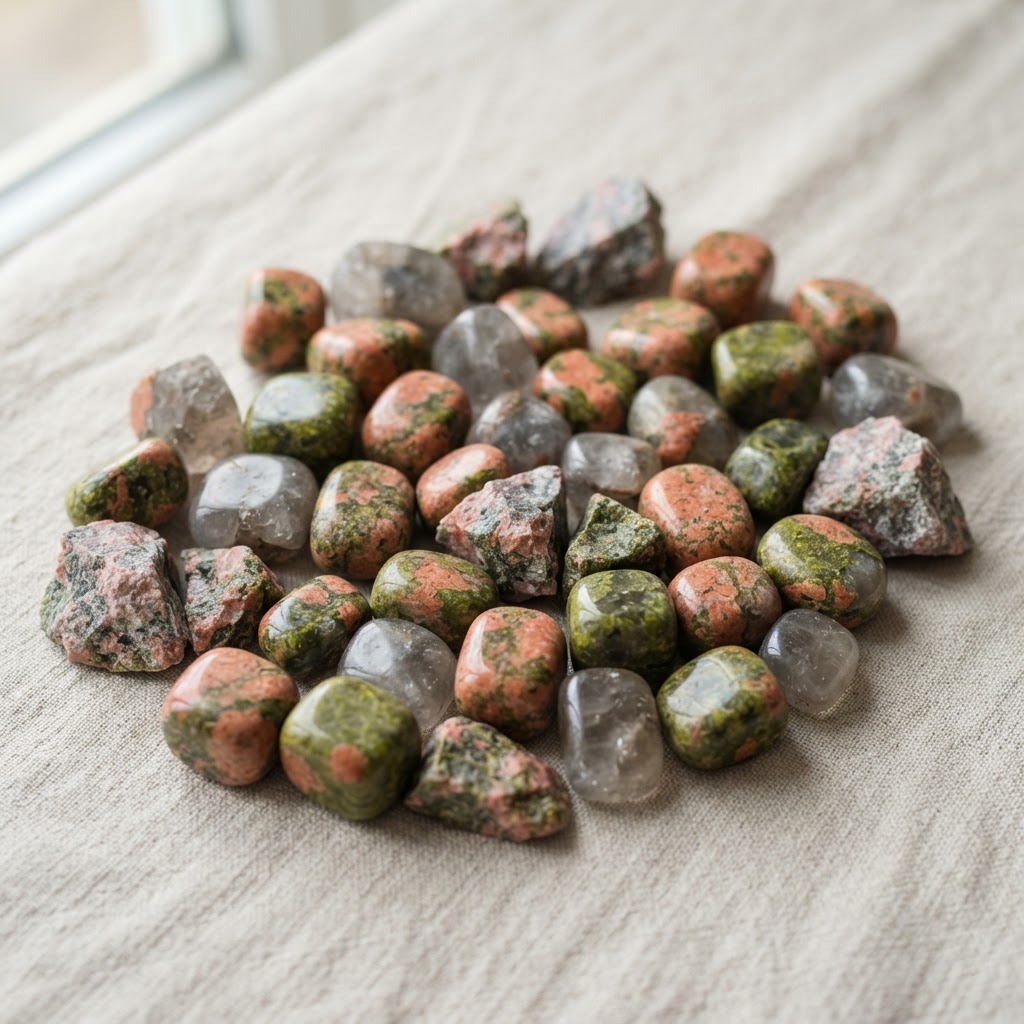
What Unakite Is
Unakite is altered granite. That is the whole story, and it explains everything about how it looks.
Take a normal granite — pink potassium feldspar, grey or white quartz, and some darker minerals — and run hot, mineral-rich fluids through it. The fluids convert the plagioclase feldspar into epidote, a pistachio-green mineral. What is left is a rock made of salmon-pink feldspar, green epidote and grey quartz, in a granular, interlocking texture.
The name comes from the Unaka Range in the Blue Ridge Mountains of North Carolina and Tennessee, where it was first described. It is also called epidotised granite, or unakite granite, which is a more accurate name.
Why the Texture Matters
The most important thing about unakite is that it is a granular rock, not a dyed one. Look closely and you can see individual mineral grains, each with its own colour and its own shape, packed together.
The pink is feldspar, and it has the slightly cloudy, opaque look of feldspar rather than the glassiness of quartz. The green is epidote, which has a distinctive pistachio or olive tone and often forms as irregular patches and veinlets cutting through the other minerals. The grey to colourless areas are quartz.
Because it is a real rock with a real texture, no two pieces look the same. The proportions of pink, green and grey change from piece to piece, and the boundaries between the minerals are irregular and interlocking.
That is exactly what you should be checking for. A dyed stone has colour that follows cracks and pores, and its underlying texture is uniform. Unakite has colour that follows mineral grains.
Hardness and Composition
Because it is made of quartz, feldspar and epidote, unakite is hard. Quartz is 7, feldspar is 6, and epidote is 6 to 7. The rock as a whole sits at around 6 to 7 on the Mohs scale, so a knife will not mark it and it will scratch glass.
It has no cleavage as a rock, though individual feldspar grains do. It breaks with an irregular fracture across the grains rather than splitting on planes.
Streak is white, because every mineral in it is a silicate. Specific gravity is around 2.6 to 2.9, typical for granite-family rocks, so it feels ordinary in the hand rather than heavy.
Unakite vs Its Lookalikes
Five materials get confused with unakite, and four of them are not rocks at all in the same sense.
| Material | What it is | How to tell it from unakite |
|---|---|---|
| Dyed agate or howlite | Coloured stone sold in pink and green | Colour follows cracks and pores rather than mineral grains, and the underlying texture is uniform and fine rather than granular. |
| Rhodonite | A manganese silicate, usually pink with black veins | Pink with black manganese oxide veins and no green. Rhodonite is 5.5–6.5 and opaque, and it is not granular in the same way. |
| Epidote in quartz | Epidote crystals in a quartz vein | Green epidote in grey quartz with no pink feldspar. Unakite always has all three minerals together. |
| Amazonite with epidote | Green feldspar with green epidote | Amazonite is green feldspar rather than pink, so the rock is green and grey with no salmon colour at all. |
| Jasper | Opaque microcrystalline quartz | Uniform and opaque with no visible grains, and it breaks with a smooth curved fracture rather than a granular one. |
Where Unakite Is Found
The type locality is the Unaka Range, and unakite also occurs in the Sierra Nevada, in the Lake Superior region, in South Africa and in Zimbabwe. It forms wherever granitic rock has been altered by epidote-bearing fluids, which usually means near fault zones or hydrothermal systems.
In Australia, epidotised granite occurs in the Precambrian and Palaeozoic terranes of Western Australia and in altered granites in the eastern states, though it is not commonly collected under the name unakite.
Most of the unakite in the market comes from a handful of localities and is sold as tumbled stones, cabochons and beads. It is an inexpensive ornamental stone rather than a gem material.
Using and Working It
Unakite takes an excellent polish because it is hard and fine-grained, and it is popular for cabochons, beads, spheres and small carvings. Because the colour varies from piece to piece, no two cabochons are alike.
It is also tough. With no strong preferred cleavage direction in the rock as a whole, it holds up well in a tumbler and in jewellery that takes some wear.
Because it is a granite-family rock, it is worth knowing that some granite contains elevated natural radioactivity from potassium, uranium and thorium in trace amounts. This is normal for granite and not a concern for handling, but it is the reason granite is sometimes tested for use in enclosed spaces.
The Bottom Line
Unakite is epidotised granite: salmon-pink feldspar, pistachio-green epidote and grey quartz, in a granular texture at hardness 6 to 7 with a white streak. No two pieces have the same pattern.
The key test is texture. Real unakite has colour that follows mineral grains; dyed stone has colour that follows cracks, with a uniform texture underneath.
For related material, see granite identifier and green stones identification. Pink crystal identifier covers the pink minerals, and tumbled stones identifier explains how to identify polished pieces like unakite cabochons.
Frequently Asked Questions
Look for a granular rock with salmon-pink feldspar, pistachio-green epidote and grey quartz in interlocking grains. It is hardness 6 to 7, leaves a white streak, and the pattern varies from piece to piece.