What Slate Is
Slate is a low-grade metamorphic rock formed from shale or mudstone. Bury that mud and subject it to heat and directed pressure, and the clay minerals begin to recrystallise into tiny flakes of mica and chlorite. The flakes grow perpendicular to the pressure, and the rock develops a fabric.
That fabric is called slaty cleavage, and it is why slate splits into thin flat sheets. The rock has a plane of weakness running through it, and a roofing slate is simply a piece of rock split along that plane.
The important subtlety is that slaty cleavage is not the same as the original bedding. The rock may have been deposited in flat layers and then tilted, and the cleavage cuts across the bedding at an angle. If you look at the edge of a slate sheet and see two sets of lines crossing, you are seeing exactly that.
The Split Test
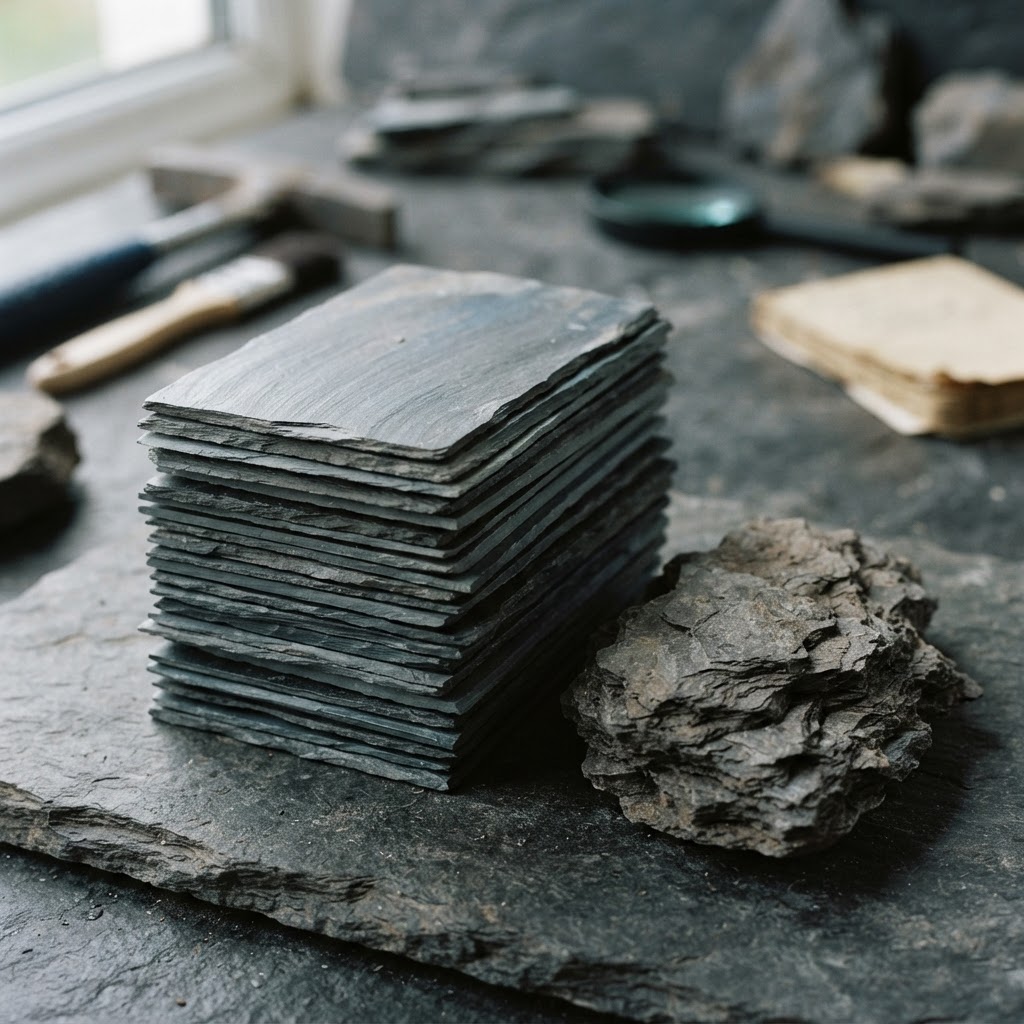
Try to split the rock. Slate cleaves into thin, flat, remarkably even sheets. Strike a piece with a chisel or a hammer along the grain and it comes apart cleanly, often into sheets only a few millimetres thick.
The sheet surfaces are dull to slightly satiny, and they often carry a faint sheen from the aligned mica flakes. Run a fingernail across the surface: it feels smooth, not gritty.
Slate also rings when you tap it. A thin sheet of good roofing slate gives a clear, almost bell-like note, which is one of the traditional ways slate quality was judged. A dull thud means a flaw.
Hardness is 2.5 to 4, depending on how much quartz the rock contains. That is soft enough that a knife scratches it, though not as easily as shale.
Slate vs Its Lookalikes
Four rocks are mistaken for slate, and the split test separates most of them.
| Rock | Hardness | How to tell it from slate |
|---|---|---|
| Shale or mudstone | 2–3 | Sedimentary, so it splits along bedding rather than cleavage, and the sheets are rougher and less even. It also disintegrates in water and feels softer and duller. |
| Phyllite | 3–4 | Higher metamorphic grade. The cleavage surfaces are wavy rather than flat, and it has a stronger, silky sheen from more abundant mica. |
| Schist | 3–5 | Higher grade again. The mica flakes and other minerals are visible with the naked eye, so the surface glitters rather than being smooth and satiny, and it does not split into thin flat sheets. |
| Bluestone (basalt) | 6 | In Melbourne the word bluestone means basalt, not slate. Basalt is much harder, has no cleavage at all, and does not split into sheets. |
Colour and What Causes It
Slate is most commonly grey to blue-grey, and the blue-grey material is the classic roofing slate of Wales and Vermont. The colour comes from fine-grained graphite, chlorite and iron minerals.
Black slate contains more organic carbon. Green slate owes its colour to chlorite. Red and purple slate contains iron oxides in a more oxidised state, and it usually formed from a mud that was deposited in oxygen-rich conditions.
Some slate is mottled or banded where the colour changes across the sheet. This is a relic of the original sedimentary layering, and it is a nice demonstration that the cleavage and the bedding are two different things.
Where Slate Comes From
Slate requires a specific combination: a fine-grained muddy parent rock, low-grade metamorphism, and directed pressure. That usually means an ancient mountain belt.
The most famous slate country in the world is North Wales, where the quarries at Penrhyn and Blaenau Ffestiniog roofed much of Britain and exported worldwide. Vermont and New York in the United States, Spain, Portugal, Brazil and China are also major producers.
In Australia, slate occurs in the metamorphic belts of Victoria, New South Wales and Tasmania, generally in the older folded terrains associated with the Lachlan Fold Belt and its equivalents. It is not a major commercial product here, and most Australian roofing slate is imported.
One Australian naming trap: in Melbourne, bluestone is basalt, not slate, even though the two can look similar in colour. If you are identifying a dark blue-grey building stone in Melbourne, you are almost certainly looking at basalt.
Uses
Slate has been a roofing material for centuries because it splits into flat, water-resistant, durable sheets. A good slate roof lasts a century or more, and many historic buildings still carry their original slates.
It is also used for flooring, paving, cladding, billiard tables, laboratory benches and, historically, for writing slates. Ground slate has been used as a filler and as a lightweight aggregate.
As a specimen, slate is less about beauty than about structure. A good piece shows the cleavage clearly, and if you are lucky you will find one where the cleavage and the original bedding cross each other at an angle, which is the clearest possible demonstration of what metamorphism does.
The Bottom Line
Slate is low-grade metamorphic rock, derived from shale, that splits on slaty cleavage into thin flat even sheets. Hardness 2.5 to 4, dull to satiny surfaces, and often a clear ring when tapped.
Shale splits on bedding and crumbles in water. Phyllite has wavy cleavage surfaces with a stronger sheen. Schist has visible glittering crystals and does not split flat. Melbourne bluestone is basalt, which is much harder and has no cleavage.
For the igneous stone that shares its name, see basalt identifier. Sandstone identifier and granite identifier cover the other common building stones, and mineral identifier explains the hardness and streak method.
Frequently Asked Questions
Try to split it. Slate cleaves into thin, flat, even sheets along slaty cleavage, the surfaces are dull to satiny, and a thin sheet often rings when tapped. Hardness is 2.5 to 4.