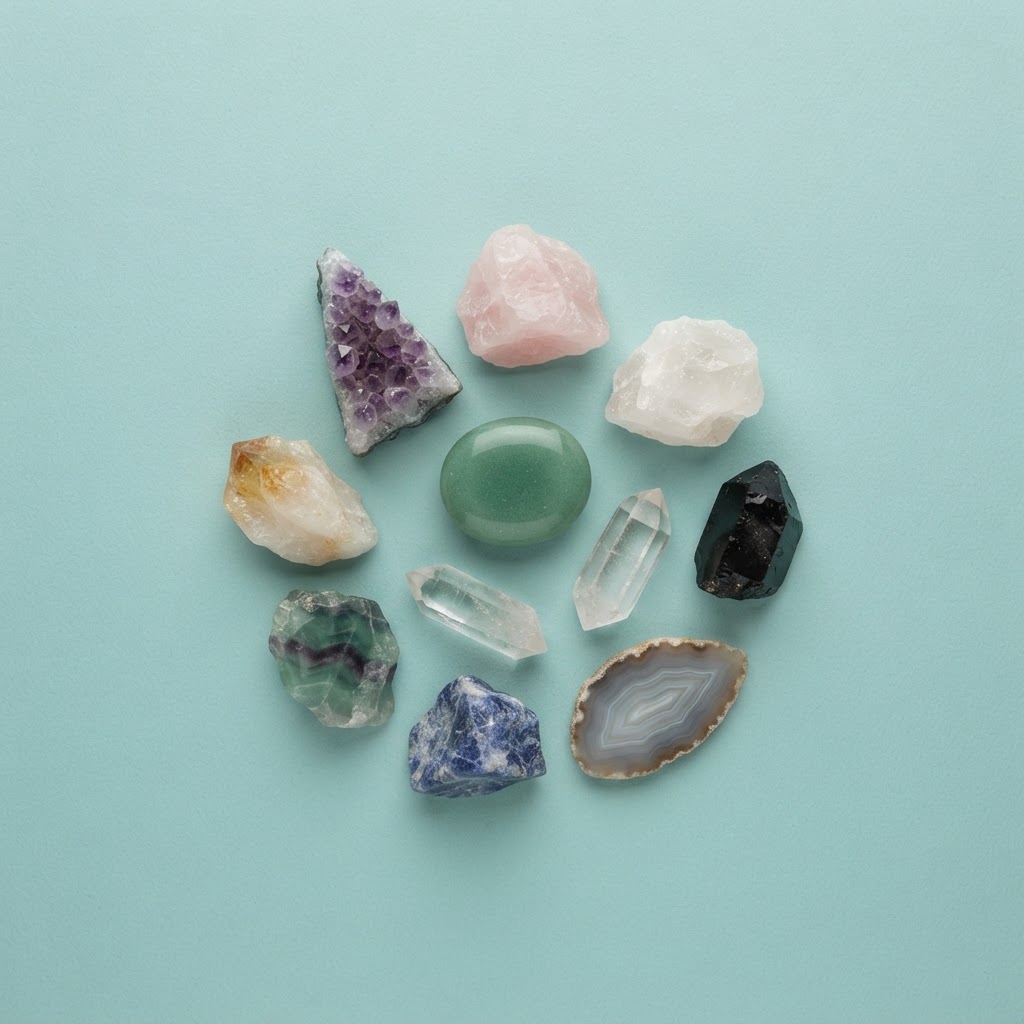
Most Crystals People Have Are One of About Twenty
There are thousands of mineral species, but the crystals that turn up in shops, in gravel, on beaches and in inherited collections come from a surprisingly short list. Learn those twenty and you can name the great majority of what you will ever be handed.
The reason is commercial. Quartz, amethyst, calcite, fluorite, pyrite, gypsum and the feldspars are abundant, easy to mine and attractive, so they dominate both the mineral trade and the geology you meet in the field.
So the useful skill is not encyclopaedic knowledge. It is knowing the twenty common ones well enough to recognise them on sight and confirm them with one test.
The One Test That Identifies Most of Them
Hardness separates the common crystals better than any other single property, because the common ones are spread widely across the scale.
Gypsum is 2 and a fingernail scratches it. Calcite is 3 and a copper coin does. Fluorite is 4 and a knife does. Apatite is 5 and a knife just about does. Feldspar is 6 and a knife will not. Quartz is 7 and it scratches glass. Beryl is 7.5 to 8, topaz is 8 and corundum is 9.
Work through that ladder once and you have placed the specimen in a group of two or three, and the second test — streak, acid, cleavage or magnetism — finishes it.
The Common Crystals
Everything below is confirmed by hardness plus one other property, which is listed with each entry.
The Traps
The most common mistakes with common crystals are all variations on the same theme: assuming a familiar colour means a familiar mineral.
Purple does not always mean amethyst — it can be fluorite, lepidolite or charoite, and fluorite is far softer. Green does not always mean emerald or jade. Clear does not always mean quartz, because calcite, fluorite and topaz are all clear too.
The second trap is dyed and synthetic material. Blue dyed quartz is sold as lapis, green dyed quartz as emerald, and lab-grown quartz is indistinguishable from natural by eye. The tests above still work on treated stones, because dye does not change hardness.
- Check hardness on a fresh face, not a weathered one.
- Check streak before you trust colour.
- Check for dye pooling in cracks if the colour looks unusually vivid.
- Check for round bubbles, which mean glass rather than crystal.
Photographing a Crystal for a Lookup
If you are going to use a photo tool alongside the lookup, take the shot that shows the crystal habit rather than the one that shows the colour. Habit is diagnostic, colour is not.
One shot of the whole crystal for form and scale, one close-up of a broken face for lustre and fracture, and one backlit shot if the material is translucent. Daylight, no flash, and something neutral for scale.
The Bottom Line
Twenty common crystals cover most of what you will ever be handed, and hardness places nearly all of them. Gypsum 2, calcite 3, fluorite 4, apatite 5, feldspar 6, quartz 7, beryl 7.5 to 8, topaz 8, corundum 9.
Then confirm with streak, acid, cleavage or magnetism. Do not trust colour on its own, and check vivid stones for dye.
For related reading, see crystal identification app and quartz identifier. Mineral identifier covers the method, tumbled stones identifier covers polished pieces, and crystal identifier app covers what photo tools can do.
Frequently Asked Questions
Quartz, by a very long way. It makes up a large share of the Earth’s crust, comes in almost every colour, and turns up in nearly every rock type and every gravel bed.