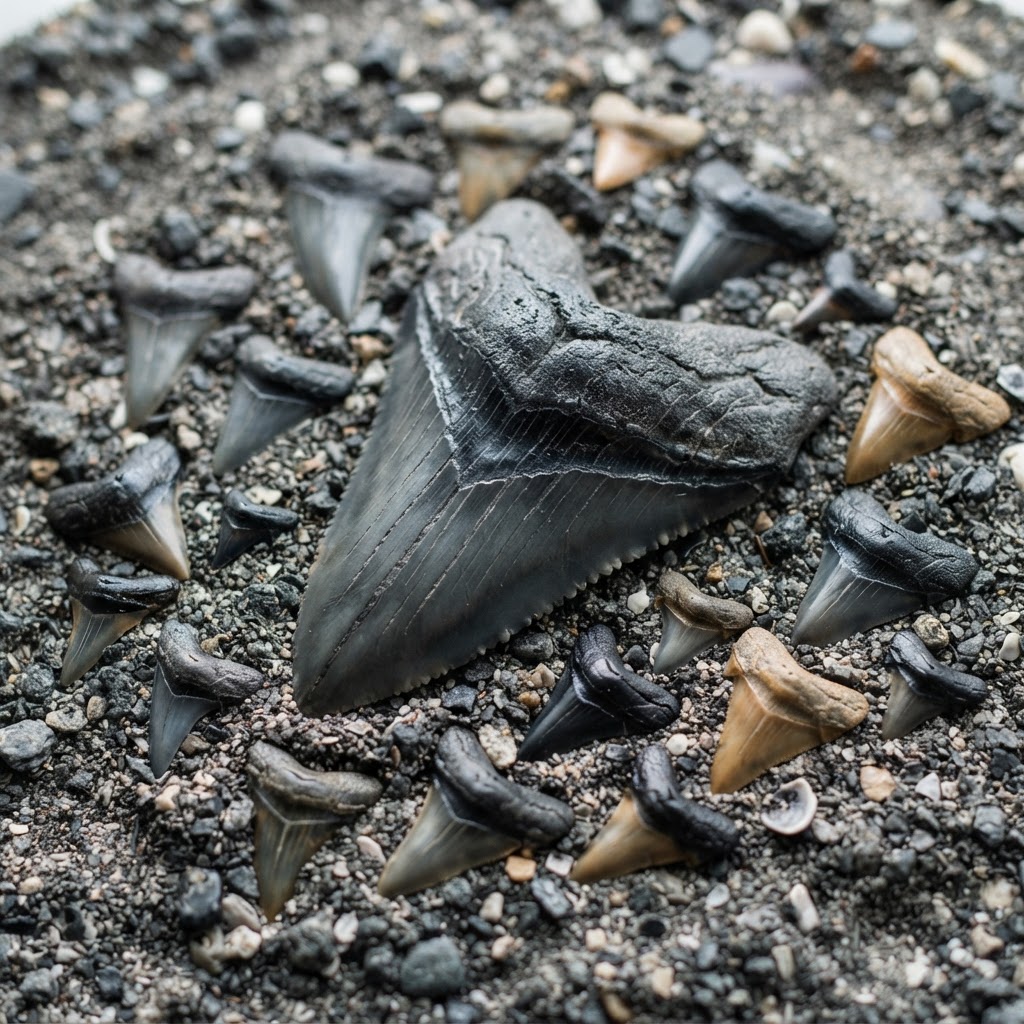
Why Shark Teeth Fossilise So Well
A shark skeleton is mostly cartilage, which almost never fossilises. Teeth are the exception. They are made of dentine capped with enamel, both of which are hard, mineralised tissues, and a single shark can shed thousands of teeth in a lifetime.
That combination — hard teeth, endless supply, and sea-floor sediment to bury them in — is why fossil shark teeth are among the most common vertebrate fossils in the world. Some beaches are practically paved with them.
Over millions of years the original material is mineralised, usually with phosphate from the surrounding sediment. That is what turns a white tooth into the grey, black, brown or tan fossil you pick up today.
Reading a Real Tooth
A fossil shark tooth has three parts worth looking at: the crown, the root, and the junction between them.
The crown is the blade. On most species it is smooth and glossy, with a sheen that is hard to fake. Many species have serrated edges, and those serrations should be sharp, irregular and slightly different from one another.
The root is the clincher. Real fossil teeth almost always retain part of the root, which is porous, matte and a different colour from the crown. On many species there is a distinctive nutrient groove running along the base, and on others the root has two lobes.
Where the enamel meets the dentine you should be able to see a clear band of transition. That layered structure — hard enamel over softer dentine over porous root — is very difficult to reproduce convincingly in resin.
The Five Tests for a Replica
Resin and plaster casts are extremely common in souvenir shops. These checks catch most of them.
- Gloss. Real enamel has a deep, wet-looking gloss. Resin looks either too matte or uniformly plasticky, and the shine does not change as you rotate it.
- Weight. Fossil teeth are dense and stone-like. A cast of the same size feels light and hollow.
- Sound. Tap it gently against your tooth or a hard surface. A fossil clicks; resin thuds dully.
- Mottling. Natural fossils are unevenly stained, with colour varying across the crown, root and any cracks. Casts are usually a single uniform colour, sometimes with paint pooled in the serrations.
- Serrations and edges. Machine-cast serrations tend to be uniform and slightly rounded, and the edges may show a seam or mould line. Real serrations vary in size and are razor-sharp.
Fossil Tooth vs Other Fossil Shapes
Not everything pointed and tooth-like is a shark tooth, and not every shark fossil is a tooth.
| Material | What it is | How to tell it from a shark tooth |
|---|---|---|
| Belemnite guard | The internal shell of an extinct squid-like animal | A solid bullet or cigar shape with a pointed end and a hollow socket at the other. No enamel, no serrations, no root. |
| Fish tooth | Teeth of bony fish | Usually smaller and more slender, often with a rounded or flattened tip, and rarely serrated in the shark pattern. |
| Ray or skate plate | Crushing tooth plates | A flat, tessellated mosaic of small blocks rather than a single blade. |
| Concretion | A mineral nodule | No enamel gloss, no root structure, and it does not taper to a blade edge. Often has concentric internal layering. |
| Resin replica | A cast sold as a souvenir | Uniform colour, light weight, dull tap, and a seam or mould line along the edge. |
Where Fossil Shark Teeth Come From
They occur wherever marine sediments of the right age are exposed, and a few places are world famous. Florida is the big one: Venice Beach, the Peace River and the phosphate mines produce enormous numbers, from small sand tiger teeth to the occasional megalodon. North and South Carolina, especially around Summerville, are also prolific.
Outside the United States, Morocco exports huge quantities of Cretaceous and Eocene teeth from the phosphate deposits around Khouribga. England has classic localities at Barton-on-Sea and on the Isle of Sheppey, and Australia has fossil shark teeth in Tertiary marine sediments in several states.
Megalodon teeth are the ones everybody wants. They are genuinely enormous — the largest known exceed 17 centimetres — and they have a distinctive shape: a broad triangular blade, fine serrations, a pronounced bourlette between crown and root, and a large V-shaped neck.
Before You Collect
Collecting rules vary enormously, and this is one of the areas where people get into trouble. In the United States, some beaches and rivers are open to collecting and others are not, and rules on federal and state land are stricter than on private land.
In Australia, vertebrate fossils are protected in most states. Fossils are part of the natural heritage, and collecting them from Crown land, national parks or fossil sites without a permit is generally prohibited. If you find something significant, report it rather than pocket it.
Wherever you are, the safe approach is to check the rules for the specific site before you go, and to leave anything that looks scientifically important in place.
The Bottom Line
A fossil shark tooth has glossy enamel over dentine, a porous root that is usually a different colour, and irregular sharp serrations if the species has them. It is dense, it clicks when tapped, and the staining is uneven.
A replica is uniform in colour, light in the hand, dull when tapped, and often shows a seam. That is five quick checks that will catch nearly every fake.
For other fossil guides, see petoskey stone identification and coprolite identification. Beach gemstones identification covers what else to look for on a shoreline, and rock identification by photo explains how to photograph a specimen for a reliable identification.
Frequently Asked Questions
Check the gloss, weight, tap sound, colour mottling and serrations. Real fossil teeth are dense, glossy, unevenly stained and click when tapped, while resin casts are light, uniform in colour and thud dully.