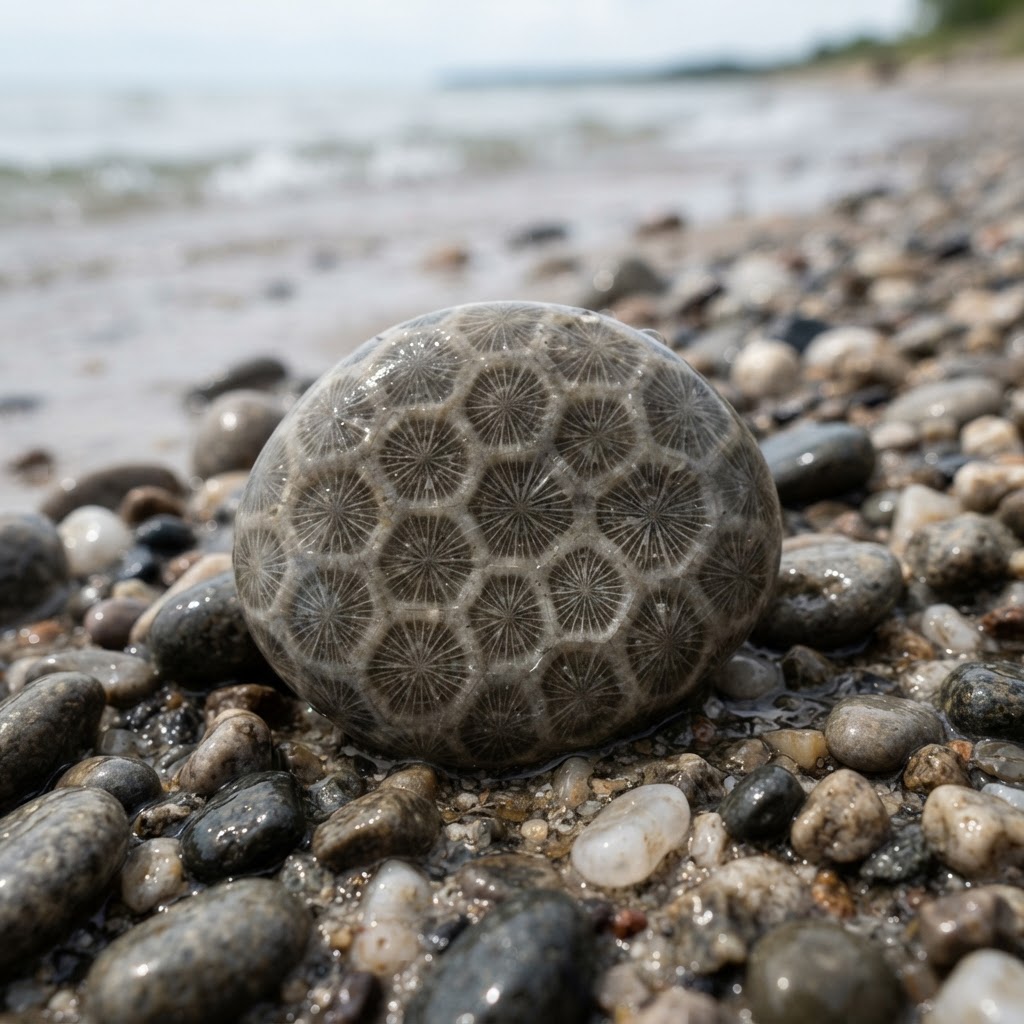
What a Petoskey Stone Is
A Petoskey stone is a piece of fossilised colonial coral, and the species is Hexagonaria percarinata. It lived in a shallow tropical sea during the Devonian period, roughly 350 million years ago, in what is now the Great Lakes region of North America.
The rock itself is the coral colony, replaced and cemented by calcite. When it is wet or polished, the surface shows a honeycomb of tightly packed hexagons, each one a single coral polyp’s skeleton, with a sunburst of fine lines radiating from the centre of each cell.
Michigan made it the state stone in 1965, and the name comes from Petoskey, a town on the shore of Lake Michigan where the stones wash up in quantity.
Why You Have to Wet It
Dry, a Petoskey stone looks like an ordinary grey pebble. The pattern is there but the contrast is too low to see. This is the single most common reason people walk past them.
Wet the stone — lake water is fine, a spray bottle is better — and the hexagons jump out. The calcite in the coral skeleton takes a polish differently from the surrounding matrix, so any moisture or polish brings the pattern up sharply.
That is why beach hunters on Lake Michigan carry a spray bottle, and it is why almost every good Petoskey stone in a collection has been polished. If you find a promising grey pebble on a Great Lakes beach, wet it before you decide.
Reading the Pattern
Each hexagon is a corallite: the skeleton of one coral animal. Inside each one you should see fine radiating lines called septa, running from the centre out to the walls of the hexagon. In a good specimen they form a distinct sunburst or spider pattern.
The hexagons are packed tightly together with no gaps, sharing walls, which is what gives the stone its honeycomb look. They are usually between about three and ten millimetres across.
The colour varies with the matrix. Most Petoskey stones are grey to tan, with darker septa. Some are almost black, and a few are pale cream. The pattern, not the colour, is what matters.
Petoskey Stone vs Its Lookalikes
Two fossil corals and three mineral patterns account for almost all the confusion.
| Material | What it is | How to tell it from a Petoskey stone |
|---|---|---|
| Favosites | A tabulate coral, also Devonian, also found in Michigan | Smaller honeycomb cells with no radiating septa. The cells are simple tubes, so there is no sunburst inside. Often sold as Charlevoix stone. |
| Horn coral | A solitary rugose coral | A single large cone or horn shape rather than a packed colony. Cut across it, it shows radiating septa in one big circle, not a honeycomb. |
| Septarian pattern | Mineral veins in a nodule | Cracks filled with calcite, not fossils. The lines are irregular and do not form repeating hexagons. |
| Stromatoporoid | An extinct sponge-like organism | A layered, lumpy structure with no regular cell pattern at all. |
| Ordinary limestone | Sedimentary rock | No repeating pattern. Fizzes in acid, as does a Petoskey stone, so use the pattern rather than the acid test. |
The Acid Test and Hardness
Both a Petoskey stone and ordinary limestone are calcite-based, so both fizz in dilute acid. That makes the acid test useless for telling them apart, but it is useful for confirming that you are looking at a carbonate rather than a quartz-based lookalike.
Hardness is 3 to 4, which is soft. A copper coin will scratch a Petoskey stone. A knife will scratch it easily. If your specimen resists a knife, it is not a Petoskey stone, whatever pattern it shows.
Handle them carefully for the same reason. They scratch, they chip, and a drop onto a hard floor can ruin a good specimen.
Where to Find Them
The classic ground is the Lake Michigan shoreline around Petoskey, Charlevoix and Traverse City, and the Traverse Group limestones of northern Michigan generally. They also turn up in Iowa, Indiana, Ohio and New York, anywhere Devonian limestone is exposed.
Beaches are best after a storm, when wave action has shifted the gravel. Early morning, before the crowds, is the usual advice. Look for grey pebbles with a faint texture, then wet them.
Collecting rules matter here. Collecting is allowed on many Michigan beaches but restricted in state parks and on some private shoreline, and there are limits on how much you can take. Check before you fill a bucket.
The Bottom Line
A Petoskey stone is fossil colonial coral with a packed honeycomb of hexagons, each containing a radiating sunburst of septa. It is calcite, hardness 3 to 4, and it needs to be wet or polished before the pattern reads properly.
Favosites is the main trap: same age, same region, similar honeycomb, but no radiating septa inside the cells.
For other fossil material, see shark tooth identification and coprolite identification. Mineral identifier covers the acid and hardness tests, and rock identification by photo explains how to photograph a pattern like this clearly.
Frequently Asked Questions
Wet the stone and look for tightly packed hexagons with fine radiating lines inside each cell, forming a sunburst pattern. The stone is calcite, hardness 3 to 4, so a copper coin will scratch it.