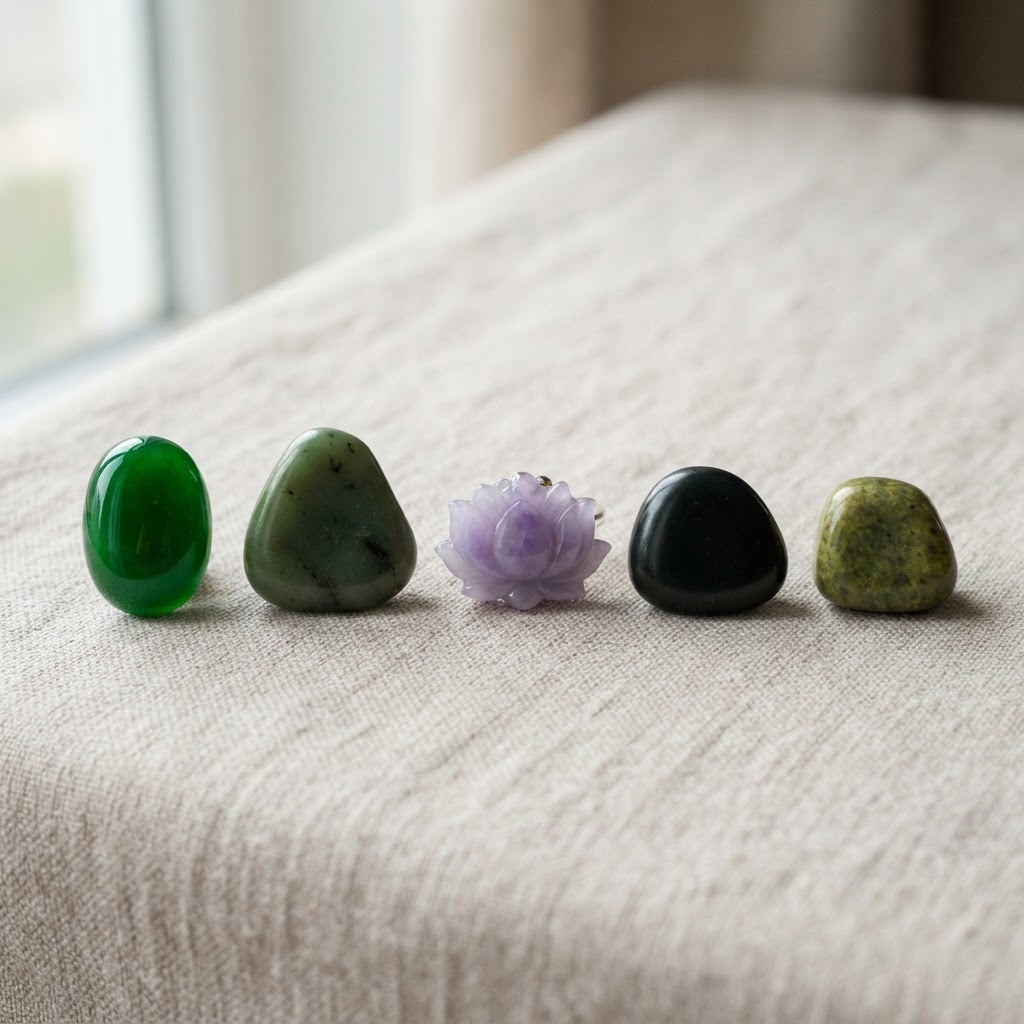
Jade Is Two Different Minerals
This is the first thing to get straight, because it explains almost everything else. The word jade covers two completely different minerals that were grouped together historically because they look alike and behave alike.
Nephrite is an amphibole, part of the actinolite–tremolite series. It is the material of Chinese carving, of Māori pounamu, and of most ancient jade artefacts. Hardness 6 to 6.5, specific gravity 2.95 to 3.0.
Jadeite is a pyroxene. It is harder at 6.5 to 7 and denser at 3.25 to 3.4, and it is the material of the finest Burmese imperial green jade. It was not recognised as a separate mineral until 1863, which is why a lot of older references lump the two together.
Toughness, Not Hardness
Jade is famous for being tough, and toughness is not the same thing as hardness. Hardness is resistance to scratching. Toughness is resistance to breaking, and jade is the toughest natural stone there is.
The reason is its texture. Both nephrite and jadeite are made of interlocking fibrous crystals, tangled together like felt. A crack has to work its way around thousands of fibres rather than running through a single plane, so jade absorbs impacts that would shatter granite or quartz.
That is why jade was used for axe heads, for mauls and for weapons long before it was used for jewellery. It is also why jade carving can be so delicate: thin sections hold together because the fibrous structure resists cracking.
The practical test follows from this. Strike jade with a hammer and it will not shatter along a clean plane. It dents, bruises and eventually breaks irregularly. Nothing else in the gem world behaves quite that way.
Colour and What It Means
Nephrite ranges from cream and white through the spinach and sage greens to brown and black. The most valued nephrite is a rich, even, slightly translucent green.
Jadeite has a wider range. Imperial green, the most valuable jade in the world, is a deep vivid emerald green that is almost transparent. Jadeite also occurs in lavender, white, orange, grey and black, and "black jade" is usually jadeite coloured by graphite or iron.
Both stones are usually cut as cabochons, beads or carvings rather than faceted, because the value is in the colour and the texture rather than in brilliance. Jadeite is not particularly brilliant, and nephrite is opaque to translucent.
Jade vs Its Imitators
The jade market is the most imitated in the gem world, and most of what is sold as jade is not jade.
| Material | Hardness | How to tell it from jade |
|---|---|---|
| Serpentine (new jade, Korean jade) | 2.5–5.5 | Much softer, so a knife scratches it. Specific gravity 2.5 to 2.6, noticeably lighter, and it feels waxy rather than hard. |
| Dyed quartzite (Malaysian jade) | 7 | Harder than jade, and the dye sits in cracks and pores rather than in the stone. Colour is usually too uniform and too bright. |
| Soapstone or talc | 1 | Extremely soft and greasy, marks with a fingernail, and is usually carved rather than polished. |
| Grossular garnet (Transvaal jade) | 6.5–7.5 | Much heavier at specific gravity 3.6, singly refractive, and it has a resinous lustre rather than the waxy look of jade. |
| Vesuvianite (Californite) | 6.5 | Similar colour and hardness, but it is usually mottled with white patches and has a greasier feel. Specific gravity 3.3 to 3.4. |
| Glass or resin | 5–5.5 | Contains bubbles, is isotropic, and is uniform. It also feels warm rather than cold and dense. |
| Bleached and polymer-treated jadeite | varies | Real jadeite that has been acid-bleached, impregnated with polymer and dyed. Looks unnaturally even, and it is sold as "B" or "B+C" jade. |
The Field Tests
Specific gravity is the most useful measure. Jadeite at 3.25 to 3.4 and nephrite at 2.95 to 3.0 both feel notably heavy for their size, and they feel cold. Serpentine, the most common substitute, is much lighter at 2.5 to 2.6.
Hardness separates jadeite from serpentine immediately. Jadeite at 6.5 to 7 scratches glass and resists a knife. Serpentine at 2.5 to 5.5 does not, and a knife marks it easily.
Sound is a traditional test. Tap a piece of jade gently against another — good jade rings clear and sustained, while treated, cracked or imitation material gives a dull thud. It takes practice, but it works.
And finally, look at the surface. Natural jade has a slightly uneven, waxy lustre with subtle variations in translucency. Bleached and polymer-treated material looks glassy and unnaturally even, and it can show a faint haze or a network of fine cracks from the acid treatment.
Where Jade Comes From
Myanmar is the world’s dominant source of jadeite, and it has been for centuries. Guatemala, Japan, Russia and the United States produce smaller amounts.
Nephrite is more widespread. British Columbia, Siberia, Alaska, Wyoming and Taiwan all produce it. New Zealand’s South Island produces pounamu, the greenstone that is central to Māori culture and is protected under New Zealand law — it is taonga, a treasure, and there are significant restrictions on its collection and export.
Australia has nephrite in the Great Serpentine Belt of New South Wales, in Tasmania and in Western Australia. It is not a major commercial source, and most jade on the Australian market is imported.
One naming warning: "Australian jade" and "New Zealand jade" are sometimes applied to serpentine rather than nephrite. If a dealer is vague about which mineral they mean, ask.
The Bottom Line
Jade is either nephrite, at hardness 6 to 6.5 and specific gravity 2.95 to 3.0, or jadeite, at 6.5 to 7 and 3.25 to 3.4. Both are made of interlocking fibres, which makes them the toughest natural stones and gives them a waxy, cold, dense feel.
Serpentine is much softer and lighter. Dyed quartzite is harder and has dye in the cracks. Soapstone marks with a fingernail. Grossular garnet is much heavier. Glass has bubbles.
For related stones, see green stones identification and tumbled stones identifier. Turquoise identifier covers the other great opaque carved stone, and semi-precious gemstones identifier puts jade alongside the other affordable gems.
Frequently Asked Questions
Check the weight, the hardness and the feel. Real jade feels heavy and cold for its size, at specific gravity 2.95 to 3.4. Jadeite at 6.5 to 7 scratches glass, while the most common substitute, serpentine, is 2.5 to 5.5 and much lighter.