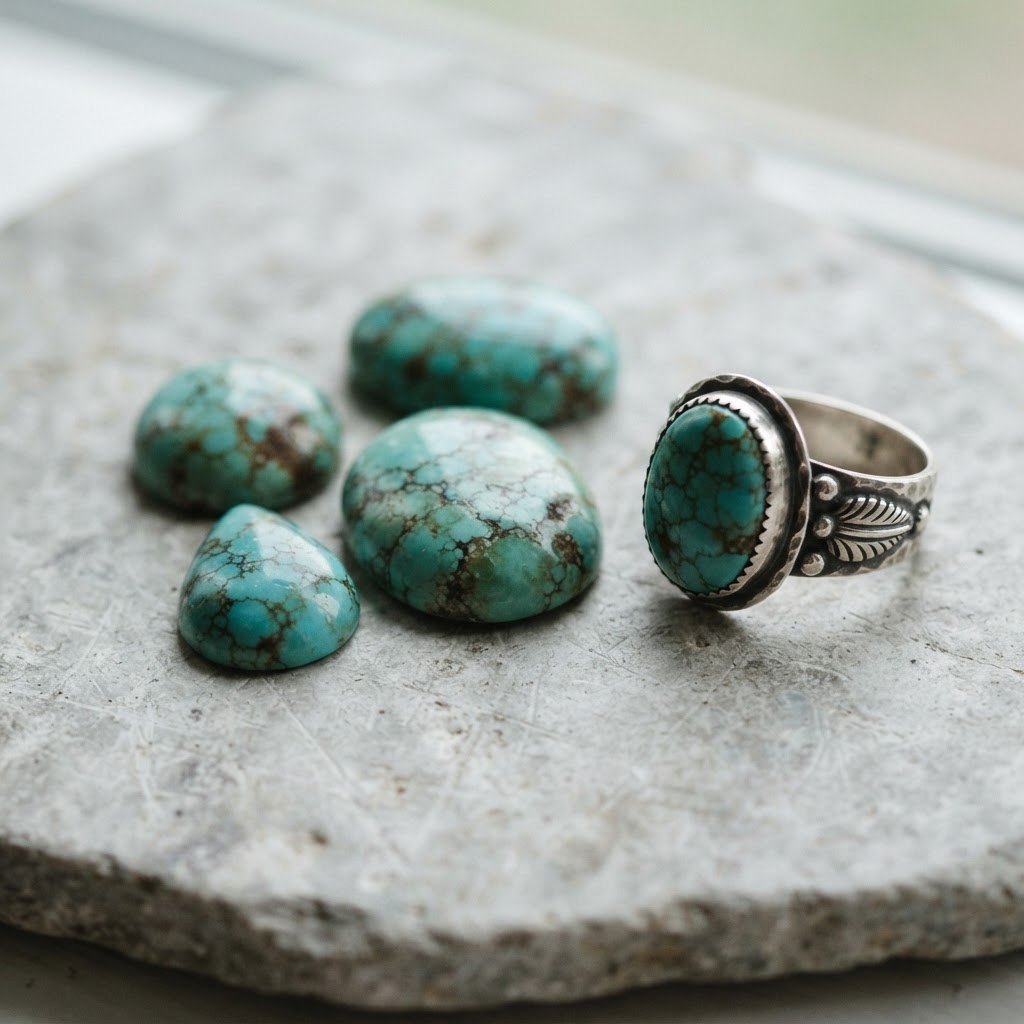
Turquoise Is Imitated More Than Any Other Stone
Turquoise has been valued for thousands of years, and it has been faked for almost as long. The problem is that genuine turquoise is soft, porous and often poor quality, while the materials used to imitate it are cheap, abundant and easy to colour.
That means the market is full of stones that look like turquoise and are not, alongside genuine turquoise that has been treated to hold together. Knowing which is which is mostly about understanding what real turquoise actually is.
What Real Turquoise Looks Like
Turquoise is a hydrated copper aluminium phosphate — chemically, CuAl6(PO4)4(OH)8·4H2O. The copper is what makes it blue. Where iron replaces some of the aluminium, the colour shifts toward green, which is why turquoise runs the full range from sky blue to apple green.
It is a relatively soft stone at hardness 5 to 6, and it is porous. Those two facts explain most of what goes wrong in the market: soft stones scratch and porous stones absorb oils, dyes and resins, which is exactly what makes treatment and imitation so easy.
Real, Stabilised and Fake
Not everything that is not pure natural turquoise is a con. There is a legitimate middle ground, and it should be labelled.
| Type | What it is | How to spot it |
|---|---|---|
| Natural turquoise | Untreated stone, cut and polished | Slight colour variation, natural matrix, waxy to dull lustre. Rare and expensive. |
| Stabilised turquoise | Low-grade turquoise impregnated with resin | Harder and glossier than natural. Colour is deeper and more even. Should be disclosed. |
| Treated turquoise | Surface coated with resin or oil | Glassy surface sheen that looks like a coating rather than the stone itself. |
| Reconstituted | Ground turquoise powder bonded with resin | Uniform colour, no natural matrix, often suspiciously cheap. |
| Dyed howlite | White howlite dyed blue | Grey-black web veins that are too regular and too dark. Dye pools in the veins. |
| Dyed magnesite | White magnesite dyed blue or green | Very uniform colour, no matrix at all, and dye visible in any surface cracks. |
| Plastic or resin | Moulded imitation | Light, warm to the touch, and perfectly uniform. Often has mould seams or bubbles. |
The Matrix Is Your Best Clue
Turquoise does not usually form as a clean, solid blue mass. It grows in veins and cavities in its host rock, so most real turquoise carries some of that host rock with it as a dark web of veins running through the stone. That web is called the matrix.
Natural matrix is irregular. It branches unpredictably, varies in thickness, and follows the way the vein grew. The matrix in dyed howlite, by contrast, is a regular grey-black web that looks like a printed pattern, and because howlite is porous the dye soaks into the veins and darkens them further. A matrix that looks like a design rather than a fracture is a warning sign.
The other end of the spectrum is turquoise with no matrix at all. That does exist — the famous Sleeping Beauty mine in Arizona produced almost matrix-free blue material — but the mine closed in 2012 and clean, deep blue, matrix-free turquoise is now genuinely rare and priced accordingly. If someone is selling it cheaply, it is not that.
Why the Hot Needle Test Is a Bad Idea
The hot needle test is the most widely repeated turquoise test and one of the worst. The idea is that heating a needle and touching it to the stone will smell of burning plastic if the stone is fake.
It will, if the stone is solid plastic. But it will also scorch the surface of genuine turquoise, damage the resin in stabilised turquoise, and leave a permanent mark on a stone you may have paid a lot of money for. It also cannot detect dyed howlite or dyed magnesite, which are the two most common fakes. Do not do it.
If you want a non-destructive check, use a cotton bud dipped in acetone on an inconspicuous spot such as the back of a cabochon. On dyed howlite or magnesite the dye will lift onto the bud. On natural turquoise, nothing comes off. On stabilised turquoise you may see a faint resin residue, which tells you the stone has been treated rather than faked.
Dyed Howlite and Magnesite
These two account for a huge share of the "turquoise" sold online. Howlite is a white to grey borate mineral with a natural web of dark veins, which makes it an almost perfect blank canvas for a turquoise imitation. Magnesite is white and porous, takes dye beautifully, and has no veins at all.
Both are softer than turquoise — howlite is about 3.5 and magnesite about 3.5 to 4.5, where turquoise is 5 to 6. That gives you a genuinely useful test: on real turquoise a steel blade is borderline, but on dyed howlite or magnesite a blade cuts in easily. Turquoise is also heavier than it looks for its size, while the dyed imitations feel light.
One more giveaway is colour behaviour. Real turquoise varies across a single stone, often shifting subtly from blue to green. Dyed material is uniform, and where the dye has settled in cracks or pores it is noticeably darker than the surrounding surface.
Hardness and the Copper Question
Turquoise sits at hardness 5 to 6. That means a steel blade at 5.5 is right on the boundary — sometimes it marks, sometimes it does not. That is not a very useful test on its own, which is why hardness works better as a way of ruling out the softer imitations than as a way of confirming turquoise.
The copper content is the more interesting angle. Turquoise is a copper mineral, and a proper test for copper will react positively on it. Some collectors use a drop of dilute nitric acid, which turns blue-green in the presence of copper. This is destructive on a porous stone, so it belongs in a laboratory rather than on your kitchen table, but it explains why turquoise is a genuine mineral rather than just a coloured rock.
How to Buy Turquoise You Can Trust
Buy from a seller who names the mine. Genuine turquoise is usually sold as Kingman, Morenci, Bisbee, Tyrone, Carico Lake, Persian or similar, because the mine is part of the value. A seller who cannot say where the stone came from is usually selling dyed howlite.
Expect variation. Real turquoise is almost never perfectly even in colour, and stones with natural matrix are the norm rather than the exception. Expect to pay properly for clean, deep blue material, because the supply is limited and the good mines are largely worked out. And treat any turquoise jewellery under about twenty dollars as what it almost certainly is — a dyed substitute.
Take care of it once you own it. Turquoise is porous and will absorb skin oils, sunscreen, perfume and soap. Keep it away from chemicals, take it off before swimming or showering, and store it out of direct sunlight, which can fade the colour over years.
The Bottom Line
Real turquoise is a soft, porous copper mineral at hardness 5 to 6, with irregular natural matrix and colour that varies across the stone. Dyed howlite has too-regular grey-black veins, and dyed magnesite has no veins and a perfectly even colour.
For the wider field, semi precious gemstones identifier covers the other major opaque gemstones, and gemstone identification app explains what a photograph can and cannot settle before you buy.
Frequently Asked Questions
Look at the matrix and the colour. Real turquoise has irregular natural matrix and colour that varies across the stone. Dyed howlite has a regular grey-black web and dye pooling in the veins. An acetone swab on the back will lift dye from a fake.