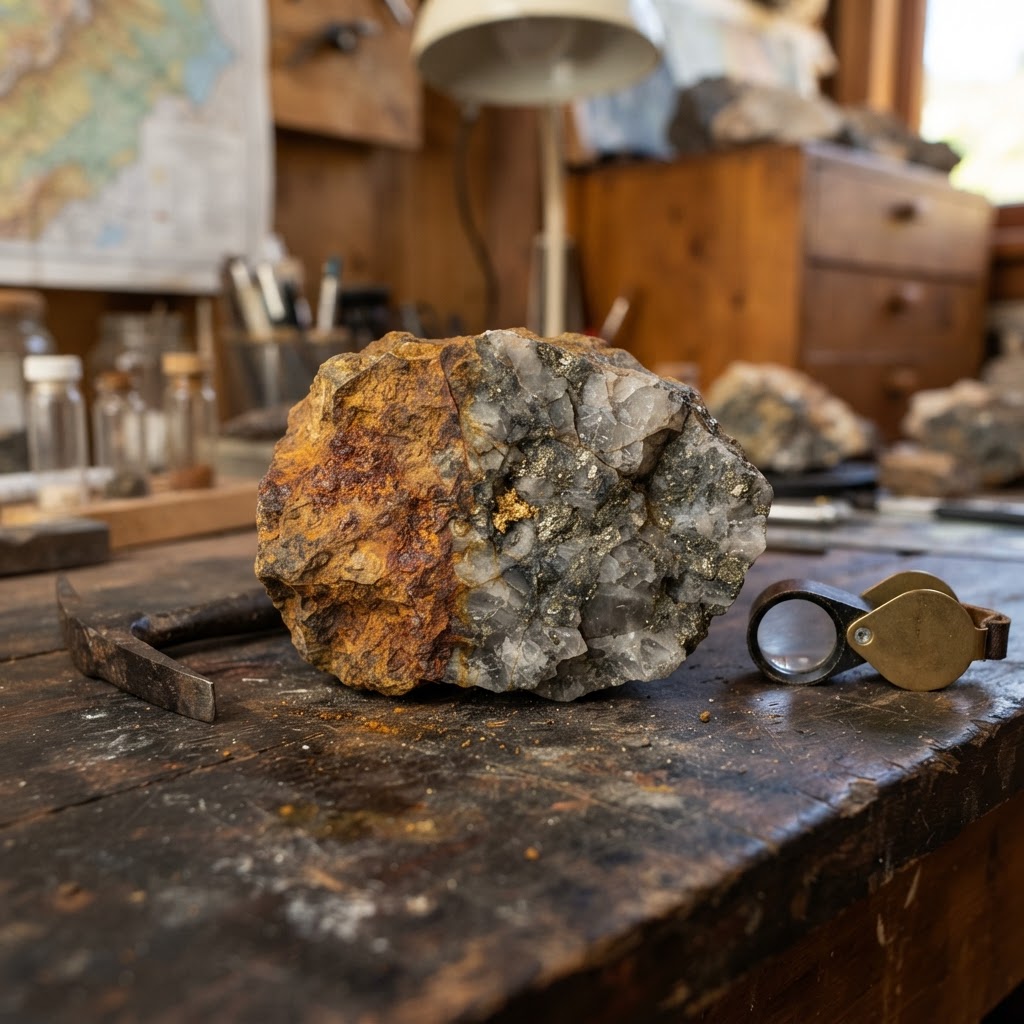
Ore Is Not the Same as a Specimen
A gold specimen is a rock with visible gold in it, kept because it looks good. Gold ore is a rock that contains enough gold to be worth processing, and those are two very different things. Almost all ore contains no visible gold whatsoever.
That distinction is the single most important thing to understand before you go looking. Mining operations work with grades measured in grams per tonne, and a gram of gold in a tonne of rock is invisible to every human sense. What prospectors actually look for is not gold — it is the set of rock types, structures and alteration features that tend to carry it.
The Host Rocks Worth Knowing
Gold is not evenly distributed through the crust. It concentrates in particular geological settings, and knowing which ones you are standing on narrows the search enormously.
| Setting | What it looks like | Why it matters |
|---|---|---|
| Greenstone belts | Dark green, altered volcanic and sedimentary rock, often with a schistose fabric | Host many of the world’s major goldfields, including the Archaean terrains of Western Australia |
| Quartz veins in older rock | Bulky white to grey quartz filling fractures in granite, slate or basalt | The classic primary setting. Gold deposits with the sulphides in the vein |
| Shear and fault zones | Crushed, broken or sheared rock, often with a slickensided or scaly texture | Fluids travel along these structures, so they focus where gold is deposited |
| Granite and granodiorite margins | Coarse pale igneous rock with dark inclusions near its edges | The heat source that drives the mineralising fluids in many systems |
| Placer gravels | Rounded stream gravel and heavy dark sand downstream of a vein | Gold survives weathering and concentrates in streams, which is why panning works |
The Field Signs That Actually Mean Something
None of these signs proves gold, and none of them is required. What they do is tell you that you are in a system where gold could plausibly be present.
- Rusty, iron-stained quartz. The orange and red staining comes from weathered sulphides, and sulphides are where gold likes to sit. A bright white quartz vein is less interesting than a rusty one.
- Vuggy or cellular quartz. Quartz with visible cavities where crystals once grew suggests open space for mineralising fluids to move through.
- Sulphide minerals. Pyrite, arsenopyrite, pyrrhotite and chalcopyrite are all common companions of gold. Arsenopyrite in particular is a well-known pathfinder.
- Brecciated rock. Angular fragments of rock cemented back together by quartz or iron oxide means fractures opened and fluids passed through them.
- Bleached or altered wall rock. Pale, soft, clay-like rock next to a vein is a sign that hot fluids altered it, which is what happens in a mineralising system.
- A gossan. The rusty, porous, iron-rich cap that forms when a sulphide body weathers at the surface. It is one of the classic surface expressions of a mineralised zone.
The Sulphide Connection
Gold does not usually travel alone. It is transported in hot fluids along with sulphur, arsenic, iron and other metals, and when those fluids cool, the sulphides drop out of solution and gold comes with them. That is why sulphide minerals are the most useful field indicator there is.
Pyrite, or fool’s gold, is the most common. It is the brassy, cubic iron sulphide that has fooled prospectors for centuries, and while it contains no gold itself, it frequently hosts microscopic gold particles trapped inside its crystal structure. Arsenopyrite, a silver-grey mineral with a distinctive metallic sheen, is an even stronger indicator in many deposits, and its presence is often what geologists look for first.
Pyrrhotite, chalcopyrite, galena and sphalerite are also common in gold-bearing systems. None of them is gold, and none of them guarantees gold. What they tell you is that the chemistry was right.
Oxidised and Refractory Ore
Near the surface, sulphides weather. Oxygen and water break them down into iron oxides, sulphuric acid and dissolved metals, leaving behind the rusty, porous rock that prospectors call oxidised ore. In oxidised ore the gold is relatively free, which is why it can often be recovered by simple gravity methods such as panning.
Go deeper and the rock is still fresh and sulphide-rich. This is called refractory ore, and it is much harder to process, because the gold is locked inside the sulphide crystals and cannot be reached by gravity or by simple chemical leaching. Commercial operations handle this by roasting the ore, oxidising it under pressure, or using bacterial leaching to break the sulphide down first.
For an amateur, the practical consequence is simple: rusty, oxidised rock near the surface is where hand methods work, and fresh sulphide-rich rock at depth is where they do not.
Why You Almost Never See the Gold
Gold in ore is usually submicroscopic. It occurs as particles measured in microns, invisible even under a hand lens, either locked inside sulphide crystals or dispersed through quartz along healed fractures. Deposits where you can see the gold with the naked eye exist, and they are called visible gold deposits precisely because they are unusual enough to deserve a name.
That is why the visible gold you might find in a creek is not a sign that you are standing on a deposit. It is a sign that somewhere upstream there is rock with enough gold in it for a little to have survived the journey. The trail is real, but it is long and usually ends at a deposit that was never economic.
How Ore Is Actually Tested
The definitive test is a fire assay. A weighed sample is fused with fluxes at high temperature, the gold is collected in a lead button, and the button is cupelled to leave a bead of precious metal that can be weighed precisely. It is the standard method because it is accurate at the very low concentrations that matter.
Portable X-ray fluorescence guns are widely used for field work, but they are unreliable for gold at low grades, because gold is usually present below the instrument’s reliable detection limit and because the gold may be locked inside minerals the gun cannot see into. A positive XRF reading is interesting; a negative one proves nothing.
Panning remains the best first pass for an amateur, because it concentrates the heavy fraction and costs nothing. If panning a crushed sample leaves a tail of yellow metal, you have something worth investigating properly. If it leaves nothing, you have your answer for the price of an afternoon.
The Bottom Line
Gold ore is rock, not treasure. Look for rusty iron-stained quartz, sulphides such as pyrite and arsenopyrite, brecciated or sheared rock, and the altered margins of greenstone belts or granite intrusions. Those are the settings where gold deposits form.
Then remember that the gold itself is almost always invisible, and that only an assay can tell you whether what you have is worth anything. If you are trying to work out whether yellow material in your rock is gold or pyrite, gold in rocks identifier covers that question directly, and mineral identifier will name the sulphides you find alongside it.
Frequently Asked Questions
Usually like ordinary rock. The useful field signs are rusty iron-stained quartz, sulphide minerals such as pyrite and arsenopyrite, brecciated or sheared rock, and the altered margins of greenstone belts. Most ore contains no visible gold at all.