The Two Questions Everyone Is Really Asking
When someone holds up a rock with yellow flecks in it, there are two separate questions hiding behind the one they ask. The first is whether the yellow material is gold or one of the minerals that imitate it. The second, and the one that actually matters, is whether any of it is worth anything.
The first question has a clear answer and you can reach it at home. The second question is where most disappointment lives, because visible gold is genuinely rare, and a rock containing a few specks of real gold is usually worth nothing at all.
What Gold Actually Looks Like in Rock
Native gold in rock is a metal, not a crystal, and it behaves like one. It is soft, it is heavy, it does not tarnish, and it deforms rather than shatters. Those four properties are the whole basis of telling it apart from the minerals that mimic it.
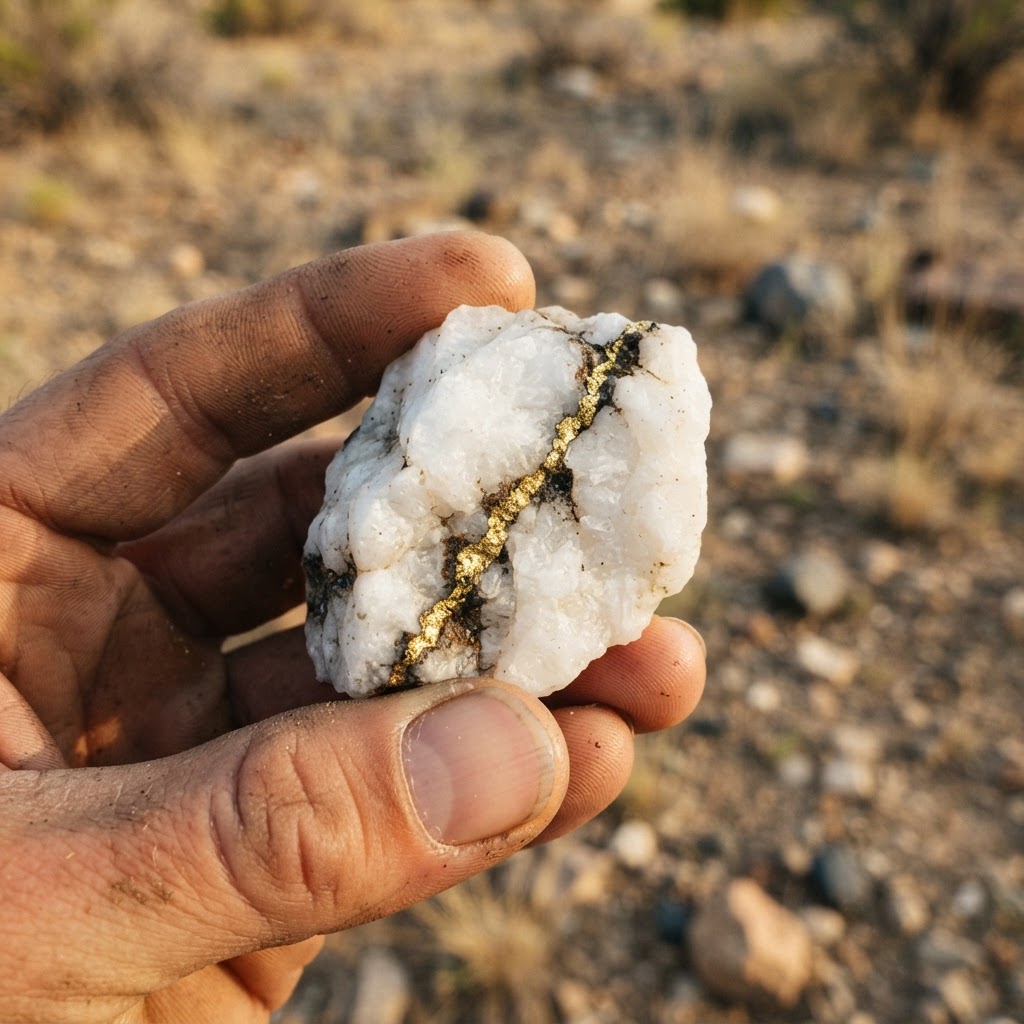
In quartz veins, gold typically appears as irregular flakes, wires or blebs filling cracks and cavities, often with a slightly duller, warmer colour than the brassy yellow people expect. In weathered rock it can look almost matte, because a thin surface film develops over time. Nuggets are the exception rather than the rule; most visible gold is measured in millimetres.
The context matters too. Gold is usually found in or near quartz veins cutting through older, altered rock, and it is often accompanied by iron oxides — the rusty staining that comes from weathered sulphides. A rusty, iron-stained quartz vein is the most promising thing an amateur can look at.
Gold and Its Imitators
These are the materials that fool people, and how each one gives itself away.
| Material | Hardness | Streak | How to tell it from gold |
|---|---|---|---|
| Gold | 2.5–3 | Golden yellow | Soft enough to cut with a knife. Malleable — it dents rather than breaks. Very heavy. |
| Pyrite (fool’s gold) | 6–6.5 | Greenish-black | Harder than a knife. Brittle — it shatters. Distinct cubic or pyritohedral crystal faces. |
| Chalcopyrite | 3.5–4 | Greenish-black | Softer than pyrite but still brittle, and it tarnishes to a purple or blue iridescence. |
| Muscovite mica | 2.5–3 | White | Flakes peel off in thin sheets. Very light — it flutters away rather than dropping. |
| Biotite mica | 2.5–3 | White | Dark brown to black flakes rather than yellow, but the same flaking and light weight. |
| Pyrrhotite | 3.5–4.5 | Dark grey | Weakly magnetic, which gold never is. Often a dull bronze rather than a bright yellow. |
| Marcasite | 6–6.5 | Greenish-black | A dimorph of pyrite. Brittle, hard and pale brassy, usually in radiating clusters. |
The Knife Test: Soft, Malleable, Heavy
Gold is unusual among metallic-looking minerals because it is soft. At hardness 2.5 to 3, a pocket knife will mark it easily, and a sharp blade will actually cut a flake of gold rather than break it. That is the single fastest test you can run in the field.
Pyrite and marcasite are around 6 to 6.5, which is harder than the steel of most knives, so a blade will skate off them without leaving a mark. Chalcopyrite at 3.5 to 4 is softer but brittle: press a blade into it and it will crumble or splinter, where gold will flatten and hold together.
Weight is the second tell. Gold has a specific gravity of about 15.6 for pure native gold, rising toward 19.3 for pure metal, while pyrite sits at about 5.0 and quartz at 2.65. In practice, that means a flake of gold feels absurdly heavy for its size, and a rock that is loaded with gold will feel noticeably heavier than a similar rock without it.
The Streak Test and the Panning Test
Streak is quick and clean. Drag the suspect material across an unglazed tile. Gold leaves a golden-yellow streak, which is unusual because most minerals leave a streak much paler than the mineral itself. Pyrite, chalcopyrite and marcasite all leave a greenish-black streak, which is nothing like the colour of the mineral.
The definitive amateur test, though, is gravity. Crush a sample of the rock to gravel and pan it, or swirl it in a shallow dish of water. Gold is roughly six times denser than the quartz and rock around it, so it drops to the bottom and stays there while everything else washes away. Pyrite and mica, being much lighter, will wash out with the waste. A gold pan is cheap, the technique takes an afternoon to learn, and it is the same principle commercial operations use.
If you find a concentrate of yellow flakes at the bottom of the pan, you can finish the job with a drop of nitric acid, which dissolves pyrite and most other sulphides but leaves gold untouched. This is destructive, so do it on a small sample, in a ventilated space, with eye protection and gloves.
Where Gold Actually Occurs
Gold is widely distributed but almost always at very low concentrations. It forms in hydrothermal veins, where hot mineral-rich fluids deposit quartz and metals together, and it concentrates further when those rocks weather and erode, because gold survives chemical attack that destroys everything around it.
That gives two settings worth knowing. Primary deposits are the quartz veins in older, altered rock, often within greenstone belts — the Archaean volcanic terrains that host many of the world’s major goldfields. Secondary, or placer, deposits are stream gravels downstream of those veins, where gold has been washed out and concentrated by water over millions of years. Placer gold is where most amateur prospecting happens, because the gold is already loose and the panning is straightforward.
Is It Worth Anything?
This is the honest part. Visible gold in a rock does not make the rock valuable. A specimen with a few flakes of gold showing is usually worth more as a curiosity than as metal, because the quantity is tiny — a speck of gold the size of a grain of rice weighs well under a gram.
The deposits that are actually mined usually contain no visible gold at all. Gold occurs at concentrations of a few grams per tonne, which is utterly invisible to the naked eye, locked inside sulphide minerals or as microscopic particles in quartz. That is why mining companies drill, sample and assay rather than look for shiny specks.
If you think you have found something, the next step is an assay from a commercial laboratory, not a buyer. And before you go looking at all, check the rules: fossicking requires a permit in most Australian states and territories, collecting is prohibited in national parks and on many Crown lands, and rules differ between states.
The Bottom Line
Real gold is soft enough for a knife to cut, malleable enough to dent rather than shatter, and heavy enough to feel wrong for its size. Pyrite is harder than a knife and brittle; mica flakes and is far too light; chalcopyrite is softer but crumbles.
The pan is the test that settles it, because gravity is not fooled by colour. For the minerals that accompany gold, mineral identifier covers the streak and hardness method, and if you have a rock that might be ore rather than a specimen, gold ore identifier looks at what gold-bearing rock actually looks like.
Frequently Asked Questions
Gold is soft at hardness 2.5 to 3, so a knife will cut it, and it dents rather than shatters. Pyrite is harder than a knife and brittle, and mica flakes away and is far too light. Panning is the definitive amateur test, because gold is about six times denser than the rock around it.