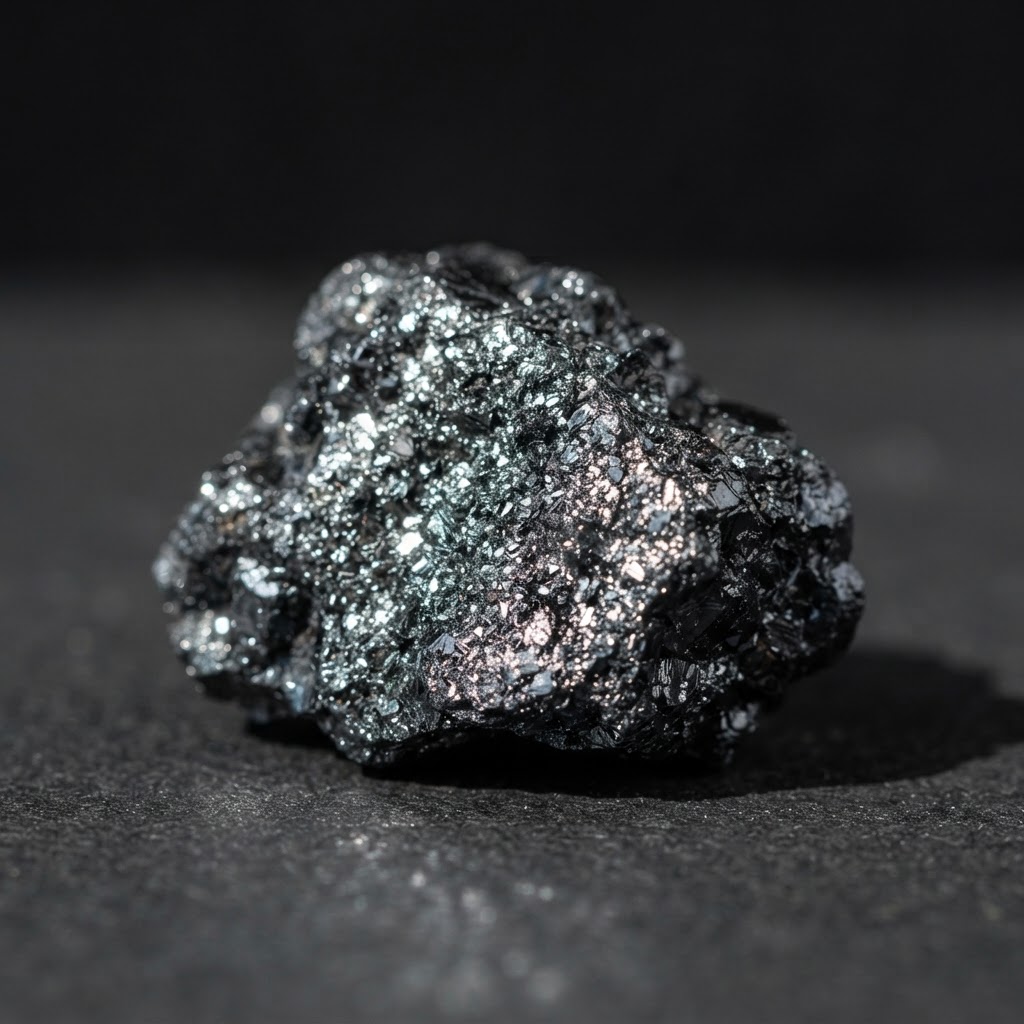
Three Different Things Produce a Black Sparkle
A black rock that glitters is not one material, it is at least three, and telling them apart is much easier once you know what is producing the shine.
The first cause is metallic reflection. A mineral with a genuinely metallic lustre reflects light like a polished metal surface, which is what hematite and magnetite do. The second is mica flakes. A rock packed with flakes of biotite or muscovite catches the light on thousands of individual flat faces at once, producing a glitter that moves as you tilt it. The third is crystalline or glassy reflection, where light bounces off crystal faces or a glassy fracture surface, which is what obsidian does.
Work out which of those three you are looking at, and you have already eliminated two-thirds of the candidates.
The Streak Test Comes First
Black minerals are the hardest group to identify by colour, because they are all black. The streak test is the single most useful thing you can do, and it takes about ten seconds.
Rub the stone firmly across the unglazed back of a ceramic tile — the underside of a bathroom tile works perfectly. What you are looking for is the colour of the powder left behind, which is often completely different from the colour of the stone. Hematite looks metallic grey-black and leaves a red-brown streak. Magnetite looks identical and leaves a black streak. Pyrite looks brassy and leaves a greenish-black streak.
This is the test that separates the two minerals people confuse most often. Hematite and magnetite are both dark, both metallic and both heavy, and the streak is the fastest way to tell them apart.
The Black Sparkly Rocks You Are Most Likely Holding
These eight account for almost every glittery black stone an amateur will pick up.
| Rock or mineral | Hardness | Streak | How to tell it |
|---|---|---|---|
| Hematite | 5–6.5 | Red-brown | Metallic grey-black, heavy, and the red-brown streak is diagnostic. Often earthy or botryoidal. |
| Specularite | 5–6.5 | Red-brown | The micaceous variety of hematite. Glittery black flakes and rosettes that sparkle like sequins. |
| Magnetite | 5.5–6.5 | Black | Strongly magnetic — a magnet will jump to it. Black streak and no red tone at all. |
| Ilmenite | 5–6 | Black to brownish | Weakly magnetic. Usually a dull black mass rather than a bright metallic one. |
| Biotite schist | 2.5–3 | White | A rock packed with shiny black mica flakes. Soft, and the flakes peel off in thin sheets. |
| Obsidian | 5–5.5 | White | Volcanic glass. Uniform inside, breaks with a curved fracture, and often translucent at the thin edges. |
| Coal | 1–2.5 | Brown to black | Very light for its size and soft enough to mark paper. Often has a dull, banded or woody look. |
| Pyrite | 6–6.5 | Greenish-black | Brassy yellow rather than black, with cubic faces. Harder than a knife and brittle. |
Hematite and Specularite
Hematite is iron oxide, and it is one of the most abundant minerals on the surface of the Earth. Its colour is a dark steel grey to black with a metallic sheen, and it is noticeably heavy — specific gravity around 5.3, roughly twice that of quartz.
Specularite is the same mineral in a different habit. Where hematite usually forms earthy red masses or smooth grey kidney-shaped lumps, specularite forms thin, flat, mirror-like plates and rosettes that glitter brilliantly. It is the material most people are describing when they say their rock looks like it is covered in tiny black sequins. The streak is the same red-brown, and that is what confirms it.
Hematite is the main ore of iron, and it is the mineral that gives banded iron formations their alternating red and grey bands. Some of the oldest rocks on Earth are built from it.
Magnetite: Let a Magnet Do the Work
Magnetite is also iron oxide, but with a different ratio of iron to oxygen, and it has a property nothing else in this group shares: it is strongly magnetic. A small magnet will snap onto a piece of magnetite, and occasionally you will find a specimen that is itself magnetised — a natural lodestone, which is what early compasses were made from.
That makes the test trivial. If the stone is black, metallic and a magnet sticks to it, you have magnetite. If a magnet does nothing, it is not magnetite, and hematite becomes the strong favourite.
The streak confirms it. Magnetite leaves a black streak, where hematite leaves a distinctly red-brown one. Ilmenite and pyrrhotite are weakly magnetic but not strongly so, and neither will grab a magnet the way magnetite does.
When the Sparkle Is Mica
A great many black sparkly rocks are not metallic minerals at all. They are metamorphic rocks packed with flakes of mica, and the glitter comes from thousands of flat cleavage faces catching the light.
Biotite is the black mica, and a biotite schist is a rock that has been compressed and recrystallised until the mica grew into aligned sheets. The giveaway is hardness and structure. Mica sits at 2.5 to 3, so a fingernail will not scratch it but a copper coin will, and a knife cuts it easily. More importantly, the flakes peel off. Pick at the rock and thin flexible sheets come away, which is something a metallic mineral will never do.
Muscovite is the pale silver version of the same thing. A schist with both micas and some quartz will look like a black and silver glittery stone, and it is one of the most common rocks in the field.
Obsidian and Coal: The Two Impostors
Obsidian is volcanic glass, and it is black, shiny and often spectacular. What separates it from a metallic mineral is that it has no grain at all. Break it and you get a smooth, curved, shell-like fracture with razor-sharp edges, and in thin slivers it is translucent rather than opaque. Its streak is white, and it is not magnetic.
Coal is the other one people bring home thinking it is a mineral. It is soft — hardness 1 to 2.5, so it marks paper — and it is far lighter than it looks, because it is mostly carbon. A black rock that feels like polystyrene for its size is coal, and if you scratch it you will see a brown-black streak rather than a metallic one.
The Bottom Line
Start with the streak. Red-brown means hematite or specularite. Black means magnetite. Greenish-black means pyrite. White means you are looking at mica schist or obsidian rather than a metallic mineral.
Then use a magnet. Magnetite grabs it, hematite does not, and mica and obsidian do nothing. Finally check hardness: if a knife cuts the rock and the flakes peel off, it is mica, not metal.
For the wider black stone group, black stone identification covers obsidian, jet, tourmaline and basalt, and tumbled stones identifier handles polished material where the shape has been ground away.
Frequently Asked Questions
Start with the streak test on an unglazed tile. Red-brown means hematite or specularite, black means magnetite, greenish-black means pyrite and white means mica schist or obsidian. Then check whether a magnet sticks to it.